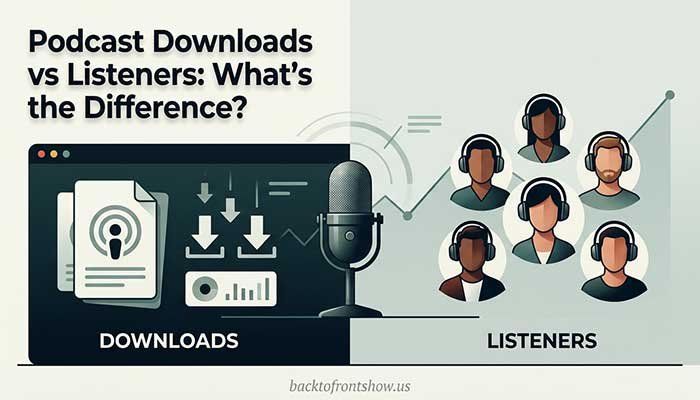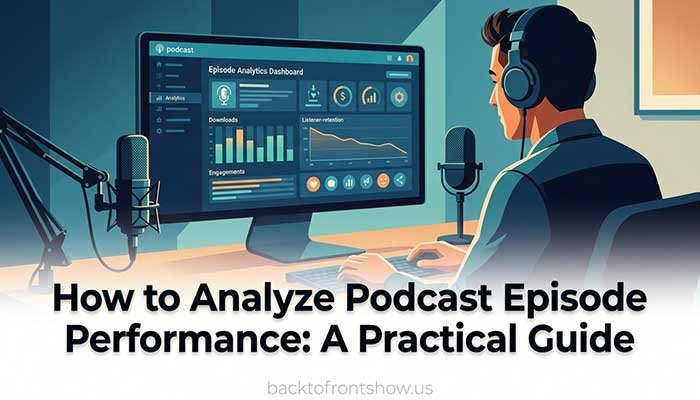
How To track podcast audience growth, measure whether your show is attracting more people, turning first-time listeners into returning listeners, and creating meaningful actions over time.
The most useful metrics are:
- Unique listeners or audience size
- New and returning listeners
- Followers or subscribers
- Downloads during a consistent period after release
- Episode consumption and completion
- Website visits, email sign-ups, or other conversions
- Growth by platform, topic, and discovery source
Use the same reporting periods and metric definitions every time. Don’t compare an episode’s lifetime downloads with another episode’s first seven days, and don’t combine Apple listeners, Spotify plays, and YouTube views as if they were the same measurement.
A simple monthly spreadsheet is enough for most independent podcasters. The goal is to see a reliable trend and understand what caused it—not to track every number available.
What Does Podcast Audience Growth Actually Mean?
Podcast audience growth can describe several different changes:
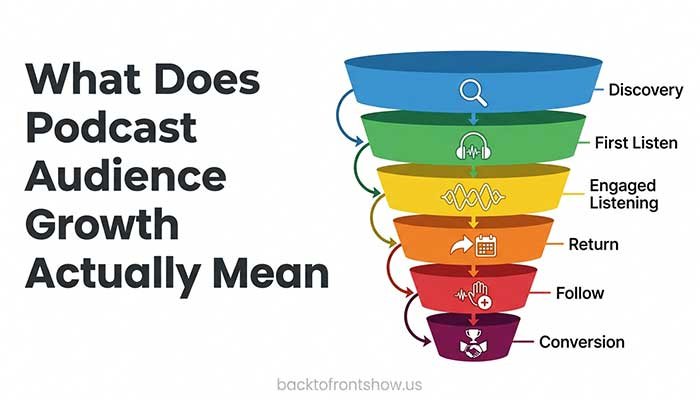
- Reach growth: More people discover or access the show.
- Listener growth: The estimated number of individual listeners increases.
- Follower growth: More people choose to follow or subscribe.
- Retention growth: More listeners return for future episodes.
- Engagement growth: Listeners consume more content or interact more often.
- Conversion growth: More listeners join an email list, visit a website, buy something, or complete another valuable action.
These outcomes are connected, but they are not identical.
A podcast can gain downloads without building a loyal audience. For example, a guest may bring a temporary spike that disappears after one episode.
A show can also grow in quality before it grows significantly in size. If more listeners finish episodes, return the following week, and join the email list, the audience foundation may be improving even if total downloads rise slowly.
In my experience, audience tracking becomes much clearer when you separate discovery from loyalty. One tells you how effectively the show reaches new people. The other shows whether those people find enough value to return.
Read More: How to Understand Podcast Listener Demographics
The Most Important Podcast Growth Metrics
Unique listeners or audience
A listener or audience metric attempts to represent individual people or devices rather than total activity.
This is generally more useful for measuring audience size than raw downloads. However, identification methods and definitions vary by provider. One platform’s listener count should not automatically be combined with another platform’s audience count.
Use this metric to answer:
- Is the active audience getting larger?
- Did growth occur gradually or because of one episode?
- Which platforms are adding listeners?
- Are new people becoming returning listeners?
New listeners
New-listener data shows whether the podcast is reaching people who haven’t recently consumed the show on that platform.
Spotify currently separates its audience into new and returning groups. According to Spotify for Creators, a new audience member is a distinct person who played at least one episode during the selected period but hadn’t played the show on Spotify during the previous year.
New-listener growth is important, but it should be evaluated alongside return behavior. A large number of new listeners who never come back may indicate strong promotion but weak audience fit or onboarding.
Returning listeners
Returning listeners show whether the podcast is developing loyalty.
Spotify defines a returning audience member as someone who played at least one episode in the previous 12 months and returned during the selected reporting period.
A growing returning audience is often a healthier signal than one temporary download spike. It suggests that the show is becoming part of listeners’ routines.
Followers and subscribers
A follower chooses to stay connected to the show through a listening platform. Depending on the service, following can make new episodes easier to find and may enable downloads or notifications.
Followers are useful because they show intent, but they are not the same as active listeners.
A person can follow a show and stop listening. Someone else can listen regularly without following. Measure follower growth alongside actual listening behavior.
Apple Podcasts Connect lets creators view follower trends and net new followers over periods such as the last week, month, 60 days, or all time, according to Apple’s follower documentation.
Be careful with the word subscriber. On some platforms, it means a free follower. On others, it may describe someone paying for premium content. Label the metric precisely.
Downloads
Downloads measure qualifying deliveries or requests for an episode’s media file under the reporting provider’s rules.
They are useful for:
- Comparing episode reach
- Tracking release performance
- Reporting to advertisers
- Identifying long-term trends
- Comparing topics and formats
A download does not prove that the complete episode was heard. Automatic downloads and partial consumption can create a difference between delivery and actual listening.
Track downloads using fixed windows, such as:
- First 24 hours
- First 7 days
- First 30 days
- First 60 or 90 days
- Lifetime, when long-tail discovery matters
The best window depends on your publishing frequency and subject. A daily news podcast needs a shorter evaluation period than an evergreen educational show.
Consumption and completion
Consumption metrics help show whether people stayed after pressing play.
Depending on the platform, you may see:
- Average consumption
- Average listening time
- Completion rate
- Engaged listeners
- Total listening time
- Audience-retention curves
These do not directly measure audience size, but they help explain the quality of growth.
Suppose two episodes each attract 1,000 listeners. If one has strong completion and produces more returning listeners, it may contribute more to sustainable growth.
Conversion metrics
Podcast growth should support the purpose of the show.
Relevant conversions may include:
- Email subscriptions
- Resource downloads
- Website visits
- Community memberships
- Product purchases
- Trial registrations
- Event sign-ups
- Consultation requests
- Listener survey responses
Use dedicated landing pages, campaign-tagged links, memorable URLs, or unique offer codes when appropriate.
A growing podcast that produces no measurable progress toward its purpose may need a clearer call to action or a better connection between the episode and the offer.
Read More: Podcast Listener Retention Explained
Podcast Growth Metrics at a Glance
| Metric | What it tells you | What it doesn’t prove |
|---|---|---|
| Unique listeners or audience | Approximate audience size on a platform or provider | That every person completed an episode |
| New listeners | Whether the show is reaching new people | That they will return |
| Returning listeners | Whether prior listeners came back | Why they returned |
| Followers | How many people chose an ongoing connection | That all followers are active |
| Downloads | How often episode files were delivered under reporting rules | That every download became a full listen |
| Average consumption | How much of an episode was consumed on average | The reason people stayed or left |
| Completion rate | How often qualifying listeners reached the completion point | Whether they took another action |
| Website visits | Whether listeners reached your site | That every visitor came from the podcast unless tracked |
| Conversions | Whether people completed a desired action | The full value of awareness or loyalty |
Where to Track Podcast Audience Growth
Your hosting provider
Your hosting dashboard is normally the best starting point for broad distribution data.
Depending on the host, you may see:
- Downloads
- Estimated listeners
- Apps and devices
- Countries, states, or cities
- Episode comparisons
- Daily or monthly trends
Review the provider’s definitions before building your dashboard. “Unique listeners,” “downloads,” and “starts” can mean different things.
Use your host’s data consistently rather than switching between providers when comparing historical results.
Apple Podcasts Connect
Apple Podcasts Connect Analytics provides Apple-specific data such as:
- Followers
- Listeners
- Engaged listeners
- Plays
- Time listened
- Average consumption
- Countries, regions, and cities
Apple also provides episode-performance comparisons based on equal periods after publication, including 7, 14, 30, and 60 days. Creators can compare selected episodes with a median, an average, or a top-performing episode.
Apple requires at least five unique users to play content within the selected period for the relevant analytics metric to appear. This privacy threshold can limit data for smaller shows.
Spotify for Creators
Spotify’s audience reports can separate new and returning audience members and display changes over a selected date range.
Depending on how the show is hosted, Spotify for Creators can also provide:
- Spotify audience
- Locations
- Platforms
- Apps and devices
- Age and gender
- Episode-level analytics
- Engagement and completion information
Spotify says most analytics update frequently, although some metrics can take as long as 48 hours to refresh. Avoid reacting to incomplete same-day data.
YouTube Studio
For podcasts published on YouTube, the Audience tab can help distinguish reach from loyalty.
YouTube’s audience documentation describes:
- Monthly audience
- Unique viewers
- New viewers
- Returning viewers
- Casual viewers
- Regular viewers
- Subscribers
- Watch time
- Views
YouTube defines monthly audience as estimated unique viewers during the previous 28 days. Its new, casual, and regular viewer groups are based on viewing behavior.
A subscriber total is not the same as an active audience. YouTube specifically recommends monthly audience or unique viewers as a better estimate of active viewers than subscriber count alone.
If your channel also publishes Shorts, livestreams, or unrelated videos, remember that channel-level audience metrics may include those formats.
Your website and email platform
Podcast platforms show listening behavior, but your website and email platform show what happens after someone leaves the listening app.
Track:
- Visits to episode pages
- Landing-page sessions
- Newsletter subscriptions
- Resource downloads
- Purchases or inquiries
- Email open and click trends
- Returning website visitors
These figures shouldn’t be added to podcast listeners. Use them as conversion and owned-audience metrics.
An email subscriber is particularly valuable for direct communication because the relationship is not limited to a podcast platform’s interface.
How to Track Podcast Audience Growth Step by Step
Step 1: Define what growth means for your show
Choose one primary growth objective.
Examples include:
- Increase the monthly active audience
- Attract more new listeners
- Increase returning listeners
- Gain followers
- Grow an email list
- Reach more listeners in the United States
- Build an audience in a particular professional niche
- Increase qualified sales inquiries
Then choose two or three supporting metrics.
For example:
Primary goal: Grow the active monthly audience
Supporting metrics: New listeners, returning listeners, and 30-day episode downloads
This is clearer than trying to improve every number at once.
Step 2: Establish a baseline
Record at least several weeks or months of existing results before setting a target.
Your baseline might include:
- Median seven-day downloads per episode
- Median 30-day downloads per episode
- Monthly listeners
- New and returning audience
- Net new followers
- Average completion
- Monthly email sign-ups
Use the median for episode comparisons when possible. One viral or unusually weak episode can distort an average.
Step 3: Choose consistent reporting periods
Match each comparison carefully.
Good comparisons include:
- First 7 days vs. first 7 days
- First 30 days vs. first 30 days
- September monthly audience vs. October monthly audience
- Q2 vs. Q3
- Recent 10 interviews vs. prior 10 interviews
Misleading comparisons include:
- Lifetime downloads vs. first-week downloads
- A five-episode month vs. a two-episode month without adjustment
- A daily show vs. a monthly show
- Apple listeners vs. Spotify plays
- Total channel subscribers vs. one episode’s active viewers
Step 4: Build a simple growth dashboard
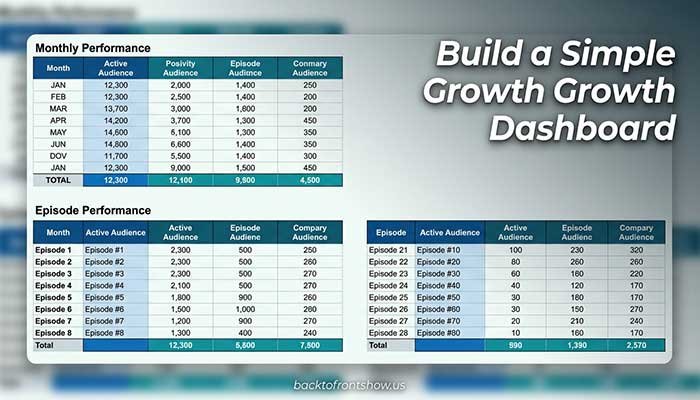
You don’t need an expensive analytics tool. A spreadsheet with one row per month and one row per episode can work well.
Monthly show-level dashboard
| Month | Active audience | New audience | Returning audience | Net new followers | Total downloads | Email sign-ups | Notes |
|---|---|---|---|---|---|---|---|
| Month 1 | |||||||
| Month 2 | |||||||
| Month 3 |
Episode-level dashboard
| Episode | Format | Topic | 7-day downloads | 30-day downloads | Completion | Followers or conversions | Promotion notes |
|---|---|---|---|---|---|---|---|
| Episode 1 | |||||||
| Episode 2 |
Record definitions and sources in the spreadsheet. This prevents confusion when platforms change their dashboards or when someone else reviews the data.
Step 5: Calculate growth rates
A basic growth formula is:
Growth rate = (Current value − Previous value) ÷ Previous value × 100
Imagine a hypothetical podcast grows from 2,000 monthly listeners to 2,300:
(2,300 − 2,000) ÷ 2,000 × 100 = 15%
The audience grew by 15% for that comparison period.
If it falls from 2,000 to 1,800:
(1,800 − 2,000) ÷ 2,000 × 100 = −10%
The audience declined by 10%.
Always report:
- The metric
- The source
- The time period
- The starting value
- The ending value
“Podcast growth increased 15%” is too vague. “Monthly listeners reported by the hosting dashboard increased from 2,000 in August to 2,300 in September” is much clearer.
Step 6: Separate acquisition from retention
Create two sections in your report.
Acquisition metrics
These show whether new people are finding the show:
- New listeners or viewers
- Impressions
- Search traffic
- Referral traffic
- Guest-promotion traffic
- Social clicks
- First-time website visitors
Retention metrics
These show whether people stay connected:
- Returning listeners or viewers
- Followers
- Completion or consumption
- Repeat website visits
- Email retention
- Community participation
If acquisition is strong but retention is weak, the packaging or promotion may be attracting people who don’t connect with the content.
If retention is strong but acquisition is weak, the show may serve existing listeners well but need better discovery.
Step 7: Connect growth with episodes and campaigns
Mark important events on the timeline:
- Guest appearances
- Cross-promotions
- Paid advertising
- Newsletter features
- Conference appearances
- Viral social posts
- New episode formats
- Publishing breaks
- Seasonal topics
- Feed or hosting changes
Then compare the timing of each event with audience movement.
Do not assume that two events occurring together proves one caused the other. Look for tracking evidence and repeated patterns.
Step 8: Find what produces repeatable growth
Ask:
- Which topics attract new listeners?
- Which formats produce returning listeners?
- Which guests generate sustained rather than temporary growth?
- Which platforms send listeners who later convert?
- Which episodes continue growing after 30 or 60 days?
- Which calls to action earn followers or email sign-ups?
- Which publishing patterns correspond with steady audience growth?
The goal is to find a process you can repeat, not just explain one spike.
Step 9: Choose one growth experiment
Run a focused test, such as:
- Publish a three-part series on a high-retention topic
- Improve the opening of the next four episodes
- Add one clear follow request
- Create a dedicated landing page
- Arrange a feed swap with a relevant show
- Produce video clips for one month
- Invite guests whose audiences match the show
- Repromote an evergreen episode
Define the metric and evaluation period before starting.
For example:
For the next four episodes, place a brief follow request after the first useful takeaway. Compare net new followers per episode with the previous four comparable episodes.
That is a measurable experiment.
How to Interpret Common Growth Patterns
| Pattern | Possible meaning | What to examine |
|---|---|---|
| New audience rises, returning audience stays flat | Discovery improved, but loyalty has not yet followed | Topic fit, completion, follow rate, later return behavior |
| Downloads rise, active listeners stay flat | Existing listeners may be downloading more episodes | Episodes per listener, automatic downloads, audience definition |
| Followers rise, listening stays flat | The show gained connections that are not yet active | Future episode performance, inactive followers, promotional source |
| Reach stays flat, completion improves | Content quality may be improving before discovery | Promotion, titles, descriptions, collaborations |
| One episode spikes, then traffic returns to normal | Guest, topic, or campaign created temporary attention | Whether spike listeners sampled other episodes |
| Slow but consistent monthly growth | Sustainable audience development may be occurring | Returning audience, topic consistency, long-tail discovery |
| YouTube subscribers rise but monthly audience falls | Subscriber count may not reflect current activity | Unique viewers, monthly audience, regular viewers |
| Website conversions rise faster than listeners | Audience relevance or calls to action may be improving | Landing pages, episode topics, conversion tracking |
These interpretations are starting points, not automatic conclusions.
How to Measure Whether a Popular Episode Created Real Growth
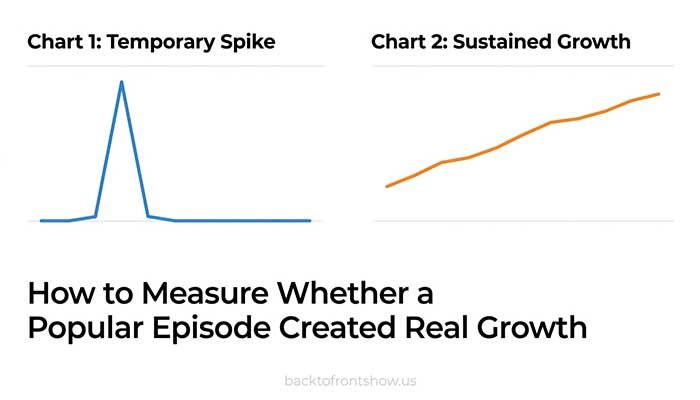
A popular episode isn’t automatically an audience-growth success.
Review what happened after the spike:
- Did listeners sample another episode?
- Did returning-audience numbers increase?
- Did followers increase?
- Did the next release perform above the usual range?
- Did email sign-ups or other conversions increase?
- Did the episode continue receiving traffic?
- Can you identify the discovery source?
Imagine a hypothetical technology podcast that normally receives 1,000 downloads within seven days. An interview receives 5,000, but the next three episodes return to 1,000 and follower growth remains unchanged.
The interview generated reach, but the available evidence does not show lasting audience growth.
If the following episodes rise to 1,300, returning listeners increase, and email sign-ups remain higher, the spike may have expanded the show’s ongoing audience.
Common Podcast Audience-Tracking Mistakes
Tracking only total downloads
Total downloads can rise because you published more episodes or because old episodes continue accumulating activity. Track active audience, per-episode windows, and return behavior as well.
Treating followers as listeners
Followers show connection or intent. Active listeners show actual recent behavior. Use both.
Adding incompatible platform metrics
Apple listeners, Spotify audience, YouTube viewers, and hosting-provider downloads use different definitions. Report them separately unless you have a valid, documented method for combining them.
Comparing unequal periods
A 31-day month and a 28-day month are not identical. Neither are an episode’s first week and its lifetime total. Use consistent windows or normalize the calculation.
Ignoring publishing frequency
Publishing twice as many episodes can increase monthly downloads without increasing the number of people listening. Track downloads per episode and estimated audience size.
Overreacting to short-term changes
A holiday, news event, guest, technical issue, or paid campaign can create temporary movement. Look at several reporting periods before changing the strategy.
Focusing only on percentage growth
A move from 10 listeners to 20 is 100% growth, but the absolute increase is 10. Report percentages and raw numbers together.
Assuming correlation proves cause
A listener increase after a social campaign does not prove the campaign caused it. Use campaign links, landing pages, referral reports, and repeated tests when possible.
Changing too many variables
If you alter the format, schedule, titles, advertising, and guest strategy at the same time, it becomes difficult to identify what helped.
A Practical Monthly Growth Review
Once a month:
- Record active audience or unique listeners.
- Record new and returning audience where available.
- Record net new followers by platform.
- Compare seven-day and 30-day episode performance.
- Review completion or average consumption.
- Record website and email conversions.
- Mark promotions, guests, and unusual events.
- Compare with the prior month and a longer rolling period.
- Write down one conclusion.
- Choose one action for the next month.
A rolling three-month view can help separate a real trend from a temporary spike.
I usually recommend keeping this review short enough to repeat. A basic dashboard updated consistently is more useful than a complicated report that gets abandoned after two months.
Key Takeaways
To track podcast audience growth accurately:
- Decide what growth means for your show.
- Measure reach, loyalty, and conversions separately.
- Use fixed reporting periods.
- Record the source and definition of every metric.
- Compare similar episodes.
- Track raw changes as well as percentages.
- Separate new listeners from returning listeners.
- Investigate whether traffic spikes produce lasting behavior.
- Connect data to specific content and promotional decisions.
- Run focused experiments and review the results over several releases.
Sustainable growth is not simply a bigger download total. It is an expanding group of people who discover the podcast, receive value from it, and choose to return.