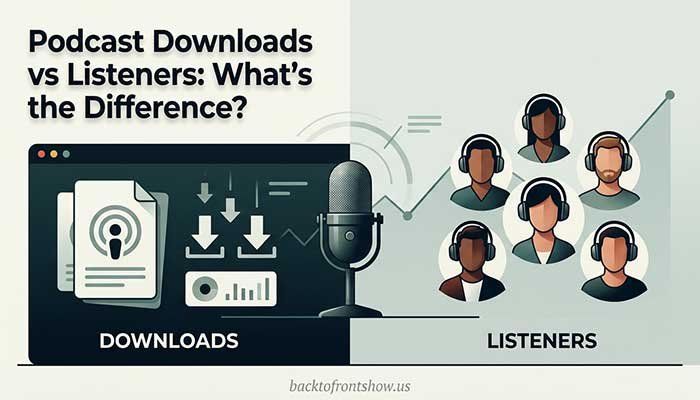
Podcast downloads measure how many qualifying times podcast episode files are delivered, while podcast listeners estimate how many unique people are behind those downloads.
That distinction matters because one person can download several episodes—or even generate more than one qualifying download over time. So 10,000 podcast downloads does not necessarily mean 10,000 different people listened.
If you’re trying to understand the size and performance of your podcast, downloads and listeners answer different questions:
- Downloads: How many qualifying episode deliveries occurred?
- Listeners: Approximately how many unique people generated those deliveries?
Both metrics are useful, but neither tells the whole story by itself.
Podcast Downloads vs Listeners at a Glance
| Metric | What It Measures | Best Used For |
|---|---|---|
| Podcast downloads | Qualifying deliveries of an episode file | Episode performance, historical comparisons, advertising |
| Podcast listeners | Estimated unique people consuming or downloading content | Audience reach |
| Downloads per episode | Downloads generated by an individual episode | Comparing episode performance |
| Plays | Playback activity as defined by a particular platform | Platform-specific engagement |
| Engaged listeners | People who reach a platform-defined listening threshold | Measuring deeper consumption |
The exact definitions can vary somewhat between analytics platforms, which is why you should always check how your podcast host or listening app calculates a metric.
What Is a Podcast Download?
A podcast download is not simply someone clicking a large Download button and saving an MP3 to a computer.
In modern podcast measurement, streaming an episode through many podcast apps also involves downloading the media file—often progressively as the person listens.
The IAB Tech Lab’s current Podcast Technical Measurement Guidelines v2.3 define a download as a unique episode request that results in an episode being delivered to the consumer’s device. The guidelines cover complete as well as qualifying partial downloads.
That means a listener tapping play may generate a download even though they would describe what they’re doing as “streaming.”
Not Every Server Request Should Count as a Download
Podcast hosting servers may receive multiple requests for the same file. Counting every raw request would inflate the numbers.
IAB guidelines therefore include filtering requirements.
For example, the current guidelines say that enough content for one minute of the podcast generally needs to be delivered for a partial download to qualify. They also describe filtering duplicate requests and invalid traffic.
The standard method for identifying unique activity uses information such as the IP address and user agent, with additional metadata potentially used when available.
So when your hosting dashboard reports 500 downloads, it normally isn’t saying, “Our server received exactly 500 requests.”
It is reporting requests after applying its measurement and filtering rules.
What Is a Podcast Listener?
A podcast listener is an estimate of a unique person behind podcast consumption.
This sounds straightforward, but podcast hosting companies usually can’t physically identify every individual who listens.
With open RSS podcast distribution, a hosting provider typically sees technical information about requests rather than a universal user account attached to every listener.
Under the IAB Tech Lab guidelines, a podcast consumer/listener represents a single user downloading content within a specified time period. A combination of IP address and user agent is one standard method used to estimate unique consumers.
This is why listener counts are estimates rather than perfect headcounts.
The Time Period Matters
You shouldn’t talk about “unique listeners” without considering the reporting window.
For example:
- unique listeners today
- unique listeners over seven days
- unique listeners over 30 days
- unique listeners over 90 days
These are different measurements.
A person who listens every week might contribute many downloads during a month but should ideally represent one person in a monthly audience calculation.
The IAB also notes an important limitation: mobile users’ IP addresses can change, while IP addresses can also be shared or recycled. That can result in either overcounting or undercounting audience size.
So a listener count should be treated as a useful audience estimate—not a perfect census.
A Simple Podcast Downloads vs Listeners Example
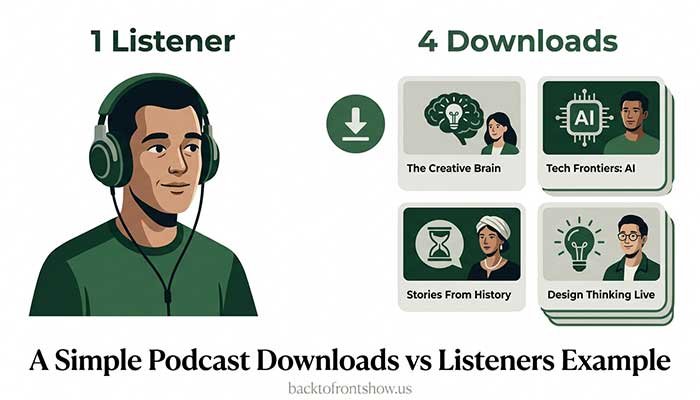
Imagine a hypothetical weekly business podcast with 1,000 regular listeners.
During one month, it releases four episodes.
If all 1,000 people download all four episodes, the show could generate roughly:
1,000 listeners × 4 episodes = 4,000 episode downloads
In this simplified example:
- Monthly listeners: about 1,000
- Monthly downloads: about 4,000
The audience did not suddenly grow to 4,000 people.
The same audience downloaded multiple episodes.
Now suppose 200 of those listeners also download an older episode from the back catalog.
Total monthly downloads might rise to about 4,200, while the approximate unique audience could remain close to 1,000.
That’s the easiest way to understand the difference: downloads measure activity; listeners measure reach.
Why Are Podcast Downloads Usually Higher Than Listener Count?
Downloads can exceed listeners for several reasons.
One Person Can Download Multiple Episodes
This is the biggest reason.
If one listener consumes five episodes, that activity can create five episode downloads while still representing one person in an audience measurement for the relevant period.
Listeners May Explore Your Back Catalog
A new fan might discover your podcast and immediately listen to six older episodes.
That’s great engagement, but those six downloads still came from one person.
The Same Person May Use More Than One Device
Someone could listen on a phone during a commute and use a computer later.
Depending on the measurement system and identifying information available, distinguishing those devices as belonging to one human can be difficult.
Measurement Windows Can Affect the Count
IAB v2.3 describes different methods for handling measurement windows, including fixed calendar windows and rolling approaches.
That means seemingly small technical differences in methodology can affect reported totals.
This is one reason you shouldn’t compare numbers from two analytics providers without first checking what each provider measures.
Downloads Don’t Prove That Someone Finished the Episode
This is one of the most important limitations of podcast download statistics.
A qualifying download tells you that enough of an episode was delivered to meet the measurement rules.
It does not automatically tell you:
- whether the listener finished the episode
- where they stopped listening
- whether they skipped an advertisement
- whether they replayed an important segment
- whether they were actively paying attention
For those questions, platform-level listening analytics can be more useful.
Apple Podcasts, for example, separately reports metrics including listeners, engaged listeners, plays, and average consumption.
Apple currently defines an engaged listener as someone who listened to or watched at least 20 minutes or 40% of an episode.
That type of consumption data can tell you something a basic download count cannot.
How Apple Podcasts Defines Listeners and Plays
Apple Podcasts provides a useful example of why analytics terminology needs context.
In Apple Podcasts Connect:
- Listeners are people who played or watched the show.
- Engaged listeners listened to or watched at least 20 minutes or 40% of an episode.
- Plays represent the total number of plays with a duration greater than zero seconds.
- Average consumption estimates how much of an episode was played per device.
Apple also explains that its analytics focus on listening and viewing activity from unique devices, while hosting providers may provide download information.
So your Apple Podcasts listener number and your hosting company’s total download number are not intended to match.
They measure different things.
How Spotify Handles Podcast Analytics
Spotify also separates several analytics concepts.
Spotify for Creators currently describes:
- Plays as times an episode was watched or listened to for at least 30 seconds on Spotify.
- Downloads as RSS-feed downloads on podcast platforms for shows hosted with Spotify for Creators.
- Audience as unique people who played or downloaded an episode during the selected reporting period.
Spotify explicitly notes that audience should normally be smaller than total plays and downloads because one person may consume multiple episodes or play an episode multiple times.
This is essentially the same principle behind the downloads-vs-listeners distinction.
What Are Unique Listeners?
“Unique listeners” generally means the estimated number of different people who listened during a particular reporting period.
If you see:
2,000 unique listeners in the last 30 days
the useful interpretation is:
The analytics system estimates that approximately 2,000 different people generated qualifying podcast activity during those 30 days.
It does not necessarily mean:
- exactly 2,000 identifiable human beings
- all 2,000 completed an episode
- all 2,000 listened to your newest episode
- each person listened only once
The measurement method and time range always matter.
In my experience working with podcast-related content and analytics, this is where beginners often get confused. They see a listener number and assume it’s the same thing as verified individual people.
I find it more useful to think of unique listeners as a reach estimate.
That keeps you focused on what the metric can actually tell you without expecting precision it wasn’t designed to provide.
What Does “Downloads Per Episode” Mean?
Downloads per episode tracks the number of qualifying downloads generated by an individual episode.
It’s especially helpful for comparing your own episodes.
Suppose your recent episodes generated:
| Episode | First 7-Day Downloads |
|---|---|
| Episode A | 850 |
| Episode B | 910 |
| Episode C | 1,240 |
| Episode D | 895 |
Episode C clearly generated more early download activity.
You could then investigate:
- Was the topic more appealing?
- Did the title perform better?
- Was a guest involved?
- Did you promote the episode more heavily?
- Did another website or social account mention it?
The important point is that downloads per episode are most useful when compared consistently.
Don’t compare an episode that’s been live for six months with one published three days ago and conclude that the older episode “performed better.”
Compare equal windows, such as:
- first 24 hours
- first 7 days
- first 30 days
That gives you a much cleaner picture.
Downloads vs Listeners: Which Metric Should You Track?
You should track both when they’re available.
They answer different questions.
Track Downloads When You Want to Understand Episode Performance
Podcast downloads are useful for:
- comparing new episodes
- monitoring growth over time
- understanding back-catalog activity
- measuring total content delivery
- discussing advertising reach when using accepted measurement standards
If you’re talking with advertisers, make sure everyone understands exactly what your numbers represent and what measurement methodology is being used.
Track Listeners When You Want to Understand Audience Reach
Listener count is more useful when you’re asking:
- How many people is my podcast reaching?
- Is my audience growing?
- How many unique people consumed the show this month?
- Are more people discovering the podcast?
If your monthly downloads increase because your existing fans simply consume more episodes, your downloads may grow without a similar increase in unique audience.
That’s why looking at both metrics is valuable.
A Better Way to Evaluate Podcast Growth
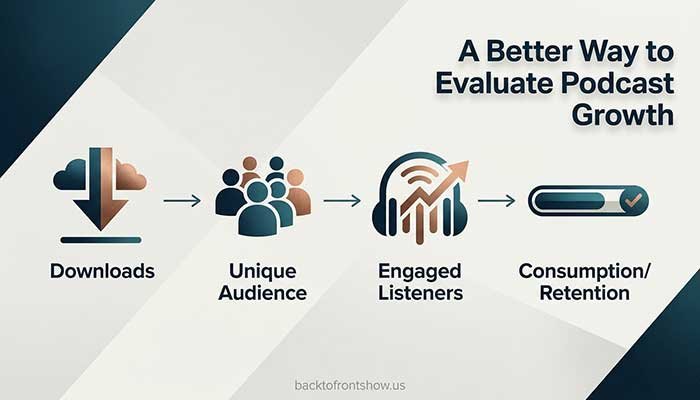
I wouldn’t recommend judging a podcast using one headline number.
A more useful approach is to build a small group of metrics that answer different questions.
1. Track Downloads Per Episode
Compare episodes at the same age—especially the first 7 or 30 days.
This shows whether new releases are gaining or losing traction.
2. Track Unique Audience
Use listeners, audience, or your hosting provider’s equivalent unique metric.
This helps show whether your actual reach is expanding.
3. Look at Consumption Data
Where available, examine:
- average consumption
- completion
- listening time
- engaged listeners
- retention patterns
A podcast with a modest audience that consistently listens through most episodes may have a stronger foundation than a larger show with weak engagement.
4. Watch Long-Term Trends
A single viral episode can distort your perception of performance.
Look at several months of data.
Ask:
- Is the baseline getting higher?
- Are new episodes reaching more people?
- Are listeners returning?
- Is the back catalog continuing to generate downloads?
One thing I’ve found particularly useful is comparing a podcast against its own past performance first.
Industry benchmarks can provide context, but every show has a different niche, release schedule, episode length, and audience.
Consistent improvement in your own numbers is usually more actionable than obsessing over another show’s estimated downloads.
Why Your Podcast Host and Apple or Spotify Numbers Don’t Match
Seeing different numbers across dashboards is normal.
Your host might report downloads from the broader RSS ecosystem, including activity from multiple podcast apps.
Apple Podcasts analytics primarily tell you what happens inside Apple Podcasts.
Spotify’s first-party playback analytics tell you what happens on Spotify, while hosting functionality may also provide broader RSS download data.
Each system may therefore have:
- different data sources
- different definitions
- different filtering rules
- different reporting windows
- different thresholds
You shouldn’t add every metric together as if they represent completely separate people.
For example, someone included in your Apple Podcasts listeners may already be represented in your hosting provider’s overall podcast audience data.
Can You Convert Podcast Downloads Into Exact Listener Numbers?
No reliable universal formula exists.
You shouldn’t say:
10,000 downloads ÷ 4 = exactly 2,500 listeners
unless your own analytics provide evidence supporting that specific relationship.
Different podcasts have different listening behavior.
A daily news show might generate many episodes per listener each month.
A monthly interview show might generate only one.
Back-catalog consumption can change the relationship even more.
If your hosting platform provides a unique listener or audience metric, use that instead of attempting to reverse-engineer it from total downloads.
Read More: How to Measure Podcast Engagement
How Accurate Are Podcast Listener Counts?
They are useful, but they’re not perfect.
The open nature of podcast distribution makes identifying one human across every app, network, and device difficult.
As IAB Tech Lab notes, changing mobile IP addresses can potentially cause double counting, while recycled addresses can contribute to undercounting.
That’s one reason the reporting period and methodology matter.
For practical decision-making, I’d focus less on whether the number represents every human with absolute precision and more on whether you’re using the same reliable methodology consistently over time.
That lets you identify meaningful trends even when the metric itself has technical limitations.
Common Podcast Analytics Mistakes to Avoid
Treating Downloads as People
Five thousand downloads does not automatically equal 5,000 individual listeners.
Always keep activity and audience reach separate.
Comparing Different Time Windows
Don’t compare:
- one episode’s first seven days
with:
- another episode’s lifetime downloads
Use equivalent reporting periods.
Combining Platform Metrics Without Understanding Them
Apple plays, Spotify plays, hosting downloads, engaged listeners, and audience numbers aren’t interchangeable.
Read the definitions before combining or comparing anything.
Focusing Only on Total Downloads
Lifetime downloads almost always rise as you publish more episodes.
That doesn’t necessarily mean your current audience is growing.
Recent episode performance and unique audience trends usually provide more useful context.
Ignoring Engagement
Getting the file delivered is only part of the story.
When available, use retention and consumption analytics to see whether people actually stay with your content.
Read More: Podcast Metrics Every Creator Should Track
What Should a Beginner Track?
If you’re just starting, you don’t need a complicated dashboard.
I’d begin with four things:
- Downloads per episode after 7 days
- Downloads per episode after 30 days
- Monthly unique listeners or audience, if available
- Completion or consumption data from major platforms
Record those consistently.
After several months, you’ll have enough history to answer much more useful questions than “Is 500 downloads good?”
You’ll know whether your show is improving.
The Bottom Line
Podcast downloads and listeners measure two related but different things.
Downloads measure qualifying episode deliveries. Listeners estimate the unique people behind podcast consumption during a specified period.
One listener can generate multiple downloads, which is why total downloads are commonly higher than unique audience figures.
For useful podcast analytics, don’t choose one metric and ignore the others.
Use:
- downloads to measure episode activity,
- listeners to understand reach,
- consumption metrics to understand engagement,
- and consistent reporting windows to evaluate growth.
Once you separate those concepts, your podcast analytics become much easier to interpret—and much more useful for deciding what to do next.