How To choose a podcast topic, look for the overlap between what you can discuss with credibility, what a specific audience wants, and what can support dozens of useful episodes.
A good topic doesn’t have to be completely original. It needs a clear audience, a recognizable purpose, and an angle that gives people a reason to choose your show.
Before committing to an idea, you should be able to:
- Describe the intended listener in one sentence.
- Explain what the listener will get from the show.
- Write at least 25 realistic episode ideas.
- Identify several existing shows in the broader category.
- Explain how your approach will be different.
- Produce a few test episodes without losing interest.
This guide will walk you through that process, including how to research demand, narrow a broad subject, evaluate profitability, and test an idea before launching.
What Makes a Good Podcast Topic?
A strong podcast topic usually has six characteristics:
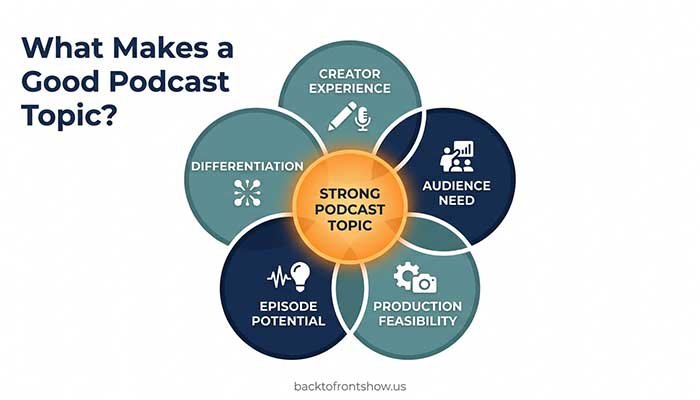
| Characteristic | Question to ask |
|---|---|
| Personal fit | Do I have enough interest or experience to keep discussing this? |
| Audience relevance | Does a recognizable group of people care about it? |
| Clear value | Will the show educate, entertain, inspire, investigate, or connect? |
| Repeatability | Can the topic support many episodes without constant repetition? |
| Differentiation | Is there a clear reason to choose this show over similar ones? |
| Practical fit | Can I produce this format with my available time and resources? |
You don’t need a perfect score in every area. However, a show becomes difficult to sustain when it depends entirely on one strength.
Passion without audience value can become a private hobby. Demand without genuine interest can lead to burnout. Expertise without a clear format may produce useful information that still feels unfocused.
In my experience, the most sustainable podcast ideas are rarely the broadest or cleverest. They’re the ones that make it easy for a particular listener to say, “This show is for someone like me.”
Step 1: Decide Why You Want to Start a Podcast
Your goal influences which topic makes sense.
You may want to:
- Teach a subject you understand.
- Build authority in a professional field.
- Grow a business or personal brand.
- Interview people you find interesting.
- Document a learning journey.
- Entertain a specific community.
- Explore stories that receive little attention.
- Build relationships within an industry.
- Create a future sponsorship or membership opportunity.
Be honest about the primary goal. A show designed to attract consulting clients may need a different topic from a show created mainly for entertainment.
For example, a freelance web designer who wants business leads could create a show about improving small-business websites. A general show about entrepreneurship might attract a larger theoretical audience, but it would be less directly connected to that person’s work.
Write your goal in this format:
I want this podcast to help me ______ by providing listeners with ______.
For example:
I want this podcast to help me build credibility with independent retailers by providing practical explanations of affordable ecommerce improvements.
This sentence doesn’t have to appear in the show description. It helps you make consistent decisions about the audience, format, guests, and episode topics.
Read More: How Much Does It Cost to Start a Podcast? 2026 Budget Guide
Step 2: Take Inventory of Your Useful Experience
You don’t have to be the world’s leading expert. You do need a legitimate reason to discuss the topic.
List your:
- Professional experience
- Education or training
- Hobbies
- Personal interests
- Communities you understand
- Problems you’ve learned to solve
- Subjects people ask you about
- Access to knowledgeable guests
- Experiences you can discuss responsibly
- Skills you’re currently developing
Then separate the list into three groups:
- Topics you can teach
- Topics you can explore
- Topics you can facilitate through interviews
This distinction matters.
If you’re qualified to teach bookkeeping, you might create an instructional show for freelancers. If you’re learning woodworking, a transparent beginner journey could work better than presenting yourself as an authority. If you have access to experienced restaurant owners, you could act as an informed interviewer rather than the main expert.
A lack of formal credentials doesn’t automatically disqualify you from a subject. It does affect how you should frame the show. Medical, legal, financial, and safety-related topics require particular care because inaccurate advice can cause real harm.
One common mistake I’ve seen is choosing a topic because it appears popular, then trying to manufacture authority afterward. It’s usually better to start with an honest role: expert, practitioner, reporter, learner, critic, storyteller, or facilitator.
Step 3: Define a Specific Target Audience
“Everyone” isn’t a useful target audience.
A podcast can be available to everyone while still being created for a clearly defined group. Specificity helps you choose relevant examples, guests, titles, questions, and promotional channels.
Compare these audiences:
- People interested in business
- Small-business owners
- First-time restaurant owners
- First-time independent restaurant owners trying to control operating costs
Each level provides more direction.
You don’t always need to narrow by age or location. You can define listeners through:
- Occupation
- Experience level
- Goal
- Problem
- Identity or life stage
- Hobby
- Industry
- Location
- Shared situation
Use this audience statement:
This podcast is for [specific people] who want to [desired outcome] but struggle with [main obstacle].
For example:
This podcast is for first-time managers who want to lead confident teams but struggle with difficult conversations and unclear expectations.
That statement immediately suggests potential episodes:
- How to give feedback without making an employee defensive
- What to say when deadlines keep slipping
- How to set expectations during an employee’s first week
- When a performance problem needs formal documentation
- How to manage a former peer
The clearer the audience, the easier it becomes to generate useful podcast content ideas.
Step 4: Start Broad, Then Add a Useful Angle
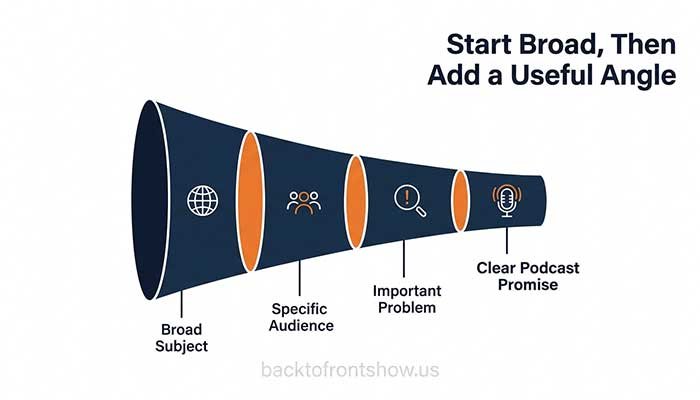
Many new podcasters begin with categories such as:
- Business
- Health
- Sports
- Technology
- Personal finance
- Education
- True crime
- Parenting
- Comedy
- Entertainment
- History
- Relationships
These are categories, not fully developed podcast topics.
Apple Podcasts currently organizes shows into more than 100 categories and subcategories. Its official category documentation explains that category choices can affect where a show appears in charts, recommendations, search, and third-party services.
Choosing a category is useful, but your show still needs an angle.
You can narrow a broad subject by combining it with:
- A specific audience
- A recurring problem
- A format
- A point of view
- An industry
- A location
- An experience level
- A time period
- An outcome
Here are some examples:
| Broad subject | More focused podcast topic |
|---|---|
| Personal finance | Simple money systems for freelancers with irregular income |
| Fitness | Strength training for busy parents who work at a desk |
| Marketing | Local marketing for independent home-service businesses |
| History | The history behind familiar American roadside attractions |
| Technology | Practical automation for small nonprofit teams |
| Parenting | Raising teenagers while caring for aging parents |
| Food | Regional American dishes and the communities behind them |
| Careers | Career changes for experienced professionals moving out of corporate roles |
A narrow topic doesn’t mean every episode must sound identical. It means the episodes share a recognizable promise.
Step 5: Identify the Listener’s Main Benefit
A topic tells people what the show discusses. A benefit tells them why they should listen.
Most podcasts provide one or more of these benefits:
- Learn a skill
- Solve a problem
- Make a decision
- Stay informed
- Feel entertained
- Discover stories
- Feel understood
- Join a community
- Gain motivation
- Hear informed opinions
- Save time or money
Try completing this sentence:
After listening, the audience will be better able to ______.
“Learn about home renovation” is vague.
“Plan a first home renovation without wasting money on avoidable mistakes” is more useful because it describes an outcome.
For an entertainment show, the benefit may be emotional rather than instructional:
After listening, the audience will have discovered an entertaining true story from a small American town.
The benefit should match the actual episodes. Don’t promise transformation that the show can’t reasonably deliver.
Step 6: Research Whether People Care About the Topic
Podcast topic research doesn’t require proving that millions of people want the idea. You need enough evidence that a reachable audience cares about the subject.
Use several kinds of evidence instead of relying on one number.
Search behavior
Use Google, YouTube, and podcast-app searches to see how people describe the subject.
Look for:
- Repeated questions
- Autocomplete suggestions
- Specific problems
- Beginner searches
- Comparison searches
- Myths and disagreements
- Seasonal interest
- Newly emerging concerns
Google Trends can help you compare interest in related subjects over time and filter by location. Google’s documentation explains that Trends can compare search terms and broader topics, while its related-search sections show top and rising searches connected to a subject. See Google’s guides to comparing terms and finding related searches.
Treat Trends as a directional research tool, not an exact measure of potential podcast listeners. A niche term may have limited search data but still represent a valuable professional community.
Existing podcasts
Search Apple Podcasts, Spotify, YouTube, and other platforms for shows in the broader niche.
Record:
- What audiences they appear to serve
- Which formats they use
- How recently they published
- What their episode titles emphasize
- Which topics appear repeatedly
- What their listener reviews praise or criticize
- What questions remain unanswered
The existence of competitors is usually evidence of interest—not a reason to abandon the topic.
The better question is:
What useful promise, audience, perspective, or format is missing?
For example, there may be hundreds of general career podcasts but few aimed specifically at skilled tradespeople moving into management.
Communities and conversations
Look at public conversations in:
- Online forums
- Professional associations
- Facebook or LinkedIn groups
- YouTube comments
- Reddit communities
- Event agendas
- Industry newsletters
- Customer reviews
- Frequently asked questions
- Conference programs
You’re looking for repeated language and unresolved problems.
Don’t enter a community only to promote a future show. Observe first. Learn how members describe their problems, what they already know, and what type of content they consider useful.
Direct conversations
Talk to five or ten people who resemble your intended listeners.
Ask:
- What is most frustrating about this subject?
- What have you already tried?
- Which questions are difficult to answer?
- What content do you currently follow?
- What makes you stop listening to a podcast?
- Would you prefer expert instruction, interviews, stories, or short answers?
- When and where do you normally listen?
Don’t ask only, “Would you listen to my podcast?” People often say yes to be encouraging. Questions about actual habits and problems produce more useful information.
Step 7: Study Competing Shows Without Copying Them
Create a simple spreadsheet containing 10 to 20 relevant podcasts.
For each show, note:
- Show title
- Target audience
- Main promise
- Format
- Typical episode length
- Publishing frequency
- Common episode subjects
- Guest types
- Apparent strengths
- Gaps or opportunities
Your goal isn’t to rewrite another show’s concept. It’s to understand the existing choices available to listeners.
Possible ways to differentiate include:
- Serving a more specific audience
- Covering a neglected geographic area
- Using shorter, more focused episodes
- Combining expert interviews with practical summaries
- Offering deeper reporting
- Presenting opposing viewpoints fairly
- Focusing on beginners
- Focusing on experienced professionals
- Using case-based episodes
- Publishing a limited narrative season
- Connecting two subjects in a natural way
Avoid relying on personality as the only differentiator. Your personality matters, but a new listener can’t evaluate it before pressing play. A clear promise gives that person a practical reason to try the show.
Step 8: Test Whether the Topic Can Support Enough Episodes
Before choosing a podcast niche, write at least 25 potential episode titles.
Don’t write one-word subjects such as “marketing” or “leadership.” Write titles that represent actual episodes.
For a hypothetical show about local marketing for home-service businesses, the list might include:
- How to ask satisfied customers for useful reviews
- What should a plumber put on a service-area page?
- Is direct mail still worth testing for a local contractor?
- How quickly should you respond to a new lead?
- What to photograph at a completed job
- How to market during a slow season
- Should a local service company publish its prices?
- How to track which calls came from advertising
While writing, group the ideas into three to six content pillars.
Possible pillars for that show could be:
- Local search
- Customer reviews
- Lead conversion
- Seasonal promotions
- Referrals
- Marketing measurement
Content pillars prevent a focused niche from becoming repetitive.
If reaching 25 useful episode ideas feels impossible, the topic may be too narrow—or you may need more research. If you generate hundreds of unrelated ideas, the topic may be too broad.
I usually recommend this exercise before buying equipment or designing cover art. It exposes a weak idea quickly and costs nothing.
Read More: How To Start A Podcast For Free: Complete Beginner’s Guide
Step 9: Check Whether the Topic Fits a Repeatable Format
A strong topic can still fail if the production format is unrealistic.
Ask:
- Does every episode require a difficult-to-book guest?
- Will each story require weeks of research?
- Can I legally and ethically access the necessary information?
- Do I need to travel?
- Does the show require expensive video production?
- Can I record in batches?
- Can I maintain the planned schedule?
- What happens when a guest cancels?
- Can I create a useful solo episode when necessary?
Imagine a weekly documentary show requiring travel, archival research, original interviews, and advanced sound design. The idea may be excellent, but it might be impossible for one person with five free hours per week.
A simpler version could be a six-episode season rather than an ongoing weekly show.
Choose the format based on available resources—not on what large podcast networks produce with professional teams.
Step 10: Score Your Best Ideas
If you’re considering several topics, score each one from 1 to 5.
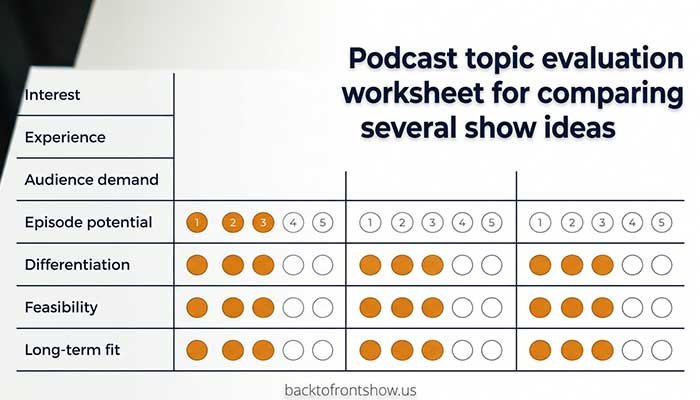
| Evaluation factor | Topic A | Topic B | Topic C |
|---|---|---|---|
| My genuine interest | |||
| Relevant experience or access | |||
| Clear target audience | |||
| Evidence of audience demand | |||
| Ability to generate episodes | |||
| Meaningful differentiation | |||
| Production feasibility | |||
| Connection to long-term goal | |||
| Total |
Don’t let the highest total make the decision automatically. Review the lowest individual scores too.
A topic scoring well everywhere except production feasibility may require a simpler format. A personally exciting idea with no clear audience may need more focus. A commercially attractive topic that doesn’t interest you may be difficult to sustain.
Step 11: Write a One-Sentence Podcast Concept
Use this formula:
A [format] podcast for [specific audience] that helps them [result] through [distinct approach].
Examples:
A weekly interview podcast for first-time restaurant owners that helps them avoid expensive operating mistakes through practical conversations with experienced operators.
A narrative history podcast for curious road-trip travelers that uncovers the stories behind unusual landmarks across the United States.
A short solo podcast for new managers that provides scripts and practical frameworks for difficult workplace conversations.
This sentence is an internal decision-making tool. It should help you judge whether an episode, guest, or promotional idea fits the show.
If the sentence is confusing, the topic probably needs more work.
Step 12: Record a Small Pilot Series
Before publicly launching, record three test episodes.
Choose:
- An episode you expect to be easy
- An episode that requires more research
- An episode representing the format you would use regularly
Then evaluate:
- Did you enjoy preparing the episodes?
- Did your experience match the topic’s demands?
- Did the episodes feel distinct but connected?
- Was the production time realistic?
- Did you discover enough depth?
- Could a new listener understand the show’s purpose?
- Did test listeners describe the intended benefit accurately?
Ask a few people from the target audience to listen. Instead of asking whether they “liked it,” ask:
- Who do you think this show is for?
- What do you expect future episodes to cover?
- Which part was most useful or engaging?
- Where did your attention drop?
- What question should the next episode answer?
If their description doesn’t match your intended concept, revise the topic, positioning, title, or opening explanation before launching.
How Narrow Should a Podcast Niche Be?
Your niche should be narrow enough to create a recognizable promise but broad enough to support ongoing episodes.
Too broad
A podcast about business, motivation, technology, and success.
The listener can’t predict what the next episode will provide.
Too narrow
A weekly podcast about one specific accounting form for independent coffee shops in one neighborhood.
That may not support enough distinct episodes.
Better focused
A practical finance podcast for independent coffee shop owners.
This topic can cover budgeting, inventory, pricing, payroll, taxes, equipment purchases, cash flow, and expansion while still serving a clear audience.
A useful test is whether someone can recommend the show naturally:
“You should listen to this. It’s for ______ who want ______.”
If filling in those blanks is difficult, keep refining.
Should You Choose a Popular or Unusual Topic?
Neither is automatically better.
Popular topics
Popular categories offer visible demand and many potential listeners. They also contain more established shows.
You can still enter a popular category if your show has a focused audience or distinctive approach.
Unusual topics
An unusual subject can face less direct competition and inspire curiosity. However, low competition sometimes means low demand.
Research the communities, questions, events, publications, and adjacent interests connected to the idea. A small but active audience can support a valuable show, especially when the members share a professional goal or strong identity.
The practical middle ground is often a familiar category with a more specific angle.
What Are Profitable Podcast Niches?
There is no podcast niche that becomes profitable automatically.
A topic’s business potential depends on factors including:
- Audience size
- Listener trust
- Purchasing intent
- Advertiser relevance
- Competition
- Products or services connected to the topic
- Membership potential
- Event opportunities
- Production cost
- The host’s credibility
- Consistent audience engagement
Business, technology, health, personal finance, careers, education, and specialized professional subjects may attract advertisers or support related services. Entertainment, comedy, history, fiction, and culture can also generate revenue, but they may require a larger audience or different monetization model.
A small show for a valuable professional audience may earn through consulting, training, events, or memberships. A larger general-interest show may rely more heavily on advertising.
For example, imagine two hypothetical podcasts:
- Show A reaches 20,000 general entertainment listeners.
- Show B reaches 1,500 owners of independent dental practices.
Show A has the larger audience. Show B may have a stronger connection to specialized software companies, consultants, equipment suppliers, or professional education. This doesn’t guarantee that either show will earn money. It illustrates why audience relevance can matter as much as size.
Choose a topic you can serve well first. Monetization works better when it grows from audience trust rather than controlling every editorial decision from the beginning.
Podcast Topics to Approach Carefully
Some subjects require stronger research, transparency, and editorial safeguards.
Health and medical topics
Separate personal experience from medical guidance. Use qualified sources, avoid unsupported treatment claims, and encourage listeners to seek appropriate professional help.
Personal finance and investing
Avoid implying guaranteed results. Explain risk, cite reliable information, disclose relevant financial relationships, and distinguish education from personalized advice.
Legal topics
Laws can vary by jurisdiction and change over time. Use qualified experts and make the limitations of general information clear.
True crime and personal allegations
Consider accuracy, privacy, consent, trauma, defamation risks, and the effect on victims and families. Entertainment value should not override responsible reporting.
Children and vulnerable groups
Use careful consent, privacy, and safety practices. Avoid exposing identifying details without a compelling and responsible reason.
News and politics
Create a verification process. Correct errors visibly and distinguish reporting from commentary.
Interest in a topic is not the same as being prepared to cover it responsibly.
Common Mistakes When Choosing a Podcast Topic
Choosing a topic only because it’s trending
Trends can help identify interest, but they can fade before a new show gains momentum. Look for an ongoing audience need beneath the temporary spike.
Copying a successful podcast
A similar title, format, and guest strategy won’t reproduce another show’s audience. Study competitors to understand the market, then develop your own promise.
Making the show about the host instead of the listener
Unless you already have a loyal audience, people need a reason to care. Frame personal stories around something useful, entertaining, or meaningful for the listener.
Combining too many unrelated interests
A podcast about real estate, fitness, celebrity news, productivity, and parenting may reflect your interests, but it gives listeners no consistent expectation.
Separate unrelated ideas or find a genuine connecting theme.
Choosing a niche with no personal connection
A potentially profitable category can become difficult to sustain if you don’t understand the audience or care about the questions.
Confusing a format with a topic
“Interview podcast” is a format. Who you interview, what you discuss, and why the listener should care define the topic.
Ignoring production difficulty
An idea requiring weekly travel, multiple guests, video, and extensive research may not fit your available time or budget.
Refusing to adjust after testing
Changing the concept before launch isn’t failure. Testing exists to reveal weak assumptions while they’re still inexpensive to fix.
A Quick Podcast Topic Checklist
Before committing to your topic, confirm that you can answer yes to most of these questions:
- Can I describe the target listener clearly?
- Does the show provide a consistent benefit?
- Do I have honest experience, curiosity, or guest access?
- Have I found evidence that people care about the subject?
- Can I explain how the show differs from existing options?
- Can I write at least 25 strong episode ideas?
- Can I group those ideas into several content pillars?
- Does the format fit my time and budget?
- Can I discuss the topic responsibly?
- Does it support my long-term reason for podcasting?
- Have I tested the concept with sample episodes?
- Can another person explain the show after hearing the pitch?
If several answers are no, don’t abandon the idea immediately. Identify what’s missing. You may need a more specific audience, a clearer benefit, a simpler format, or additional topic research.
Final Recommendation
Choose a podcast topic at the intersection of:
- What you can discuss honestly
- What a defined audience cares about
- What can support many useful episodes
- What you can realistically produce
- What has a clear angle in the existing market
Then test it.
Write 25 episode titles, study similar shows, speak with potential listeners, and record three pilot episodes. That process will tell you more than waiting for a perfect idea.
Your topic doesn’t need to be completely new. It needs to be clear, useful, sustainable, and specific enough for the right listener to recognize its value.