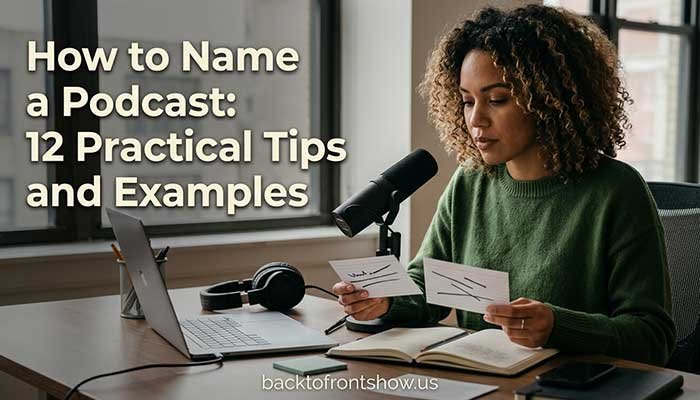
How To name a podcast, choose a title that is easy to say, easy to remember, relevant to the show, and different enough from existing brands. The best name usually combines clarity with personality: it gives potential listeners an idea of what to expect without sounding generic.
Before choosing a final name:
- Define your audience and the show’s promise.
- Brainstorm several types of names.
- Say each option aloud.
- search podcast apps, search engines, social platforms, domains, and trademarks.
- Test the strongest choices with potential listeners.
- Check how each name looks on cover art.
- Select a name that can still fit if the show grows.
A creative title isn’t useful if people can’t pronounce it, spell it, remember it, or understand why they should listen. This guide will help you avoid those problems.
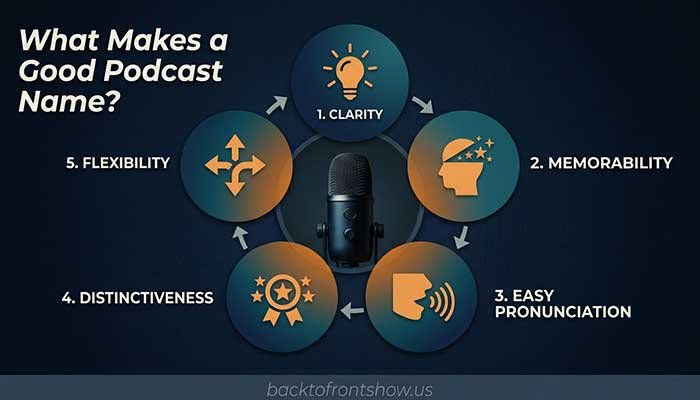
What Makes a Good Podcast Name?
A strong podcast name usually has five qualities:
| Quality | What it means |
|---|---|
| Clear | It provides a useful clue about the subject, audience, or style. |
| Memorable | A listener can recall it after hearing it once or twice. |
| Easy to say | The host and listeners can pronounce it naturally. |
| Distinctive | It doesn’t blend into a long list of similar shows. |
| Flexible | It can support future episodes without becoming misleading. |
You don’t have to explain the entire show in the title. Your cover art, description, categories, episode titles, and trailer provide additional context.
However, the name should contribute something useful. A completely abstract title creates more work because the surrounding branding must explain what the show is about.
In my experience, creators often try to make a podcast name clever before making it understandable. A clear name with one distinctive element is usually stronger than a complicated wordplay-based title that requires an explanation.
Name the Concept, Not Just the First Episode
Before brainstorming names, write a one-sentence description of the podcast.
Use this formula:
A [format] podcast for [audience] that helps or entertains them by [core promise].
For example:
A weekly interview podcast for first-time restaurant owners that explains the practical decisions behind running an independent restaurant.
Now identify the most important words and ideas:
- First-time owners
- Independent restaurants
- Behind-the-scenes decisions
- Operations
- Service
- Kitchen
- Opening
- Survival
- Hospitality
Those ideas provide a useful starting point for names.
Without a clear concept, your brainstorming will produce disconnected titles. You may find a catchy phrase but have no reliable way to judge whether it fits the show.
Read More: How to Choose a Podcast Topic: A Practical Step-by-Step Guide
12 Tips for Naming a Podcast
1. Give listeners a clue about the show
A descriptive name can communicate the subject directly:
- The Independent Restaurant Playbook
- First-Time Manager Questions
- The Weekend Garden Guide
- Freelance Money Systems
These hypothetical examples aren’t especially mysterious, but they make the show’s purpose easy to understand.
A suggestive name communicates the subject less directly while still offering a meaningful clue:
- After the Dinner Rush
- The Monday Manager
- Beyond the Trail Marker
- Between Paychecks
Either approach can work. The more abstract the title becomes, the more explanatory work your subtitle, artwork, and description must do.
Apple explains that podcast search can use metadata including the show name and episode titles. Accurate metadata helps shows appear in relevant searches and attract listeners, according to Apple Podcasts for Creators.
Don’t interpret this as a reason to stuff several keywords into the title. Write for people first.
2. Keep it short enough to remember
There is no perfect word count, but shorter names are often easier to:
- Say during an introduction
- Fit on square cover art
- Display on a phone
- Type into a search box
- Recommend in conversation
- Use consistently across platforms
Compare:
The Complete Weekly Podcast for New Small-Business Owners Who Want Better Marketing
with:
The Local Growth Playbook
The second option is easier to handle, although it may need a descriptive tagline.
Remove words that don’t add meaning. Phrases such as “The Official Podcast,” “Podcast Show,” or “Weekly Podcast” are usually unnecessary unless they serve a specific branding purpose.
Apple recommends making the podcast title clear and prominent on cover art because it appears at different sizes and on multiple devices. Its show-cover guidance also recommends limiting extra text and maintaining strong contrast.
3. Make it easy to pronounce
Say every candidate name aloud.
Imagine using it in these situations:
- “Welcome to ______.”
- “You’re listening to ______.”
- “Search for ______ in your podcast app.”
- “I host a show called ______.”
- “This episode of ______ is sponsored by…”
A name may look attractive in writing but feel awkward when spoken.
Watch for:
- Tongue twisters
- Unclear pronunciation
- Unnecessary punctuation
- Numbers that could be written several ways
- Words with multiple common spellings
- Initials that listeners won’t understand
If listeners hear the name but can’t confidently type it, word-of-mouth discovery becomes harder.
4. Make it easy to spell and search
Imagine hearing the name without seeing the cover art. Could you search for it correctly?
Potential problems include:
- Unusual spellings
- Replacing letters with numbers
- Extra punctuation
- Intentional misspellings
- Ambiguous homophones
- Generic phrases with many unrelated results
A title such as “Write Now” may be easy to say but difficult to search because someone could hear “Right Now.” That doesn’t automatically make it unusable, but it creates an avoidable challenge.
If you choose a name with ambiguous spelling, consider whether the host’s name, tagline, or visual brand can make it easier to find.
5. Avoid names that are too generic
Generic titles are difficult to own mentally and visually.
Examples might include:
- The Business Podcast
- Health Talk
- Sports Chat
- Marketing Today
- The Success Show
These titles describe a category, but they don’t communicate a clear audience, promise, or point of view.
Add specificity:
| Generic name | More focused hypothetical name |
|---|---|
| Business Talk | Main Street Business Decisions |
| Health Chat | Healthy Habits After 40 |
| Marketing Today | Marketing for the One-Person Business |
| Career Advice | Your Second-Career Plan |
| History Stories | Hidden History of the Great Lakes |
The focused versions provide more information and create a clearer identity.
6. Don’t make the name too narrow
Specificity is helpful until the title prevents natural growth.
Imagine naming a show:
The 30-Minute Facebook Ads Podcast for Chicago Coffee Shops
That name may fit the first plan perfectly. But it becomes misleading if the show later covers email, customer loyalty, delivery platforms, or restaurants outside Chicago.
A more flexible name might be:
The Independent Cafe Growth Show
Ask:
- Could this name fit 50 episodes?
- Would it still work if the format changed?
- Can I introduce related subjects without misleading listeners?
- Is the location essential to the concept?
- Does a platform or technology in the name create unnecessary dependence?
Avoid building the entire identity around a tool, trend, or narrow format unless that limitation is intentional.
7. Consider the emotional tone
The name should sound like the show.
A serious investigative podcast, a relaxed comedy show, and a practical business podcast require different language.
| Intended tone | Naming direction |
|---|---|
| Practical | Clear, direct, outcome-focused |
| Professional | Credible, specific, restrained |
| Funny | Playful language, contrast, wordplay |
| Investigative | Tension, unanswered questions, discovery |
| Warm | Conversational, welcoming, community-oriented |
| Energetic | Movement, action, momentum |
| Reflective | Thoughtful imagery or open-ended language |
Imagine a hypothetical podcast about difficult management conversations.
- The Manager’s Conversation Guide sounds instructional.
- What Do I Say Now? sounds conversational and relatable.
- Inside the One-on-One sounds thoughtful and workplace-specific.
- Management Disasters sounds more humorous or story-driven.
All four could cover similar subjects, but they set different expectations.
8. Decide whether to include your name
Using the host’s name can make sense when:
- The host already has a recognizable audience.
- The podcast supports a personal brand.
- The show covers several connected subjects.
- The host’s perspective is the main attraction.
- The podcast will feature prominent commentary or interviews.
Examples of common structures include:
- The [Host Name] Show
- [Topic] with [Host Name]
- [Host Name] on [Topic]
- The [Host Name] Interviews
Using your name may be less effective when you’re unknown and the title gives no clue about the show. A new listener searching for practical tax information won’t know that an unfamiliar person’s name represents a tax podcast.
A useful compromise is a descriptive title followed by the host’s name in the author field, description, or cover art.
9. Avoid unnecessary keyword stuffing
Relevant words can help people understand the subject, but a title shouldn’t look like a list of search queries.
Avoid titles such as:
Small Business Marketing, SEO, Social Media, Sales, Advertising and Growth Podcast
That title is long, difficult to remember, and visually awkward.
Choose a clear central idea, then use the podcast description and episode titles to explain the scope naturally.
Apple’s presentation guidance recommends writing descriptions that explain the content and listener benefit while using relevant vocabulary potential listeners may search for. See Apple’s official podcast presentation guide.
10. Check existing podcasts and brands
Before becoming attached to a name, search:
- Apple Podcasts
- Spotify
- YouTube
- Bing
- Major social platforms
- Domain registrars
- State business records when relevant
- The USPTO trademark database
Search the exact name in quotation marks. Then search:
- The name without punctuation
- Singular and plural variations
- Similar spellings
- Similar-sounding words
- Common abbreviations
- Reversed word order
- The key words separately
- The name combined with “podcast”
Finding a small, inactive podcast with the same title doesn’t automatically answer whether you can use the name. It does create practical risks, including listener confusion, misdirected searches, branding conflicts, and possible legal issues.
I’d normally remove a candidate when another active podcast already uses the same or a confusingly similar name in a related subject area. Even when legal use might be possible, sharing a name makes growth and word-of-mouth promotion unnecessarily difficult.
Read More: How Much Does It Cost to Start a Podcast? 2026 Budget Guide
11. Check domain and social-handle availability
A matching .com domain is helpful, but it isn’t mandatory.
Possible alternatives include:
- Adding “show”
- Adding “podcast”
- Using the host or company name
- Choosing a clear abbreviation
- Using a different established domain extension
- Creating the podcast as a section of an existing website
Avoid changing the show name solely to secure a perfect social handle. Consistent or closely related handles are useful, but the audience value of the name matters more.
Also search old accounts and inactive websites. A handle may be unavailable because someone registered it years ago, while the actual name remains workable with a small variation.
Do not buy domains, register business names, or pay for artwork until the name has passed the broader conflict checks.
12. Test the name before committing
Show your three strongest names to people who resemble the target audience.
Don’t begin by explaining the podcast. Ask:
- What do you think this show is about?
- Who do you think it is for?
- Which name would you remember tomorrow?
- How would you spell this after hearing it?
- Which title would you be most likely to investigate?
- Does any name create an unexpected meaning?
- Does any option sound like another brand?
Then read each name aloud without showing it in writing. Ask the person to type what they heard.
This small test can uncover spelling and pronunciation problems that are invisible to the creator.
Seven Podcast Naming Styles
Using several naming styles prevents every idea from sounding the same.
1. Descriptive names
These explain the subject directly.
Hypothetical examples:
- The First-Time Manager Guide
- Freelance Finance Weekly
- The Home Workshop Podcast
- Practical College Planning
Advantages: Clear and easy to position
Limitations: Can sound generic without a distinctive element
2. Benefit-focused names
These emphasize the listener’s desired result.
Hypothetical examples:
- Lead Better Meetings
- Build a Calmer Business
- Retire With a Plan
- Make Your Website Work
Advantages: Communicates value quickly
Limitations: Can sound like a course or marketing slogan
3. Audience-focused names
These identify who the show serves.
Hypothetical examples:
- The Rural Freelancer
- Managers in the Middle
- The Independent Retailer
- Parents Building Businesses
Advantages: Helps the right listener recognize the show
Limitations: May restrict future audience expansion
4. Metaphorical names
These use imagery connected to the show’s theme.
Hypothetical examples:
- Beyond the Trail Marker
- The Second Draft
- After the Dinner Rush
- Under the Storefront Sign
Advantages: Distinctive and emotionally engaging
Limitations: May require a tagline to explain the subject
5. Question-based names
These reflect a question the audience asks.
Hypothetical examples:
- What Do I Say Now?
- Where Did the Money Go?
- Is This Normal?
- What Happens Next?
Advantages: Conversational and curiosity-driven
Limitations: Questions can be generic or difficult to search
6. Wordplay-based names
These use rhythm, contrast, puns, or double meanings.
Advantages: Can be memorable and entertaining
Limitations: The joke may be unclear, difficult to spell, or culturally limited
Wordplay is most useful when the audience understands it immediately. If you need several sentences to explain the joke, it probably isn’t helping the title.
7. Host-led names
These feature the presenter.
Hypothetical structures:
- The Jordan Lee Show
- Business Basics With Jordan Lee
- Jordan Lee Asks Why
Advantages: Supports a personal brand and flexible subject range
Limitations: Offers little information when the host isn’t already known
A Step-by-Step Podcast Naming Process
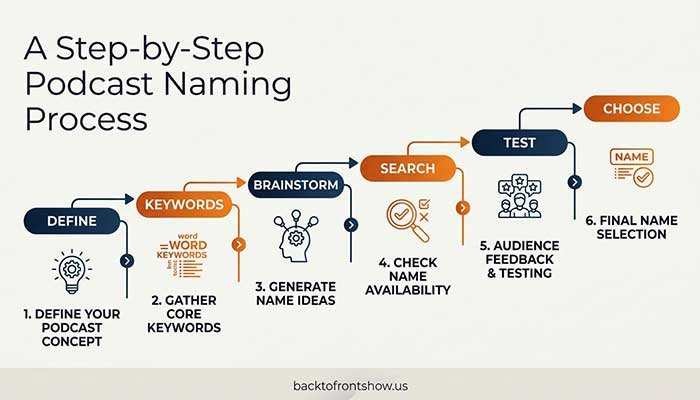
Step 1: Write the show’s core words
Create separate lists for:
- Subject
- Audience
- Outcome
- Emotion
- Format
- Setting
- Symbols or metaphors
- Common audience language
For a hypothetical podcast about helping new managers, the lists might include:
| Category | Possible words |
|---|---|
| Subject | leadership, feedback, meetings, teams |
| Audience | new managers, team leads, supervisors |
| Outcome | confidence, clarity, trust, progress |
| Emotion | uncertain, prepared, calm, capable |
| Setting | office, one-on-one, meeting room |
| Metaphor | first step, bridge, compass, playbook |
Step 2: Combine words using simple formulas
Try these formulas:
- The [Audience] [Resource]
- [Outcome] for [Audience]
- [Action] Your [Subject]
- [Metaphor] + descriptive tagline
- [Question]?
- [Subject] With [Host]
- [Place or moment] + [topic clue]
- The [Adjective] [Topic]
- [Problem] to [Outcome]
Examples:
- The New Manager Playbook
- Better Feedback for Team Leads
- Lead With Clarity
- The Leadership Compass
- What Do I Say Now?
- Management With Jordan Lee
- Inside the One-on-One
- The Practical Manager
- From Awkward to Clear
Treat these as brainstorming examples, not available names. Every candidate still needs independent research.
Step 3: Generate at least 30 options
The first ideas are often predictable. Continue long enough to discover less obvious combinations.
Don’t evaluate every name immediately. Generate first, then remove:
- Confusing options
- Overly long names
- Difficult spellings
- Names that don’t fit the tone
- Titles that are too similar to existing shows
- Options tied to temporary trends
- Names that limit the concept unnecessarily
Aim to keep five to ten serious candidates.
Step 4: Score the finalists
Rate each option from 1 to 5.
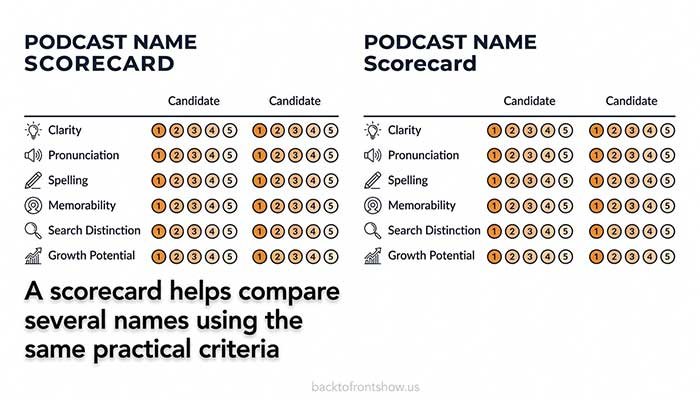
| Test | Name A | Name B | Name C |
|---|---|---|---|
| Relevant to the show | |||
| Easy to pronounce | |||
| Easy to spell | |||
| Easy to remember | |||
| Distinctive in search | |||
| Fits the intended tone | |||
| Works on cover art | |||
| Allows reasonable growth | |||
| Passes initial conflict checks | |||
| Total |
Don’t choose by total score alone. A serious trademark conflict or an inability to pronounce the name clearly should outweigh a high score elsewhere.
Step 5: Perform availability and legal checks
Search podcast platforms, the web, domains, social accounts, businesses, products, books, newsletters, and trademarks.
For a show that will become a serious commercial brand, consider asking a qualified US trademark attorney to perform a full clearance review.
Step 6: Create rough cover art
Put each finalist into a simple square design.
Check it at full size and as a small thumbnail. A name that fits poorly or becomes unreadable may still work, but it could require a different visual approach.
Step 7: Test with potential listeners
Collect reactions without revealing your favorite. Look for patterns rather than allowing one person’s preference to decide the name.
Step 8: Make the final decision
Choose the strongest overall option, not merely the most clever one.
Once selected, document:
- Exact spelling
- Capitalization
- Punctuation
- Tagline
- Preferred short form
- Pronunciation
- Domain
- Social handles
- Cover-art treatment
Consistency helps prevent several slightly different versions of the name from appearing online.
Can You Use a Podcast Name That Already Exists?
Using the same name as another podcast is usually a poor practical choice, even if no immediate legal issue is obvious.
Listeners may:
- Follow the wrong show
- Leave reviews on the wrong page
- Struggle to find you
- Confuse the social accounts
- Assume the shows are connected
- Share the wrong link
The legal question is more complicated than simply finding an exact match.
The US Copyright Office states that names, titles, slogans, and short phrases are generally not protected by copyright. However, some names may be protected under trademark law. See the Copyright Office FAQ and Circular 33.
The US Patent and Trademark Office explains that trademarks identify the source of goods or services. Two marks may create a problem when they are confusingly similar and cover related goods or services. Similarity can involve appearance, sound, meaning, or overall commercial impression—not just exact spelling.
Use the USPTO Trademark Search system for an initial search. The USPTO also warns that a complete clearance search can involve several sources and can be complex. Its federal trademark-searching guide recommends checking variations, similar pronunciation, related wording, and relevant goods or services.
An initial database search isn’t a legal opinion or a guarantee that a name is safe. If the podcast is part of a business, network, product line, or substantial investment, speak with a qualified trademark attorney.
Should You Use a Podcast Name Generator?
A podcast name generator can help you produce raw ideas, word combinations, themes, and naming directions. It shouldn’t make the final decision for you.
Pros
- Produces ideas quickly
- Suggests combinations you may not consider
- Helps overcome a blank page
- Can explore several tones and naming styles
- May provide useful keywords or metaphors
Cons
- May suggest names already in use
- Cannot reliably complete legal clearance
- Often produces generic phrases
- May misunderstand the show’s audience
- Can create awkward or misleading names
- May favor cleverness over clarity
Give a generator specific information:
- Target audience
- Main subject
- Listener benefit
- Format
- Tone
- Words to include
- Words to avoid
- Desired length
- Relevant metaphors
Then independently verify every result.
A generated suggestion isn’t automatically original, available, or legally safe.
Podcast Name Ideas: A Practical Brainstorming Example
Imagine a hypothetical show for Americans moving from salaried employment into full-time freelancing.
The show promises practical help with income planning, client communication, taxes, time management, and uncertainty.
Descriptive directions
- The Full-Time Freelancer Guide
- Freelance Business Basics
- The Independent Work Plan
Benefit-focused directions
- Build a Stable Freelance Business
- Freelance With a Plan
- Make Independent Work Work
Audience-focused directions
- The New Full-Time Freelancer
- From Employee to Freelancer
- Independent After Nine-to-Five
Metaphorical directions
- Beyond the Paycheck
- The Independent Track
- No More Timecard
Question-based directions
- Can Freelancing Be Stable?
- What Should I Charge?
- Am I Ready to Go Independent?
These examples show how one concept can produce several naming styles. They have not been checked for current availability and should not be treated as cleared names.
Podcast Naming Mistakes to Avoid
Choosing the name before defining the show
A title can’t represent a concept that hasn’t been decided. Define the audience, subject, benefit, and format first.
Copying the structure of a successful brand
Using a similar name, typography, or presentation can confuse listeners and create legal or reputational problems.
Adding “podcast” to solve a conflict
If another related brand already uses the main phrase, adding “podcast,” “show,” or “radio” may not create enough practical or legal distinction.
Depending on punctuation
Podcast apps, voice assistants, URLs, and listeners may ignore punctuation. “Work/Life” and “Work Life” can function like the same name in conversation and search.
Using a temporary year or trend
A title containing a year, platform, or short-lived expression may age quickly unless the show is intentionally limited to that period.
Ignoring unintended meanings
Check slang, abbreviations, common pronunciations, and possible interpretations. If your audience includes several communities or languages, ask relevant speakers to review the name.
Designing the logo too early
A polished logo makes creators emotionally attached to a weak name. Complete the availability and conflict research first.
Treating a domain purchase as ownership
Owning a domain doesn’t automatically establish broad trademark rights or make the underlying name legally safe.
Trying to please everyone
A title designed to offend no one and include every subject often becomes forgettable. Focus on accurately serving the intended audience.
Can You Change a Podcast Name Later?
Yes, but the change should be handled carefully.
Apple states that creators using an RSS feed can change a show title through their hosting provider by updating the feed’s title information. Apple says it normally detects metadata changes within 24 hours. See its podcast metadata instructions.
The exact process and update time can vary across hosts and listening platforms.
When renaming an existing show:
- Confirm the new name has passed your searches.
- Update the name through the podcast host.
- Keep the same RSS feed unless there is a specific reason to migrate.
- Update the cover art, website, email, and social profiles.
- Explain the change in an episode and show description.
- Consider temporarily displaying “formerly [old name].”
- Check major podcast apps after the update.
- Monitor listener messages and search results.
A small show can usually rename more easily than an established brand. That’s another reason to test the name carefully before launch.
Final Podcast Name Checklist
Before committing, ask:
- Does the title fit the actual show?
- Can a new listener get a useful clue from it?
- Is it easy to pronounce?
- Is it easy to spell after hearing it?
- Is it short enough to remember?
- Does it fit naturally into a spoken introduction?
- Can it remain legible on small cover art?
- Does it match the intended tone?
- Is it different from active shows in the same space?
- Have I searched spelling and pronunciation variations?
- Have I checked search engines and social platforms?
- Have I checked relevant domains?
- Have I performed an initial USPTO search?
- Does it leave enough room for the show to grow?
- Have potential listeners tested it?
- Have I avoided buying branding before completing the checks?
If several answers are no, return to the shortlist. Renaming before launch is much easier than rebuilding a brand after publishing dozens of episodes.
Final Recommendation
The best podcast name balances clarity, memorability, and distinctiveness.
Start with the show’s audience and promise. Generate at least 30 ideas across several naming styles, then narrow them through pronunciation, spelling, search, branding, audience, and legal checks.
For most new podcasts, I’d choose the clearest distinctive name over the cleverest one. A listener should be able to hear it, remember it, search for it, and understand why the show may be worth exploring.