How To grow a podcast from zero, choose a specific audience, create episodes that solve recognizable problems, package each episode clearly, promote it where those listeners already spend time, and use retention data to improve the next episode.
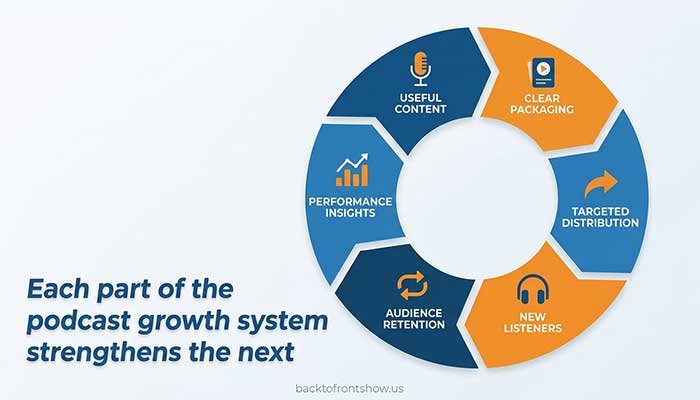
The process is less about finding one clever promotional trick and more about building a repeatable growth loop:
Useful content → clear packaging → targeted distribution → new listeners → stronger retention → audience insights → better content
Podcast growth is often slow at the beginning. You have a limited back catalog, little recognition, and no reliable source of returning listeners yet. That does not mean the podcast is failing. It means the foundations matter more than short-term download spikes.
In more than two years of working with podcast content, I have found that early growth becomes much easier when every episode is designed for one identifiable listener. A podcast aimed at “anyone interested in business” is difficult to position. A show helping first-time restaurant owners manage staffing and cash flow gives potential listeners a clear reason to press play.
Start With a Clear Podcast Promise
Before spending more time on podcast promotion, make sure people can understand the show within a few seconds.
Your podcast promise should explain:
- Who the show is for
- What subjects it covers
- What listeners will gain
- Why they should choose it over similar shows
A useful template is:
This podcast helps [specific audience] achieve [specific outcome] through [type of content or perspective].
For example:
This podcast helps independent fitness coaches attract and retain clients through practical marketing interviews and weekly case studies.
This is more persuasive than a broad statement such as “conversations about business, success, and life.”
Use the promise consistently in your podcast description, trailer, website copy, social profiles, and guest introductions. Consistency helps people remember what the show represents.
Read More: BacktoFrontShow Pricing AtoZ Update 2026: Plans, Costs & Features
Build a Strong Foundation Before Promoting
Promotion cannot compensate for confusing positioning or a weak listener experience. Audit the basic elements of the show first.
| Podcast element | What to check |
|---|---|
| Show title | Is it memorable, easy to spell, and connected to the subject? |
| Show description | Does the opening explain the audience and benefit? |
| Cover artwork | Is it recognizable at thumbnail size? |
| Trailer | Can a new visitor quickly understand why they should follow? |
| Episode titles | Do they communicate a useful outcome or compelling subject? |
| Audio quality | Is speech clear and comfortable to hear? |
| Publishing schedule | Can you maintain it without sacrificing quality? |
| Catalog | Is there an obvious episode for a new listener to start with? |
| Calls to action | Are listeners told what to do next and why? |
Accurate metadata also affects how a show appears in relevant searches. Apple recommends using clear show and episode information to help listeners understand and discover a podcast. Its guidance on podcast metadata is a useful checklist.
Define Three to Five Content Pillars
Content pillars prevent a new podcast from becoming a collection of unrelated conversations.
For a podcast serving freelance designers, the pillars might be:
- Finding clients
- Pricing and proposals
- Managing projects
- Building a portfolio
- Running a sustainable freelance business
Each episode should normally fit one pillar. This creates recognizable patterns for listeners and gives the host a manageable planning system.
Build a question bank under every pillar. Sources can include:
- Questions asked in relevant online communities
- Search suggestions and related searches
- Comments under videos or posts in the niche
- Questions received by email or direct message
- Common misconceptions
- Beginner mistakes
- Comparisons between popular options
- New developments affecting the audience
The objective is not to chase every trending topic. It is to identify questions your intended listeners already care about.
Create Episodes People Can Find and Recommend
A strong podcast growth strategy needs episodes that work for both discovery and loyalty.
Use a balanced content mix:
| Episode type | Primary purpose | Example |
|---|---|---|
| Evergreen answer | Search and long-term discovery | How to Price Your First Consulting Project |
| Timely analysis | Immediate relevance | What the New Industry Rules Mean for Small Firms |
| Guest conversation | Authority and audience overlap | An Interview With a Specialist Serving the Same Market |
| Case study | Practical credibility | How a Hypothetical Launch Plan Failed—and What to Change |
| Opinion or perspective | Differentiation | Why More Content Is Not Always the Answer |
| Listener question | Community and retention | Should You Publish Weekly or Every Two Weeks? |
Evergreen episodes can continue attracting listeners long after publication. Timely episodes can generate short-term attention. Guest conversations can introduce the show to relevant communities, but they work best when the discussion has a specific premise instead of being a general biography.
Read More: Best Podcast Equipment in 2026: Complete Setup Guide for Beginners & Pros
Improve Episode Titles
An episode title should help a potential listener decide whether the episode is relevant.
Weak titles often rely on episode numbers, vague phrases, or unfamiliar guest names:
- Episode 14: A Conversation With John Smith
- Thoughts on Marketing
- Let’s Talk About Growth
Stronger alternatives communicate a subject, tension, or outcome:
- How to Get Your First 10 Consulting Leads
- Why Your Podcast Promotion Is Not Converting
- A Sales Follow-Up System for Busy Freelancers
- What Most New Hosts Get Wrong About Episode Length
Place the clearest information near the beginning. If an episode includes a guest, add the name when it helps, but do not assume an unfamiliar name is enough to earn a click.
Apple explains that show names, episode titles, and other metadata influence search results in Apple Podcasts. Natural, descriptive titles therefore serve both listeners and podcast search systems.
Avoid stuffing keywords into titles. A title still needs to sound like something a person would willingly select.
Win the First Minute
Getting a play is only the beginning. The opening must convince the listener to stay.
A practical episode introduction can include:
- The problem or question
- The benefit of listening
- A brief preview of what will be covered
- Any context needed to understand the discussion
Long theme music, extended host biographies, unrelated conversation, and several minutes of housekeeping can cause early exits.
For example:
Today, we are breaking down a four-step follow-up process for freelancers who receive inquiries but struggle to turn them into paid projects. We will cover response timing, qualification questions, proposal follow-up, and the point at which you should stop chasing a lead.
That opening sets a clear expectation. The rest of the episode must then deliver what was promised.
From my experience, editing the opening often produces more value than creating another week of promotional posts. If listeners repeatedly leave before the main discussion begins, sending more people to the episode simply exposes more people to the same problem.
Publish on a Schedule You Can Maintain
Consistency matters because listeners need an opportunity to form a habit. However, consistency does not automatically mean publishing every day or every week.
A carefully produced biweekly podcast can be more sustainable than an inconsistent weekly show.
Choose a schedule based on:
- Research and preparation time
- Recording availability
- Editing requirements
- Promotional capacity
- The depth of each episode
- Whether the show is seasonal or continuous
If you use seasons, tell listeners when the next season is expected. If you need to change the schedule, communicate the change instead of quietly disappearing.
Get the First Podcast Listeners
When a podcast has no existing audience, the first listeners often come from direct relationships.
Start with people who genuinely match the target audience:
- Professional contacts
- Existing customers or community members
- Newsletter subscribers
- Social followers interested in the subject
- Colleagues in the industry
- Relevant friends or acquaintances
Send personal messages rather than mass announcements. Explain why a particular episode may be useful to that person.
For example:
I recently published an episode about pricing small design projects. You mentioned dealing with that issue, so I thought it might be useful. If you listen, I would appreciate hearing which part was most relevant.
Do not pressure people to leave positive reviews. Honest feedback is more useful during the early stage because it reveals unclear positioning, weak sections, and unanswered questions.
Turn Guests Into Strategic Collaborators
Guest interviews can help grow a podcast audience, but audience size should not be the only selection criterion.
Look for guests who have:
- Expertise relevant to the show
- Audience overlap
- A clear perspective or useful story
- A reason to participate
- A willingness to discuss a focused topic
Before recording, agree on a specific angle. After publication, provide a simple promotional package containing:
- A direct episode link
- A short summary
- Suggested social copy
- One or two strong clips
- A quote graphic
- The publication date
Make sharing convenient, but never treat it as guaranteed. The host remains responsible for podcast marketing.
You can also offer value to the guest through thoughtful preparation, professional editing, accurate descriptions, and useful assets they can repurpose.
Appear on Other Podcasts
Being a guest on another relevant podcast can be more effective than posting repeatedly to an uninterested social audience.
Pitch shows that serve the same listeners from a complementary angle. Instead of asking to “talk about your journey,” propose a useful subject.
A concise pitch should explain:
- Why the subject fits the show
- What the audience will learn
- Your relevant experience or perspective
- Two or three possible talking points
- Links to examples that demonstrate your communication style
Other collaboration options include:
- Trailer swaps
- Feed drops or sample episodes
- Joint Q&A sessions
- Roundtable episodes
- Newsletter mentions
- Co-created research
- Cross-promoted episode series
Disclose paid or sponsored arrangements when applicable. Audience trust is more valuable than a temporary promotional lift.
Use Search as an Ongoing Discovery Channel
Podcast search optimization starts with matching episodes to real questions.
For each episode:
- Choose one primary subject.
- Use a clear phrase in the title.
- Explain the subject naturally in the description.
- Add useful show notes.
- Include chapters when supported.
- Publish a transcript or edited article when resources allow.
- Link to the episode from relevant profiles and resources.
Show notes should add value rather than repeat a generic biography. Include a short summary, major ideas, guest information, resources mentioned, and a clear next step.
Transcripts also make the content more accessible and easier to repurpose. Review automated transcripts before publication because names, technical terms, and punctuation are frequently misinterpreted.
Use YouTube as a Podcast Discovery Platform
YouTube can introduce a podcast to people who do not regularly browse traditional podcast apps.
A podcast on YouTube is organized as a playlist, with episodes published as videos. Eligible creators can also connect an RSS feed. YouTube Studio provides podcast-relevant metrics such as impressions, click-through rate, traffic sources, views, watch time, and audience engagement, according to YouTube’s official podcast creation and analytics guidance.
You do not necessarily need a complex studio. Depending on the format, you can publish:
- Full video conversations
- A clean single-camera recording
- Remote interview layouts
- Audio with a thoughtfully designed visual
- Selected segments and explainers
Treat the title and thumbnail as a pair. The title can state the subject while the thumbnail creates a simple visual reason to pay attention.
Do not evaluate click-through rate in isolation. YouTube notes that CTR varies by traffic source and can decline as a video reaches a broader audience. Interpret impressions and CTR together using the platform’s analytics guidance.
Create Clips With One Complete Idea
A useful podcast clip should contain a recognizable insight, story, argument, or answer. It should not feel like an arbitrary section cut from a longer recording.
Strong clips often begin with:
- A surprising statement
- A clear question
- A costly mistake
- A specific result
- A disagreement
- A short story
- A practical recommendation
Add captions and remove unnecessary pauses. When possible, adapt the opening, length, and layout for each platform instead of posting the identical file everywhere.
Spotify also allows eligible creators to attach one short video clip to an episode. These clips can appear on a show page and may be recommended through other Spotify surfaces. The current requirements and placement details are available in Spotify’s Clips documentation.
Every clip should have a clear job. It might encourage viewers to hear the complete explanation, follow the show, answer a question, or share the idea with someone.
Build a Direct Audience Connection
Podcast platforms are important, but an email list or owned community gives the host a more direct relationship with listeners.
A simple newsletter can include:
- The newest episode
- One important takeaway
- A useful resource
- A question for readers
- A preview of the next episode
Offer a relevant reason to subscribe, such as a checklist, resource guide, template, episode summary, or curated reading list. The incentive should connect to the podcast’s subject. A broad giveaway may attract people who want a prize but have little interest in the show.
Invite replies. Listener language can reveal better episode titles, new questions, and gaps in the content.
Use One Primary Call to Action
Asking listeners to follow, rate, review, subscribe, visit a website, join a newsletter, download a resource, follow five social accounts, and share the episode is too much.
Choose one primary action for each episode.
Examples include:
- “Follow the show so the next episode appears in your library.”
- “Send this episode to one freelancer who is working on their pricing.”
- “Join the newsletter for the checklist mentioned in this episode.”
- “Reply to this week’s question and tell us what you want covered next.”
Explain the benefit of taking the action.
On Apple Podcasts, followers can receive automatic episode downloads and notifications. Apple Podcasts Connect also lets creators compare listening behavior and view follower trends. Apple explains these distinctions in its guide to followers on Apple Podcasts.
Measure the Entire Listener Journey
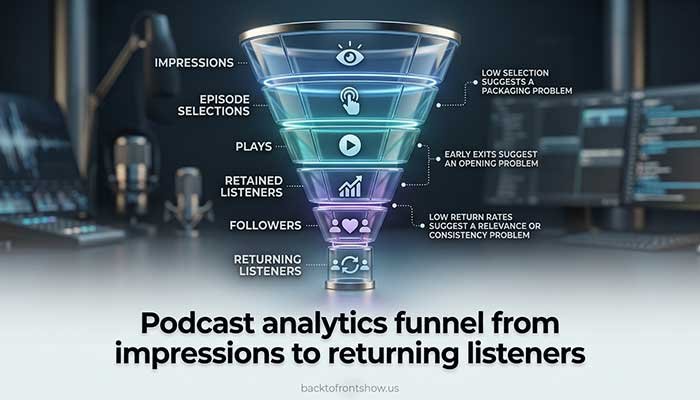
Downloads are useful, but they do not explain the whole audience journey. A host may report downloads while individual platforms report impressions, listeners, plays, followers, watch time, and completion.
Use the available data to identify where growth is breaking down.
| Pattern | Possible problem | What to investigate |
|---|---|---|
| Few impressions | Limited reach or weak topic demand | Distribution, collaborations, search subjects |
| Impressions but few plays | Weak packaging | Episode title, artwork, thumbnail, description |
| Plays followed by an early drop | Opening does not match the promise | Intro length, relevance, pacing |
| Strong beginning but low completion | Structural or pacing problem | Repetition, episode length, segment order |
| Good listening but few followers | Weak conversion | Calls to action, show promise, consistency |
| One large spike with no return | Wrong audience or one-off topic | Source of traffic, next-episode relevance |
| Stable listeners but no growth | Retention works, discovery does not | Guest appearances, search, clips, partnerships |
Spotify’s discovery analytics can show impressions, plays, conversion, completion, and the Spotify surfaces where discovery occurred.
Apple Podcasts Connect reports listeners, engaged listeners, plays, time listened, followers, location, and episode-level listening behavior. Apple defines an engaged listener as someone who listens for at least 20 minutes or 40% of an episode. Its full definitions are available in the Apple Podcasts analytics guide.
Do not combine every platform’s numbers as if they use identical definitions. Compare trends within the same measurement system whenever possible.
A Hypothetical Diagnostic Example
Suppose an episode receives 10,000 impressions but only a small number of plays. The first issue to investigate is probably packaging: the topic, title, cover presentation, or thumbnail may not be persuasive.
If another episode receives fewer impressions but attracts strong completion and several new followers, its content may be working well. The growth opportunity is getting that episode in front of more relevant people.
These figures are hypothetical, not universal benchmarks. A healthy conversion or completion rate depends on the format, platform, traffic source, audience, and episode length.
Follow a 90-Day Podcast Growth Plan
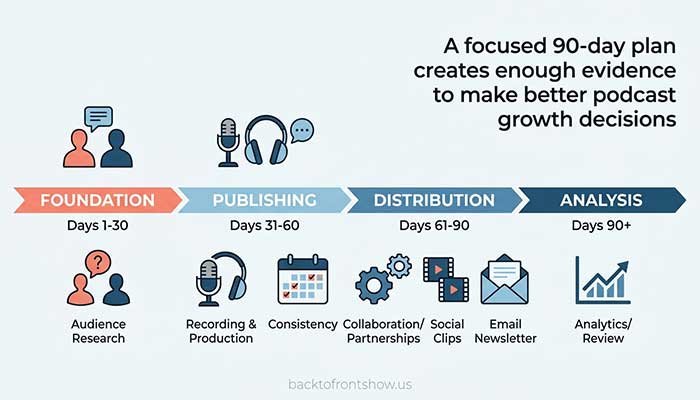
A focused 90-day period is long enough to test a system without expecting instant popularity.
| Period | Main focus | Actions |
|---|---|---|
| Weeks 1–2 | Foundation | Clarify the audience, rewrite the promise, audit artwork and metadata, identify content pillars, review existing analytics |
| Weeks 3–6 | Content and consistency | Publish useful episodes, improve openings, create show notes, test stronger titles, collect listener questions |
| Weeks 7–10 | Distribution | Pitch guest appearances, arrange collaborations, publish clips, promote through email and relevant communities |
| Weeks 11–12 | Analysis | Compare episodes, identify retention problems, review discovery sources, ask listeners for feedback, plan the next eight episodes |
During the 90 days, maintain a simple tracking sheet with:
- Episode subject and format
- Publication date
- Promotional channels
- Guest or collaboration
- Impressions where available
- Plays or listeners
- Downloads from the host
- Completion or retention
- Followers gained
- Email signups
- Qualitative listener feedback
The goal is not to prove that the podcast succeeded or failed in exactly 90 days. It is to learn which subjects, formats, packaging choices, and distribution channels deserve more investment.
Should You Pay to Promote a New Podcast?
Paid podcast promotion can help, but it is usually most useful after the show demonstrates that relevant listeners stay and take the desired next step.
Before paying for promotion, confirm that:
- The show’s target audience is clear.
- The promoted episode is a strong introduction.
- The opening retains listeners.
- The title and creative are compelling.
- A meaningful conversion event can be tracked.
- The campaign targets people likely to value the show.
Begin with a small test. Use campaign-specific links where possible and compare the quality of acquired listeners, not only the number of clicks.
If paid visitors leave quickly or never return, increasing the budget will not fix the underlying listener experience.
Podcast Growth Mistakes to Avoid
Buying Downloads, Followers, or Reviews
Artificial activity does not build an audience. It can distort analytics, weaken decision-making, violate platform rules, and damage trust.
Promoting Everywhere Without a Strategy
A small team rarely needs to manage every social platform. Choose channels based on audience fit and the format you can consistently produce.
Changing the Subject Every Week
Variety is helpful within a clear promise. Constantly switching between unrelated subjects makes it difficult for listeners to know why they should return.
Depending Entirely on Guests
Guests can expand reach, but a podcast needs its own identity. Develop recurring formats and host-led episodes that work without borrowed audiences.
Obsessing Over Charts
Podcast charts can provide exposure, but they should not be treated as a complete measurement of quality or long-term growth. Apple states that its Top Shows and Trending charts use a mix of listening, follows, completion, and other engagement signals; they are not simply lists of the largest shows. The exact algorithm is not published. See Apple’s explanation of podcast charts.
Ignoring Retention
More promotion is not always the answer. If listeners leave early, improve the content experience before increasing traffic.
Expecting Every Episode to Perform Equally
Subjects have different levels of demand. Some episodes attract new listeners, while others deepen the relationship with existing listeners. Evaluate each episode based on its intended role.
A Practical Podcast Growth Checklist
Before publishing:
- Confirm the episode serves the target listener.
- Write a clear, specific title.
- Make the opening match the title’s promise.
- Remove unnecessary repetition.
- Prepare accurate show notes.
- Select one primary call to action.
- Create two or three promotional angles.
After publishing:
- Send the episode to relevant existing contacts.
- Provide promotional assets to the guest.
- Publish useful clips.
- Share it with the email list.
- Participate in relevant communities without spamming.
- Monitor impressions, plays, and retention.
- Record listener questions and feedback.
- Apply the lesson to the next episode.
Final Recommendation
If you want to grow a podcast from zero, begin with one narrow audience and one clear promise. Publish episodes that solve recurring problems, make their value obvious through strong titles and openings, and promote them through relationships, search, collaborations, email, clips, and relevant platforms.
Then study what happens after discovery. If people see the episode but do not select it, improve the packaging. If they start but leave, improve the episode. If they listen but do not return, strengthen the show’s promise, consistency, and calls to action.
Sustainable podcast growth is not one promotional campaign. It is a continuing process of earning attention, delivering value, learning from listener behavior, and making the next episode more useful than the last.