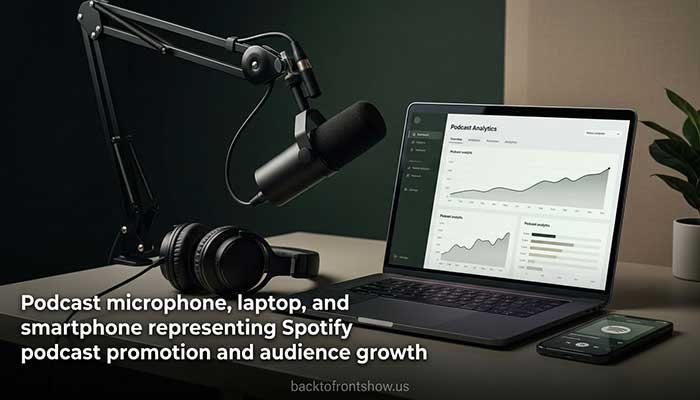
To promote a podcast on Spotify, start by optimizing your show title, description, episode titles, and cover art. Then use Spotify’s built-in discovery tools, share short clips on social media, collaborate with other podcasters, and encourage listeners to follow your show.
The most effective approach combines two things: helping new listeners discover your podcast and giving them a reason to keep listening.
You don’t need thousands of social media followers or a large advertising budget to get started. A clear podcast topic, useful episodes, and consistent promotion can help you build an audience over time.
In this guide, I’ll explain 12 practical ways to promote your podcast on Spotify, including free marketing techniques, Spotify’s creator tools, and ways to measure whether your efforts are working.
Claim Your Podcast on Spotify for Creators
Before promoting your podcast, make sure you can manage it through Spotify for Creators.
Spotify for Creators is Spotify’s platform for managing podcasts, reviewing analytics, and engaging with listeners.
It supports podcasts hosted directly with Spotify as well as shows hosted through other podcast hosting providers.
If your podcast is already available on Spotify through a service such as Buzzsprout, Podbean, or Libsyn, you can claim it without necessarily changing hosting providers.
How to claim an existing podcast:
- Visit Spotify for Creators and sign in.
- Choose the option to find an existing show.
- Select the option indicating that your show is hosted somewhere else.
- Enter your podcast’s RSS feed or Spotify show URL.
- Complete the ownership verification using the email associated with your podcast feed.
- Open your dashboard and review the available creator features.
If your podcast is hosted directly on Spotify for Creators, it is automatically published to Spotify when you publish episodes.
Once you have access, you can work on your show’s presentation, understand how people discover it, and use available audience engagement features.
This is an important first step because promoting your show becomes much easier when you can see how listeners respond.
Optimize Your Spotify Podcast Profile
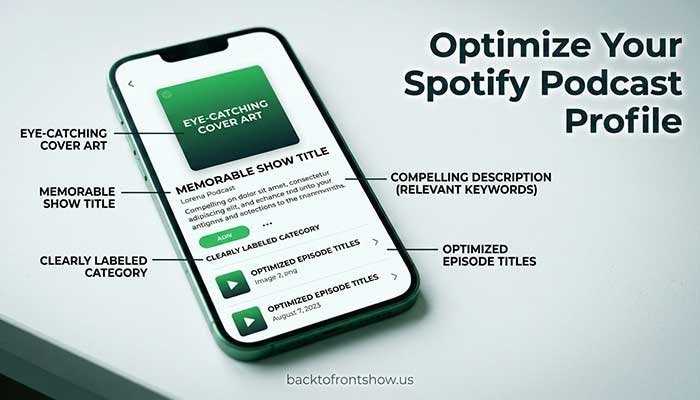
Your Spotify podcast profile is often the first thing potential listeners see after discovering your show.
If your title, description, or artwork doesn’t clearly communicate what your podcast offers, people may leave without playing an episode.
That’s why Spotify podcast optimization should be one of your earliest priorities.
Choose a clear podcast title
Your show name should be memorable and relevant to your topic.
For example, imagine you’re starting a podcast about managing money.
A title such as Everyday Money Made Simple gives people an immediate idea of what to expect.
A vague name such as The Weekly Talk Show doesn’t communicate much unless you already have an established audience.
You don’t need to force several keywords into your podcast title. Clarity and recognition matter more.
Write a helpful podcast description
Your description should answer three questions:
- What is the podcast about?
- Who should listen?
- What will listeners learn or enjoy?
Here’s an example for a hypothetical personal finance podcast:
“Everyday Money Made Simple helps working Americans understand budgeting, saving, credit cards, and everyday financial decisions. Each week, we break down practical money topics into conversations you can easily follow.”
Notice that the description naturally mentions relevant subjects without repeating the same keyword.
Spotify’s podcast SEO guidance emphasizes accurate titles, descriptions, and metadata to help listeners find relevant content.
Use professional-looking cover art
Your cover art should remain recognizable even when displayed as a small thumbnail on a smartphone.
I recommend keeping the design simple:
- Make the podcast name easy to read.
- Use strong contrast between text and background.
- Avoid too many decorative elements.
- Choose imagery that matches your podcast’s subject.
- Keep your visual branding consistent across platforms.
A complicated design may look impressive at full size but become difficult to understand in Spotify’s mobile interface.
Choose relevant podcast categories
Select categories that accurately describe your show.
For example, a podcast about entrepreneurship could fit within a business-related category, while a show explaining historical events belongs in a more relevant educational or historical category.
Don’t choose unrelated categories simply because you think they’re popular.
Accurate categorization helps communicate your show’s subject to Spotify and potential listeners.
Make Your Episode Titles Easier to Discover
Your podcast title helps people understand your overall show. Your episode titles explain why they should listen to a particular conversation.
Consider these two hypothetical titles:
Weak: Episode 18 – Let’s Talk About Money
Better: How to Build an Emergency Fund on a Tight Budget
The second title gives listeners a specific reason to click.
It also includes phrases that someone interested in personal finance might search for.
How to write better Spotify episode titles
Start by identifying the main question your episode answers.
Then write a title that communicates the value clearly.
For example:
| Podcast topic | More useful episode title |
|---|---|
| Personal finance | 7 Budgeting Mistakes That Make Saving Harder |
| Fitness | How to Start Strength Training at Home |
| Entrepreneurship | How to Price Your First Freelance Project |
| Career advice | How to Prepare for Your First Job Interview |
| Technology | How to Recognize Common Online Scams |
Use relevant keywords naturally, but don’t sacrifice readability.
It’s also worth writing detailed episode descriptions.
Explain the main topics, introduce your guests when relevant, and provide useful context. If an episode covers several important questions, mention them without turning the description into a long list of repeated search terms.
My recommendation: Before publishing, ask yourself whether someone unfamiliar with your podcast could understand the episode’s value just by reading its title.
If the answer is no, make the title more specific.
Use Spotify Clips to Reach New Listeners
Short-form video can introduce your podcast to people who aren’t ready to commit to a full episode.
Spotify offers a feature called Clips, allowing eligible creators to upload short promotional videos connected to podcast episodes.
According to Spotify’s official Clips documentation, these videos can appear on your show page and may be recommended in discovery areas such as Home, podcast feeds, Browse, and Now Playing.
Spotify currently supports one uploaded Clip per episode, with a maximum length of 90 seconds. The availability of features and placement can vary.
What makes an effective podcast clip?
Choose a moment that makes viewers curious enough to hear the full conversation.
Good examples include:
- A surprising answer to an interesting question.
- A useful tip that solves a common problem.
- A short, memorable story.
- A thoughtful disagreement between guests.
- An important takeaway from the episode.
Imagine you’re promoting an episode about personal budgeting.
Rather than opening your clip with a lengthy introduction, you might use a moment when the host asks:
“Why do some people struggle to save money even after getting a raise?”
That creates a natural reason to continue listening.
Keep captions readable, focus on clear audio, and avoid overly complicated visual effects.
You can also repurpose suitable clips for Instagram Reels, YouTube Shorts, and TikTok.
Just remember that a viral clip isn’t necessarily a successful podcast promotion. The goal is to attract people who actually want to listen to your episodes.
Improve Your Spotify Episode Previews
Spotify also provides episode previews, which are different from Clips.
Episode previews are short excerpts of your podcast that can appear while listeners browse Spotify.
Spotify can automatically generate previews using the beginning of an episode or a section selected by its system.
Creators may also be able to choose their own preview excerpts through Spotify for Creators.
Why previews matter
Think of an episode preview as a quick introduction to your content.
If a potential listener hears an engaging moment, they may be more interested in opening the full episode.
For a 40-minute interview, the strongest preview might be a compelling response from your guest rather than your opening music.
I recommend reviewing your available previews and choosing sections that make sense without additional context.
Avoid excerpts that depend on several minutes of earlier conversation to understand.
You can learn more through Spotify’s episode preview documentation.
Share Your Spotify Podcast on Social Media
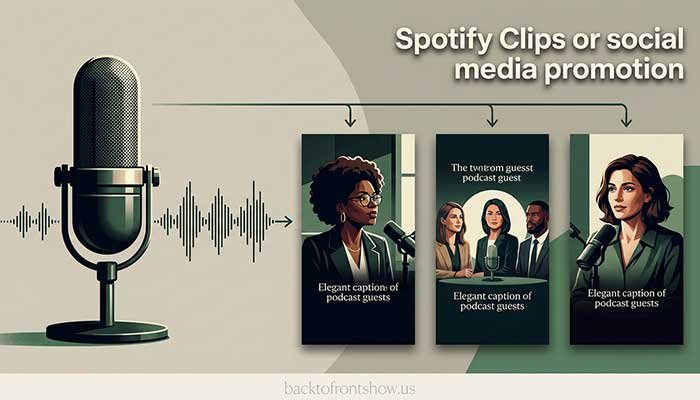
Social media is one of the most accessible ways to promote a podcast without paying for advertising.
However, simply posting the same Spotify link every time you release an episode usually isn’t enough.
Give people a reason to care before asking them to listen.
Use Reels to share interesting podcast moments.
You can also create carousel posts explaining key lessons from an episode.
For example, if you publish a podcast about productivity, an Instagram carousel might cover three mistakes that make remote work less productive.
Then direct interested readers to the full discussion on Spotify.
YouTube Shorts
Turn useful moments from your podcast into short vertical videos.
Add clear captions and a brief explanation of the full episode.
For audio-only podcasts, you can use appropriate graphics, captions, or a simple visual background rather than pretending you recorded video footage.
TikTok
Focus on moments that spark curiosity, teach something quickly, or encourage discussion.
Try to make each clip understandable on its own.
If your podcast focuses on business, careers, technology, or professional development, LinkedIn may be a useful place to reach relevant listeners.
Instead of simply posting an episode announcement, write a short post explaining one valuable lesson from the conversation.
Reddit and online communities
Look for communities that genuinely discuss the topics your podcast covers.
Participate by answering questions and sharing useful information.
Only share podcast links when they are relevant and permitted by the community’s rules.
A practical approach: Choose one or two platforms where your target listeners already spend time. Build a consistent posting routine before expanding to additional channels.
Trying to maintain five social accounts at once can become difficult when you’re also recording and editing episodes.
Encourage Listeners to Follow Your Podcast on Spotify
Getting someone to listen to one episode is valuable. Convincing them to follow your show can create more opportunities for repeat listening.
Spotify’s promotion guidance explains that following a show helps listeners keep up with new episodes through their Spotify library and personalized app experiences.
Make following your podcast feel like a useful next step.
For example, near the end of an episode, you might say:
“If this conversation helped you, follow the podcast on Spotify so you can find our next episode about building better money habits.”
That’s clearer than asking listeners to follow without giving them a reason.
You can also include a short reminder in your episode description and relevant social media posts.
Avoid repeating the same request throughout the recording.
A natural reminder is usually more pleasant than interrupting the discussion several times.
Use Spotify Polls and Comments to Build Engagement
Promotion doesn’t end when someone presses play.
Building a podcast audience also means creating reasons for listeners to return and participate.
Spotify provides polls and comments that allow creators to communicate with their audiences.
For example, imagine you host a career advice podcast.
After an episode about job interviews, you could publish a poll asking:
“What is the hardest part of a job interview?”
Possible answers might include:
- Answering unexpected questions.
- Talking about salary.
- Explaining employment gaps.
- Managing nervousness.
The answers can help you choose future episode topics.
Comments provide another opportunity to hear directly from listeners.
You might end an episode by asking people to share their experiences or suggest a question for the next discussion.
When someone leaves a thoughtful comment, respond when appropriate.
Spotify explains how creators can manage these interactions through its polls and comments tools.
In my view, listener feedback is most useful when you actually apply it.
If several people ask the same question, that may be a better starting point for your next episode than guessing what your audience wants.
Collaborate With Other Podcast Creators
Collaborating with another podcaster can introduce your show to an audience that already enjoys listening to podcasts.
The important part is choosing someone whose content is relevant to your listeners.
For example, imagine you host a podcast about starting a small business.
A collaboration with a podcast about freelance work, bookkeeping, or online marketing could make sense.
A completely unrelated show with a larger audience might produce less meaningful interest.
Ways to collaborate
Guest interviews: Invite another podcast host to discuss a subject their audience cares about.
Guest appearances: Offer to contribute useful expertise or an interesting perspective to another show.
Episode recommendations: Recommend relevant episodes from each other’s podcasts.
Joint discussions: Record a conversation exploring a subject from two different perspectives.
Social promotion: Share an interesting moment from a collaboration and tag the other creator.
Don’t approach collaborations as a way to collect free advertising.
Start by offering something valuable to the other creator’s audience.
A thoughtful collaboration gives listeners a reason to explore both shows.
Publish Episodes Consistently and Improve Listener Retention
Podcast growth isn’t only about attracting new people.
If listeners regularly leave after the opening minutes, additional promotion may not produce the audience growth you’re hoping for.
This is where retention becomes important.
Listener retention helps you understand how much of an episode people consume and where they stop listening or watching.
Start episodes with a clear reason to listen
Avoid spending too long on introductions that don’t provide immediate value.
For example, if your episode explains how to start a side business, introduce the main problem quickly.
Tell the audience what they’ll learn and begin delivering on that promise.
Keep audio quality consistent
You don’t need the most expensive microphone to produce a useful podcast.
However, listeners should be able to understand the conversation comfortably.
Check for distracting background noise, inconsistent volume, and audio that is difficult to hear.
Choose a realistic publishing schedule
Publishing every week can work well if you have enough time to maintain quality.
But if weekly production leads to rushed episodes, releasing strong episodes every two weeks may be more sustainable.
Consistency matters because it helps your audience understand what to expect.
Don’t sacrifice useful content simply to publish more frequently.
Check where listeners stop listening
Spotify for Creators provides audience analytics that can help you understand consumption and retention.
If people frequently stop listening near the beginning, review your introductions.
If the audience stays for the first half but leaves later, consider whether the conversation becomes repetitive or loses focus.
These patterns don’t prove exactly why people leave, but they provide useful starting points for improvement.
Promote Your Podcast Beyond Spotify
A strong Spotify podcast marketing strategy shouldn’t depend entirely on discovery within Spotify.
People may first discover your content through a Google search, newsletter, social media post, or another creator.
Your goal is to make it easy for those people to find the podcast on Spotify.
Create useful blog content
If you have a website, publish helpful articles related to your podcast episodes.
For example, an episode titled How to Build an Emergency Fund could inspire an article explaining emergency savings in more detail.
The article can answer readers’ questions and include a relevant Spotify episode link or embedded player.
Use email newsletters
An email list gives interested listeners another way to hear about new episodes.
Instead of sending only an episode link, include a brief summary or useful takeaway.
For example:
“This week’s episode explains three common budgeting problems and how to address them.”
Then provide the Spotify listening link.
Share episodes with relevant communities
Consider professional associations, online groups, newsletters, and niche communities where people discuss your podcast’s subject.
Always follow their promotional guidelines.
Make sharing simple
Spotify supports sharing podcast links and embedding its player on websites.
You can also create a simple landing page where people choose their preferred listening platform.
This is especially useful because not everyone uses Spotify.
One thing I recommend: Avoid measuring every promotional activity by immediate plays alone. A helpful article or guest appearance may introduce someone to your work before they eventually become a listener.
Track Your Spotify Podcast Analytics
You can’t reliably judge podcast promotion by social media views alone.
A video with thousands of views might produce very few actual podcast listeners.
Meanwhile, a smaller post reaching the right audience could lead to more meaningful engagement.
That’s why it’s important to review your Spotify analytics.
Spotify for Creators includes information about discovery, plays, followers, and audience behavior.
In June 2026, Spotify announced updates to its podcast analytics, including improved audience journey reporting and insights into first-time and returning listeners.
Spotify also updated the definition of a podcast play: a play now reflects at least 30 seconds of listening or watching on Spotify.
This distinction matters when interpreting performance data or comparing newer results with older reporting.
Which metrics should you monitor?
| Metric | What it tells you | What to do with it |
|---|---|---|
| Impressions | How often your content is displayed in Spotify discovery surfaces | Review which episodes are getting visibility |
| Plays | Qualifying listening or viewing activity | Compare episode interest over time |
| Followers | How many accounts follow your podcast | Track whether your audience is building |
| Audience retention | How long people continue consuming episodes | Identify sections that may need improvement |
| New and returning listeners | Whether you’re reaching new people and bringing existing listeners back | Balance discovery efforts with audience loyalty |
| Discovery sources | Where listeners encounter your content on Spotify | Understand which discovery channels may be contributing |
Not every metric is available in exactly the same form for every creator, and Spotify’s reporting may change.
For current definitions, use Spotify’s 2026 analytics update.
Example: Using analytics to improve promotion
Imagine a hypothetical business podcast publishes two episodes:
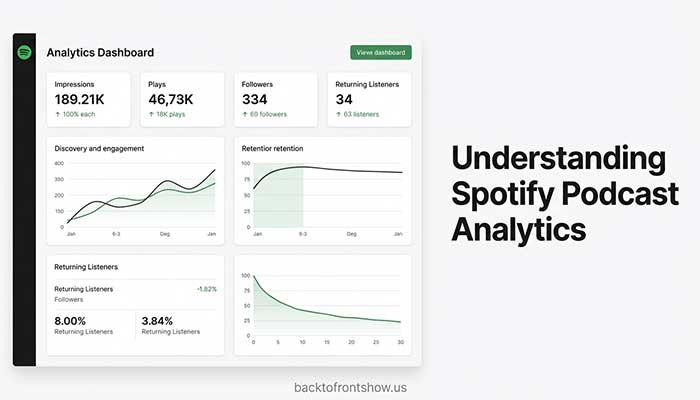
- Episode A receives 800 Spotify impressions and 80 plays.
- Episode B receives 500 Spotify impressions and 100 plays.
Episode A reached more potential listeners through impressions.
Episode B received more plays despite fewer impressions.
That doesn’t automatically mean Episode B performed better in every way. Impressions and plays may come from different sources, and the metrics aren’t necessarily a direct one-to-one conversion.
But the difference gives you a useful question to investigate.
Was Episode B’s title more appealing? Did its topic better match your audience? Did it receive traffic from an outside promotion?
Reviewing those factors can help you make more informed decisions about future episodes.
Should You Pay to Promote a Podcast on Spotify?
Paid advertising can help you reach additional people, but it isn’t necessary for every podcast.
For a new show, I generally recommend improving the basics before spending money.
Make sure your profile looks professional, your episodes provide clear value, and you understand who you’re trying to reach.
Once those foundations are in place, you can consider advertising.
Spotify Advertising provides information about advertising opportunities and available campaign tools.
Pricing, eligibility, targeting, and placement options can vary, so check Spotify’s current requirements before planning a campaign.
Free vs. paid podcast promotion
| Approach | Main advantage | Main limitation |
|---|---|---|
| Spotify profile optimization | Improves how your show is presented without media spending | Doesn’t guarantee discovery |
| Organic social media | Can reach relevant listeners with little direct cost | Requires time and consistent effort |
| Podcast collaborations | Introduces your show to another creator’s audience | Depends on finding suitable partners |
| Blogging and SEO | Can attract people searching for related topics | Often takes time to build traffic |
| Paid advertising | Offers more controlled audience targeting and distribution | Requires money and careful performance measurement |
If you decide to try paid promotion, start with a budget you can afford to lose without harming your podcast production.
Focus on one clear objective and review the results before increasing spending.
Don’t assume paid reach automatically translates into loyal followers.
Read More: How to Get More Podcast Listeners: A Practical Growth Guide
A Simple 30-Day Spotify Podcast Promotion Plan
You don’t have to implement every strategy at once.
For beginners, a focused 30-day plan can make Spotify podcast growth feel more manageable.
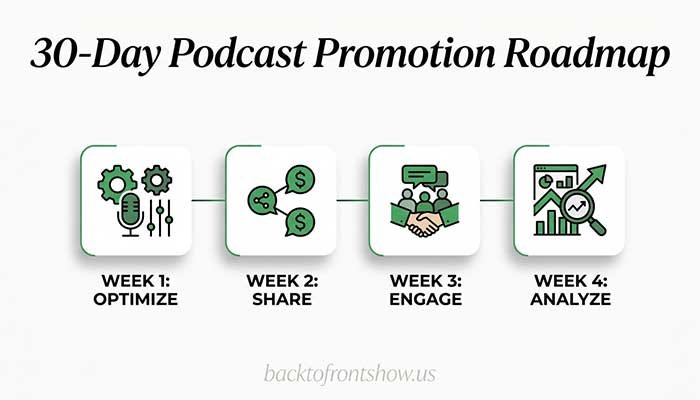
Week 1: Improve your podcast foundation
- Claim or access your show through Spotify for Creators.
- Rewrite your podcast description for clarity.
- Review your show artwork.
- Improve episode titles and descriptions.
- Select a strong introductory episode using the Best Place to Start feature, if available.
Week 2: Build your content promotion routine
- Choose two platforms where your target audience is active.
- Prepare two or three short clips from suitable episodes.
- Share useful insights rather than only promotional announcements.
- Add your Spotify link to relevant profiles.
- Create a repeatable release-day promotion checklist.
Week 3: Focus on community and collaboration
- Contact two or three relevant podcast creators about possible collaborations.
- Add a poll to a suitable episode.
- Invite listeners to share feedback through comments.
- Respond to meaningful questions.
- Encourage listeners to follow your podcast naturally.
Week 4: Review and improve
- Compare Spotify analytics with your earlier results.
- Review which episode topics attracted interest.
- Look for retention patterns.
- Identify which external promotions generated useful engagement, where measurable.
- Choose two or three tactics to continue next month.
The purpose of this plan isn’t to guarantee a particular number of followers.
It’s to help you establish a manageable promotion process and learn what works for your specific audience.
Common Spotify Podcast Promotion Mistakes
Even useful podcasts can struggle when their promotion strategy doesn’t match the audience they’re trying to reach.
Here are several mistakes worth avoiding.
1. Promoting without a clear target audience
A podcast intended for everyone often has difficulty communicating why any particular person should listen.
Define the specific group you want to help or entertain.
2. Using misleading episode titles
An exaggerated title might attract curiosity, but it can disappoint listeners when the content doesn’t deliver what they expected.
3. Publishing social clips without context
A clip that makes sense only after listening to the full episode may confuse new viewers.
Choose moments that stand on their own.
4. Ignoring existing listeners
New listener acquisition matters, but repeat listeners are also important.
Pay attention to comments, feedback, and the topics your audience enjoys.
5. Focusing only on play counts
Plays are useful, but they don’t tell the complete story.
Review discovery, followers, retention, and returning listeners together.
6. Expecting immediate growth
Podcast audience development can take time.
A few weeks of posting without dramatic results doesn’t necessarily mean a strategy has failed.
Review performance over a meaningful period and make gradual improvements.
FAQs:
Final Thoughts
Learning how to promote a podcast on Spotify isn’t about finding one secret technique.
It’s about making your show easier to discover, creating episodes people genuinely want to hear, and consistently reaching the audience most likely to enjoy your content.
Start with your podcast profile and episode titles. Then experiment with short clips, social media, collaborations, and Spotify’s engagement features.
Use analytics to understand what resonates and improve your approach over time.
My recommendation is to focus on three priorities first: make your podcast easy to understand, publish episodes worth returning to, and promote each episode where your ideal listeners already spend time.
You don’t need to master every marketing channel. A consistent, practical strategy is a better starting point than trying every promotion technique at once.