Podcast advertising is a way for businesses to reach potential customers through promotional messages placed inside podcast episodes. Brands can sponsor individual shows, pay hosts to recommend products, or run prerecorded ads across multiple podcasts.
For podcasters, advertising is also a way to earn money from their content.
Most podcast ads are priced using CPM (cost per thousand impressions), although flat-rate sponsorships, affiliate commissions, and performance-based deals are also common.
According to Libsyn Ads’ published pricing guidance, a typical 30-second baked-in host-read ad costs approximately $18–$22 CPM, while a 60-second version costs around $24–$26 CPM. Actual prices depend on the podcast, audience, targeting, placement, and advertising agreement.
Podcast Advertising 2026 Ultimate Guide
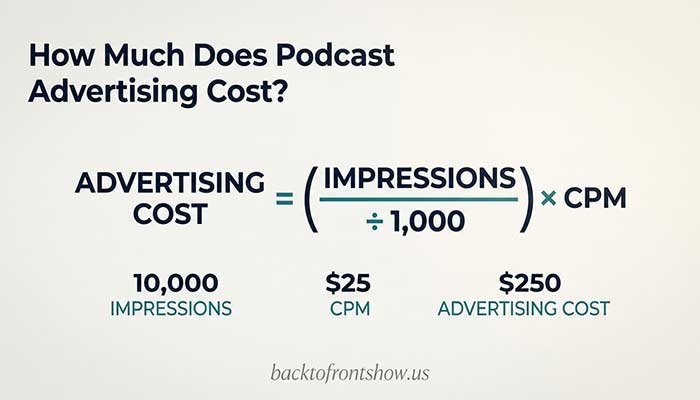
That means a podcast delivering 10,000 qualifying ad impressions at a $25 CPM would charge approximately $250 for one ad placement.
But choosing the right podcast matters just as much as the price.
A small podcast with a dedicated audience of potential customers can sometimes be a better advertising opportunity than a much larger show with an audience that isn’t interested in your product.
This guide explains how podcast advertising works, the different ad formats, current pricing benchmarks, how to find sponsors, how to launch campaigns, and how to measure results.
What Is Podcast Advertising?
Podcast advertising involves placing paid promotional messages within podcast content to promote a product, service, company, or brand.
These messages might be delivered by the podcast host, recorded by a professional voice actor, or inserted automatically through an advertising platform.
For example, imagine a weekly personal finance podcast sponsored by a budgeting software company.
During an episode, the host might introduce the sponsor, explain what the software does, and give listeners a promotional code.
That message is a podcast advertisement.
The company pays for exposure to an audience interested in personal finance, while the podcaster receives compensation for including the promotion.
Not every podcast advertisement works this way, though. Some campaigns use thousands of ads distributed across different podcasts without individual sponsorship negotiations.
Why businesses advertise on podcasts
Podcast advertising gives businesses opportunities to reach people based on their interests and the shows they choose to follow.
Some important benefits include:
- Audience relevance: Businesses can advertise on shows covering subjects closely related to their products.
- Host credibility: An authentic recommendation from a trusted host can make an advertisement feel more personal.
- Flexible formats: Brands can choose host-read sponsorships, prerecorded commercials, or dynamically inserted ads.
- Targeting opportunities: Certain advertising platforms support geographic, demographic, and contextual targeting.
- Measurable results: Advertisers can monitor delivery, website visits, promotional code usage, leads, and sales.
These benefits aren’t guaranteed for every campaign. Results depend on the audience, advertisement, product, offer, and measurement approach.
How Does Podcast Advertising Work?
Podcast advertising typically involves three parties: the advertiser, the podcast publisher, and sometimes an advertising network or marketplace.
Advertiser
Sets campaign goals, budget, audience, and message
Podcast / Ad Network
Creates, schedules, and delivers ad placements
Podcast Audience
Receives the advertising message while consuming episodes
Campaign Measurement
Evaluates delivery, responses, conversions, and costs
Here’s how a typical campaign works.
- An advertiser defines a goal. This might involve brand awareness, increasing website traffic, generating leads, or making sales.
- The advertiser chooses podcasts. Selection is based on audience demographics, topics, estimated reach, pricing, and brand suitability.
- Both parties agree on advertising terms. These include the ad format, placement, schedule, cost, and measurement approach.
- The advertisement is produced. A host may record the message, or the advertiser may supply a finished audio file.
- The advertisement is distributed. It may become part of an episode or be dynamically inserted during delivery.
- Campaign results are reviewed. The advertiser compares spending against delivered impressions and measurable business outcomes.
The exact process depends on whether the campaign is purchased directly from a podcaster or through an advertising platform.
Types of Podcast Advertising Formats
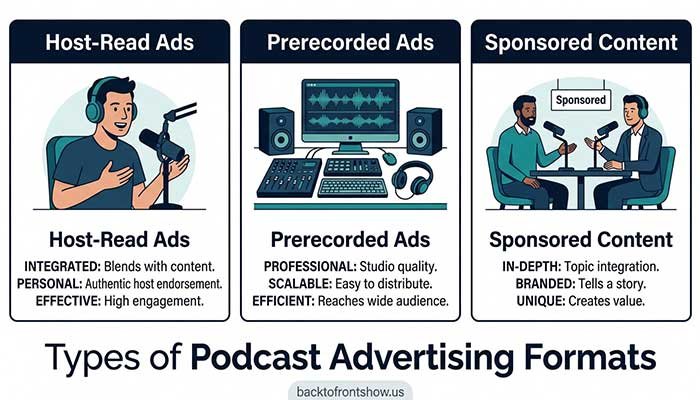
Podcast ads can be categorized in two important ways: who delivers the message and where it appears within an episode.
Understanding both helps you choose a suitable format.
1. Host-read ads
Host-read ads are advertisements spoken by the podcast host.
They often match the podcast’s regular conversational style, which can make them feel more natural than a traditional commercial.
For example, a productivity podcast host might explain how a project-management app works before sharing a sponsor’s offer.
A host-read ad can be scripted, loosely guided by talking points, or produced with an approved personal endorsement.
Advantages: The message can fit the show’s personality, explain more complex products, and connect with an established audience.
Limitations: Host availability, creative approval, pricing, and scalability can make campaigns more complicated.
A host-read advertisement isn’t necessarily permanently embedded in an episode. Host-read messages can also be delivered through dynamic ad insertion. Spotify’s advertising guidance explicitly distinguishes the speaker from the delivery method.
2. Prerecorded ads
Prerecorded ads are produced separately from the podcast episode.
They may feature a voice actor, brand representative, music, or sound effects.
Businesses can use the same advertisement across multiple podcasts, which makes it easier to maintain consistent messaging.
Advantages: Greater creative control, reusable assets, and easier distribution across multiple shows.
Limitations: A generic advertisement may feel less personal than one specifically created for a podcast’s audience.
Prerecorded ads can be particularly useful when a company wants to reach a broad audience without coordinating individually with many podcast hosts.
3. Branded content and sponsored episodes
Branded content involves a deeper partnership between an advertiser and a podcast.
Instead of inserting a short commercial, a company might sponsor a dedicated episode, a recurring segment, or a carefully planned discussion.
For example, a cybersecurity company might sponsor an educational episode about protecting small-business data.
The sponsorship should be clearly disclosed, and the content should avoid misleading audiences into believing paid promotional material is independent editorial coverage.
These arrangements often require more planning and editorial coordination than standard ad placements.
Podcast ad placements: Pre-roll, mid-roll, and post-roll
| Placement | Where it appears | Practical consideration |
|---|---|---|
| Pre-roll | Before or near the beginning of the main content | Reaches listeners early, but interrupts the opening |
| Mid-roll | During the episode | Allows an ad to appear between content segments |
| Post-roll | Near or after the end | Less disruptive to the main discussion, but some listeners may leave before reaching it |
Mid-roll ads can be attractive for sponsors because they appear after listeners have already started consuming the episode. However, no placement guarantees listener attention or campaign performance.
For a short podcast, one well-placed advertisement may be enough. Longer shows may be able to accommodate multiple breaks without significantly harming the listening experience.
Baked-in vs. Dynamic Podcast Advertising
Two common methods determine how advertisements become part of podcast episodes.
Baked-in ads
A baked-in advertisement becomes part of the episode’s audio file.
Once published, it generally remains in that version of the episode unless the publisher edits or replaces the file.
For example, a podcast host records a sponsor message directly into an interview episode.
Everyone receiving that version of the audio hears the same advertisement, assuming they reach that part of the episode.
Baked-in advertising can work well for direct sponsorships, especially when the host creates a personalized message.
However, time-sensitive promotional offers can become outdated if an episode stays available for years.
Dynamic ad insertion
Dynamic ad insertion, often called DAI, allows advertising messages to be inserted into podcast episodes through the hosting or advertising system.
The publisher creates ad breaks, and the platform can fill them with eligible advertisements when the episode is delivered.
This makes it possible to change campaigns without permanently embedding every advertisement into the original episode.
For example, a technology podcast might promote a software company during October and a different sponsor during November, even when listeners access older episodes.
Spotify for Creators documents automated and manual ad-break management, although ad delivery and monetization depend on program eligibility, supported listening environments, and advertiser demand.
| Feature | Baked-in ads | Dynamic ads |
|---|---|---|
| Included permanently in original episode audio | Usually | No |
| Can change sponsors without re-editing original audio | Generally no | Yes |
| Suitable for host-read messaging | Yes | Yes |
| Useful for older episodes | Sometimes | Yes |
| Supports campaign scheduling | Limited without editing | Commonly |
| Can support targeted delivery | Generally limited | Depends on platform |
| Best suited for | Direct, episode-specific sponsorships | Flexible and scalable advertising campaigns |
For podcasters, dynamic advertising can make back-catalog episodes more useful as advertising inventory.
For advertisers, it offers more flexibility over when and where a campaign runs.
Neither approach is universally better. A dedicated baked-in host endorsement might be preferable for a relationship-focused campaign, while dynamic ads may be more practical for campaigns that need broader reach or frequent changes.
How Much Does Podcast Advertising Cost?
Podcast advertising rates vary based on the show’s audience, genre, advertising format, placement, and how the campaign is purchased.
One of the most common pricing methods is CPM.
Podcast advertising rates and CPM benchmarks
The following figures are published benchmarks from Libsyn Ads, not guaranteed market-wide prices.
| Podcast ad format | Published CPM range |
|---|---|
| 30-second baked-in host-read ad | $18–$22 |
| 60-second baked-in host-read ad | $24–$26 |
| Dynamic episodic advertising | $18–$22 |
| Dynamic back-catalog advertising | $14–$16 |
| Programmatic podcast advertising | $12–$15 |
Source:
Libsyn Ads advertising rates. Figures are USD per 1,000 impressions/reach units as defined by the campaign. These are publisher-reported planning benchmarks, not universal quotes.
Featured Ad Reads of The Month
A highly specialized business podcast, for example, may command different rates from a general entertainment podcast.
Premium inventory, custom host endorsements, audience targeting, production requirements, and minimum spending commitments can also affect the final price.
What is podcast CPM?
CPM stands for cost per mille, meaning the cost per 1,000 advertising impressions.
It helps advertisers compare the price of reaching audiences across different advertising opportunities.
The basic formula is:
\[ \text{Ad Cost}=\frac{\text{Impressions}}{1,000}\times\text{CPM} \]
For instance, if a podcast delivers 8,000 qualifying ad impressions and charges a $25 CPM:
\[ (8,000\div1,000)\times \$25=\$200 \]
The estimated advertising cost is $200.
This calculation becomes more useful when you compare different audience sizes, campaign rates, and numbers of ad placements.
Interactive podcast advertising cost calculator
Estimate your podcast advertising budgetImpressions per ad placementNumber of ad placementsCPM rate
$25
Estimated media cost
$250.00
Assumes each placement delivers the selected number of billable impressions at the same CPM. Excludes production costs, fees, and taxes.
Other podcast advertising pricing models
Not every campaign uses CPM.
Flat-rate sponsorship: An advertiser pays an agreed amount for a placement or campaign, regardless of the eventual number of impressions.
Cost per acquisition (CPA): Compensation is tied to a defined action, such as a qualified signup or completed purchase.
Affiliate commission: A podcaster earns a commission when listeners purchase through tracked links or promotional codes.
Hybrid sponsorship: A deal combines a fixed payment with performance-based compensation.
For example, a small podcast could negotiate a $150 flat fee plus a commission for qualified sales.
That is a hypothetical negotiation example, not an established industry rate.
For advertisers seeking predictable exposure costs, CPM can be useful. For businesses prioritizing measurable customer acquisition, performance-based terms may be attractive.
However, CPA arrangements transfer more performance risk to the publisher, and attribution must be clearly defined.
How to Choose the Right Podcasts for Advertising
A podcast’s audience size is important, but it shouldn’t be your only selection criterion.
Advertisers should also consider the interests and characteristics of listeners, how consistently episodes perform, and whether the show’s content aligns with the brand.
Look for audience relevance
Imagine you’re promoting accounting software designed for independent contractors.
You have two possible advertising opportunities:
- Podcast A: A general entertainment show with 60,000 episode downloads.
- Podcast B: A small-business finance show with 5,000 episode downloads.
Podcast A offers greater potential reach.
Podcast B may attract more people who actually need your software.
For a campaign focused on acquiring customers, Podcast B could be worth testing first.
This doesn’t mean smaller podcasts always outperform larger ones. It means relevance should influence how you evaluate reach.
Review audience and performance data
Before agreeing to a campaign, request information about:
- Typical episode downloads within a defined reporting period.
- Audience location, especially the percentage based in the United States.
- Listener demographics, where reliable data is available.
- Recent episode performance rather than only lifetime totals.
- The proposed number of billable ad impressions.
- The podcast’s release schedule and advertising inventory.
- Any previous campaign results the publisher can substantiate.
Be careful when someone describes a podcast as having “50,000 listeners” without explaining how that figure was measured.
Downloads, unique listeners, followers, and ad impressions are different metrics.
The IAB Tech Lab’s podcast measurement guidance provides standardized approaches to measuring podcast downloads, audiences, and ad delivery. Its version 2.3 was published in September 2026.
A download indicates qualifying media delivery, not proof that someone listened to an entire episode or heard a particular advertisement.
Consider the host’s credibility
For host-read sponsorships, review the podcast’s tone and the way the host handles previous promotions.
Ask yourself whether the host can discuss your product naturally and truthfully.
An advertisement that conflicts with the host’s usual content may feel out of place, even if the audience demographics look attractive.
I recommend listening to at least one complete episode before booking a direct host-read campaign. You’ll get a better understanding of pacing, language, content quality, and how naturally a sponsorship could fit.
How to Launch a Podcast Advertising Campaign
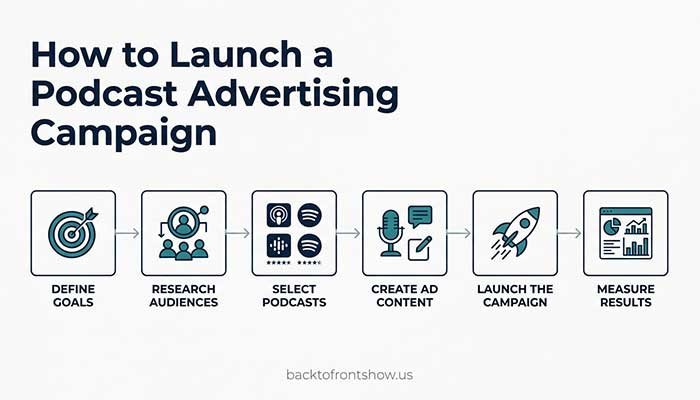
If you’re advertising a business for the first time, start with a focused campaign rather than immediately distributing your budget across dozens of shows.
Step 1: Choose one main campaign objective
Your objective determines how you should plan and evaluate the campaign.
For example:
- Brand awareness: Prioritize relevant reach and exposure.
- Website visits: Use a memorable URL and campaign tracking.
- Lead generation: Send listeners to a clear landing page.
- Product sales: Use an offer, promotional code, or trackable purchase journey.
Avoid expecting a single metric to explain every outcome.
Step 2: Define your target audience
Think about who would benefit most from your product.
Identify their interests, problems, typical purchase considerations, and geographic location.
For a US-focused campaign, determine whether you’re targeting customers nationwide or in specific states or cities.
A regional service business, for instance, may not benefit from paying for a large audience outside its service area.
Step 3: Set a test budget
Use CPM estimates, available inventory, and any production or platform fees to build a budget.
Suppose you have a hypothetical budget of $1,000.
You might allocate $750 to media placements and $250 to production and testing-related costs.
That breakdown is an example, not a recommended industry standard.
The right allocation depends on whether you’re producing your own ads, using a marketplace, or negotiating directly with hosts.
Step 4: Choose a buying method
You can purchase podcast advertising directly from creators, through podcast advertising agencies or networks, or through self-service and programmatic advertising platforms.
For example, Spotify offers podcast advertising options through Spotify Ads Manager, direct arrangements, and Spotify Ad Exchange, with available formats and buying methods depending on the campaign. Custom sponsorship inquiries may require a Spotify representative.
Direct sponsorships often allow closer creative collaboration.
Advertising platforms can simplify campaign distribution, targeting, and reporting.
Step 5: Create a relevant advertising message
A useful podcast advertisement answers three questions quickly:
What problem does the product solve? Why should this audience care? What should listeners do next?
Consider this hypothetical sponsor message for a project-management tool:
“This episode is sponsored by TaskFlow, a project-management tool designed to help small teams stay organized. If you’re juggling deadlines, client requests, and shared projects, TaskFlow gives you one place to manage the work. Visit taskflow.example/podcast to explore the features and see whether it’s right for your team.”
The example focuses on a relevant problem, explains the product’s purpose, and provides one next step.
The brand and URL are fictional.
For host-read advertisements, allow the host to use their natural voice while maintaining accurate claims and required disclosures.
Step 6: Agree on campaign terms
Before paying for an ad, confirm the details in writing.
These typically include the number and placement of ads, expected impressions, campaign duration, creative approval, payment terms, reporting, cancellation policies, and any make-good arrangements if delivery falls short.
Also define whether the host can edit the ad, whether it will remain permanently in an episode, and whether competitors can advertise during the same campaign.
Step 7: Launch and track results
Once the campaign starts, review delivery reports and business results.
If your campaign uses a unique landing page, UTM-tagged URL, or promotional code, confirm that the tracking works before publication.
Remember that podcast listeners may hear an advertisement while driving, exercising, or doing something else.
Some might respond later through a search engine or another device.
That makes podcast attribution less straightforward than simply counting immediate clicks.
Step 8: Review and improve
After collecting enough data, compare results against the campaign’s original goal.
You might discover that one show’s audience responds better than another’s, or that a shorter message produces stronger results.
Avoid changing every element simultaneously.
Testing one meaningful variable at a time can help you understand which improvements are actually useful.
How to Measure Podcast Advertising Performance
Podcast advertising measurement involves more than counting how many episodes were downloaded.
A campaign can deliver thousands of impressions without generating many sales. Another campaign might reach a smaller audience but produce valuable customers.
The right metrics depend on what you’re trying to achieve.
Important podcast advertising metrics
| Metric | What it measures | Why it matters |
|---|---|---|
| Ad impressions | Qualifying ad deliveries under the reporting methodology | Helps assess campaign delivery |
| CPM | Cost per 1,000 impressions | Helps compare media costs |
| Reach | Estimated number of distinct people or devices exposed, depending on methodology | Helps evaluate audience scale |
| Website visits | Visits attributed to the campaign | Shows traffic response |
| Conversion rate | Percentage of a defined audience group completing an action | Helps evaluate campaign effectiveness |
| CPA | Cost per acquisition | Shows the cost of acquiring a customer or other conversion |
| ROAS | Attributed revenue divided by advertising spend | Helps evaluate revenue efficiency |
| Brand lift | Changes in awareness, recall, or perception measured through research | Helps evaluate brand-building results |
It’s important to confirm how your advertising provider defines each metric.
For example, one provider’s reported impression count shouldn’t automatically be treated as equivalent to another platform’s confirmed ad plays.
How to calculate customer acquisition cost
Suppose a hypothetical podcast advertising campaign costs $600 and generates 20 attributed new customers.
\[ \text{CPA}=\frac{\text{Advertising Cost}}{\text{Acquisitions}} \]
\[ \$600\div20=\$30 \]
The campaign’s advertising-only customer acquisition cost is $30.
Whether that’s profitable depends on the business’s margins, customer value, and additional costs.
A company earning $15 in contribution margin from each new customer would evaluate that result differently from a subscription business expecting considerably more value over time.
How to calculate return on ad spend
ROAS compares attributed revenue with advertising expenditure.
\[ \text{ROAS}=\frac{\text{Attributed Revenue}}{\text{Ad Spend}} \]
If an advertiser spends $1,000 and attributes $3,000 in revenue to the campaign:
\[ \$3,000\div\$1,000=3 \]
The campaign generates a 3:1 ROAS, or $3 in attributed revenue for each $1 spent on advertising.
A 3:1 ROAS isn’t automatically profitable. Revenue doesn’t account for product costs, salaries, fulfillment, refunds, or other business expenses.
Podcast advertising attribution methods
Advertisers commonly use several ways to evaluate listener response.
Promotional codes: Give each podcast a unique discount code. This makes it easier to identify code-based purchases, although some buyers may forget to use the code.
Dedicated landing pages: Create a specific landing page for each campaign, with a memorable URL that listeners can type.
UTM tracking: Use campaign parameters on links in show notes or other clickable placements to identify tracked website visits.
Post-purchase surveys: Ask customers how they first heard about the business, with podcast advertising among the available answers.
Attribution providers: Some advertisers use specialized measurement vendors to model responses and conversions associated with podcast ad exposure.
Each method has limitations. None should automatically be treated as a complete record of every person influenced by an advertisement.
For example, a listener might hear an advertisement on Monday, search for the brand on Thursday, and purchase on Friday.
A last-click analytics report might credit organic search rather than the podcast.
A more useful approach is to compare multiple signals rather than relying entirely on one tracking method.
Podcast Advertising vs. Other Advertising Channels
Podcast advertising isn’t necessarily better than search, social media, or video advertising.
Each channel has different strengths.
| Channel | Common strength | Common limitation |
|---|---|---|
| Podcast advertising | Topic relevance and host-led storytelling | Direct-response attribution can be difficult |
| Search advertising | Reaching people expressing purchase intent | Competitive keywords can be expensive |
| Social media advertising | Targeting and rapid creative testing | Users may quickly scroll past messages |
| Video advertising | Visual product demonstrations | Production may require more resources |
| Email advertising | Communicating with an existing subscriber audience | Requires access to a suitable list |
The best choice depends on your goal.
If you’re selling a product that benefits from a detailed explanation, podcast advertising might be worth testing.
If you’re trying to capture customers already searching for an immediate solution, search advertising may be more appropriate.
For businesses with sufficient resources, these channels can also support one another.
Someone might first hear about a company on a podcast and later search for it online.
Read More: How to Monetize a Podcast: 10 Ways to Make Money
How Podcasters Can Get Advertising Sponsors
Podcast advertising isn’t only useful for large shows.
Smaller creators can pursue sponsorships when they have a clearly defined audience and a convincing reason for advertisers to reach that audience.
However, a podcast doesn’t automatically qualify for paid sponsorships simply because it publishes episodes regularly.
Advertisers generally want evidence of audience relevance, consistent performance, and professional communication.
1. Understand your podcast audience
Start with the information available through your hosting platform and podcast analytics.
Look at recent download trends, audience location, popular episodes, and other reliable audience insights.
A podcast with a specific audience can be easier to position than one with a broad, unclear focus.
For example, a podcast helping independent US restaurant owners might interest restaurant software providers, equipment businesses, or industry service companies.
These are potential sponsor categories, not guaranteed opportunities.
2. Create a podcast media kit
A media kit helps potential sponsors evaluate whether your podcast fits their campaign.
Keep it clear and factual.
A useful media kit includes:
- Podcast name, description, and main topics.
- Host information and relevant background.
- Publishing frequency and episode format.
- Recent average or typical downloads using a clearly defined measurement period.
- Verified audience information, including geographic reach where available.
- Available advertising formats and placements.
- Proposed rates or a request for a custom quote.
- Contact information and sponsorship process.
Avoid using lifetime downloads as though they represent the audience for a single episode.
If your podcast has 100,000 lifetime downloads but recent episodes average 2,000 downloads in their first 30 days, those figures tell very different stories.
3. Identify relevant advertisers
Look for businesses whose products genuinely match the problems your audience wants to solve.
For example, an educational podcast about starting a business might consider sponsorships from accounting tools, invoicing services, or business software companies.
Before contacting a brand, review what it sells and whether its claims and reputation align with your show’s standards.
Don’t promote something simply because a company is willing to pay.
4. Contact potential sponsors
A good sponsorship pitch is specific.
Rather than sending a generic message to hundreds of brands, explain why your audience could be relevant to the company and what you can offer.
Here’s a simple example:
Subject: Podcast sponsorship opportunity
Hi,
I’m reaching out about a potential sponsorship opportunity for my podcast, which focuses on practical advice for small-business owners.
I think your product could be relevant to our audience because it addresses challenges frequently discussed in this space.
I’d be happy to share our media kit, recent audience data, and available sponsorship formats if you’re exploring podcast advertising.
Thanks for your consideration.
Personalize the message with verified podcast data and specific reasons the brand is a good fit.
Avoid claiming that you can guarantee sales or that your audience will respond positively.
5. Set realistic sponsorship rates
Start by understanding the CPM model and evaluating your recent episode performance.
Suppose a hypothetical podcast receives 3,000 qualifying downloads within an agreed reporting window.
At a $25 CPM, one ad placement would have an estimated value of:
\[ (3,000\div1,000)\times\$25=\$75 \]
That’s a calculation, not a required selling price.
A sponsor might negotiate a different rate because of audience relevance, production requirements, host involvement, or the number of placements.
For smaller podcasts, flat-rate packages can sometimes be easier to discuss than CPM billing.
The key is to explain what the advertiser is purchasing and what delivery can reasonably be expected.
6. Deliver a professional sponsorship experience
Once you secure a sponsor, follow the agreement carefully.
Record and publish the approved message, include clear disclosures, respect deadlines, and provide the agreed reporting.
If your campaign underdelivers, communicate early and discuss the remedies specified in the agreement.
A professional process helps build the foundation for future sponsorship relationships.
Should small podcasts use advertising networks?
Advertising networks and marketplaces can be convenient, but eligibility, fill rates, minimum audiences, and revenue-sharing terms vary.
Some publishers may find direct sponsorship outreach more practical when they have a small but clearly defined audience.
Others may prefer automated monetization because they don’t want to manage individual advertiser relationships.
Before joining any program, review its eligibility requirements, revenue terms, payment thresholds, content policies, and available advertising inventory.
Podcast Advertising Rules and Sponsorship Disclosures
US podcast advertising must follow applicable truth-in-advertising requirements.
The Federal Trade Commission (FTC) addresses advertising endorsements and material connections between endorsers and brands.
Its guidance applies to podcasts as well as other advertising media.
Clearly disclose paid sponsorships
If a podcast host receives payment, free products, or another benefit that could influence how listeners evaluate an endorsement, the relationship may need to be disclosed.
A simple statement can help make the relationship clear:
“This episode is sponsored by [Brand].”
Or:
“This segment is a paid advertisement for [Brand].”
Disclosures should be clear and easy for listeners to notice.
For audio endorsements, making the relationship clear within the audio itself is especially important. Relying only on show notes may not adequately inform listeners.
The FTC also warns against vague language that leaves consumers uncertain about a commercial relationship.
Don’t make unsupported product claims
Hosts and advertisers should avoid claims they cannot substantiate.
For example, a podcast advertisement shouldn’t promise that a supplement cures a medical condition without the appropriate evidence and legal basis.
Likewise, hosts shouldn’t claim to have personally used and loved a product if they haven’t.
The FTC’s endorsement guidance emphasizes that recommendations must reflect genuine experiences and must not be misleading.
Check category-specific requirements
Some industries face additional advertising restrictions.
These can include financial services, healthcare, gambling, alcohol, and other regulated products or services.
Platforms and advertising networks may also have their own restrictions.
If you’re running campaigns in a regulated category, review the applicable rules before creating or distributing an advertisement.
Common Podcast Advertising Mistakes to Avoid
Many unsuccessful advertising campaigns have avoidable weaknesses.
Choosing podcasts based only on audience size
A large audience isn’t necessarily a relevant audience.
Compare show topics, listener characteristics, and buying context rather than selecting the biggest available show.
Treating downloads as confirmed ad listens
An episode download doesn’t prove that someone heard the advertisement.
Request clear definitions of the campaign’s delivery and impression metrics.
Including too many calls to action
A short podcast advertisement shouldn’t overwhelm listeners with multiple websites, social accounts, promotional codes, and instructions.
Focus on one primary action.
Using an advertisement that doesn’t fit the show
A highly polished commercial may still perform poorly if it feels disconnected from the surrounding content.
Adjust the messaging to match the audience’s interests and the podcast’s tone.
Ignoring tracking until after launch
Setting up tracking after the advertisement runs can make results harder to evaluate.
Prepare landing pages, promotional codes, and reporting procedures in advance.
Assuming every campaign will generate immediate sales
Some listeners need time to understand and evaluate a new brand.
Direct-response performance matters, but it isn’t the only possible outcome of advertising.
Overloading episodes with sponsorships
For podcasters, too many ad breaks can disrupt the content and frustrate listeners.
Advertising should support the show’s sustainability without making the listening experience unnecessarily difficult.
Best Practices for Better Podcast Advertising Results
After more than two years working with podcasting-related topics, my practical approach is to focus on the basics before getting caught up in complicated advertising metrics.
A campaign needs the right audience, a clear message, a sensible price, and a way to evaluate what happened.
I wouldn’t judge an advertising opportunity by CPM alone. A lower rate can be poor value if the audience isn’t relevant, while a higher rate may be reasonable when the listeners closely match the business’s ideal customers.
For a first campaign, I’d recommend five priorities:
- Start with audience fit. Identify podcasts that naturally attract people who might need the product.
- Keep the message simple. Explain one main benefit and provide one clear next step.
- Make the promotion credible. Choose appropriate hosts, avoid exaggerated claims, and disclose sponsorships clearly.
- Measure more than delivery. Compare campaign impressions with website activity, conversions, and broader business outcomes.
- Improve through testing. Use campaign evidence to refine the message, targeting, and advertising placements.
The same general advice applies to podcasters selling sponsorships.
Know your audience, explain your value clearly, set transparent terms, and protect the trust you’ve built with listeners.
A successful sponsorship should benefit the advertiser without compromising the listener’s experience.
FAQs:
Final Thoughts
Podcast advertising offers businesses a way to reach audiences through content they deliberately choose to consume. For creators, it provides an opportunity to turn podcast reach and audience relevance into sponsorship revenue.
However, effective podcast advertising takes more than purchasing an ad placement.
Advertisers need to understand CPM pricing, choose appropriate formats, select relevant shows, and measure meaningful results. Podcasters need accurate audience data, clear sponsorship agreements, and a commitment to maintaining listener trust.
For beginners, the best starting point is simple: choose a relevant audience, create a useful advertising message, track the results, and learn from each campaign.
A thoughtful, well-measured campaign is more valuable than a large campaign built on assumptions.