You can monetize a podcast through sponsorships, advertising, affiliate marketing, paid memberships, listener donations, digital products, and services. And you don’t necessarily need thousands of listeners to start making money.
How to Monetize a Podcast method depends on your audience size, podcast topic, and what your listeners find valuable.
For example, a podcast with 300 highly engaged listeners might earn money by promoting a relevant software product or selling a specialized digital guide. Meanwhile, a show with 20,000 downloads per episode may be better positioned to earn consistent revenue through advertising.
The key is understanding that podcast monetization isn’t just about getting paid for downloads. It’s about creating value that listeners, advertisers, or customers are willing to pay for.
In this guide, you’ll learn 10 practical ways to make money podcasting, how podcast advertising rates work, how much you could realistically earn, and how to choose the right strategy even if your show is still small.
10 Ways to Monetize a Podcast
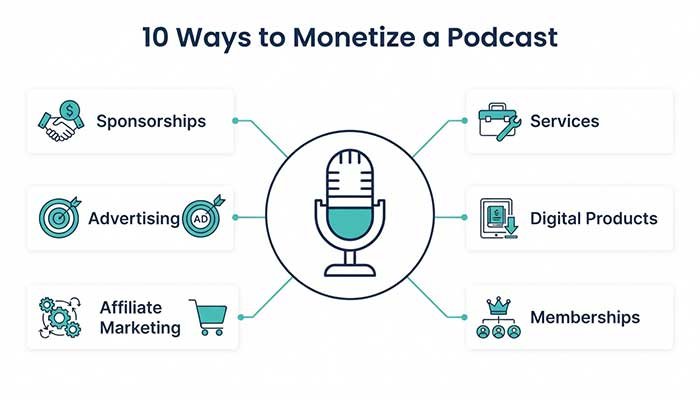
There are several ways to generate podcast income, but each works differently. Some depend heavily on downloads, while others depend more on audience trust or specialized knowledge.
Here’s a quick comparison.
| Monetization method | Best for | Main consideration |
|---|---|---|
| Podcast sponsorships | Shows with a defined audience | Requires attracting relevant brands |
| Podcast advertising | Shows with consistent downloads | Revenue depends on monetized impressions |
| Affiliate marketing | Small and niche podcasts | Requires relevant products and conversions |
| Paid memberships | Loyal, engaged communities | Requires ongoing member value |
| Listener donations | Independent, community-supported shows | Contributions can be unpredictable |
| Digital products | Educational and specialized podcasts | Requires creating something useful |
| Coaching and consulting | Hosts with relevant expertise | Income depends on time and client demand |
| Merchandise | Shows with a recognizable identity | Production and fulfillment costs |
| Online courses and workshops | Educational podcasts | Requires proven knowledge and teaching ability |
| Events and live experiences | Podcasts with active communities | Requires planning and financial risk management |
For beginners, I’d recommend starting with one or two methods rather than trying to launch all 10 at once.
1. Get Podcast Sponsorships
Podcast sponsorships are one of the most familiar ways to make money podcasting.
A sponsorship happens when a company pays you to promote its product or service during your podcast.
For example, a business podcast might partner with an accounting software company. A fitness podcast might work with a workout equipment brand.
The sponsorship could involve a short advertisement, a dedicated segment, or an entire episode built around a clearly disclosed commercial partnership.
How podcast sponsorships work
A typical sponsorship arrangement includes:
- The advertiser agrees to a fee or performance-based payment.
- You explain the product or service to your audience.
- The advertisement runs in agreed-upon episodes.
- You provide reporting, such as eligible download or impression figures, when required.
- The advertiser evaluates results using measures such as promo codes, website visits, or sales.
Some podcast sponsorships use a fixed fee, while others use CPM pricing.
CPM means cost per mille, or the price paid per 1,000 advertising impressions.
For example, imagine your podcast receives 5,000 eligible ad impressions and a sponsor agrees to a $25 CPM.
Your estimated sponsorship revenue would be:
5,000 ÷ 1,000 × $25 = $125
This is a hypothetical example. Actual revenue depends on the sponsorship agreement, eligible ad impressions, and any applicable commissions or fees.
How to find podcast sponsors
Start by identifying businesses your listeners would genuinely find useful.
For instance, if you host a podcast about freelancing, potential sponsors might include invoicing tools, website builders, business insurance providers, and project management software companies.
Create a simple media kit containing your podcast description, target audience, recent episode download figures, release schedule, and sponsorship options.
Then contact suitable brands with a concise, personalized pitch.
Don’t approach every business with the same generic message. Explain why your specific audience could be valuable to that advertiser.
My recommendation: Focus on relevance before sponsorship size. A product that solves a real listener problem is easier to promote credibly than a random product offering a larger payment.
Read More: How to Find Sponsors for a Podcast
2. Earn Money Through Podcast Advertising
Podcast advertising allows you to earn revenue when advertisements are delivered within your episodes.
Unlike direct sponsorships, where you negotiate with an advertiser, some podcast advertising platforms help connect available ad inventory with advertising campaigns.
Two common approaches are baked-in advertising and dynamic ad insertion.
Baked-in ads are included directly in the original episode audio. Unless the audio is edited or replaced, the advertisement remains part of that recording.
Dynamic ad insertion allows advertising technology to place different ads into designated spots when episodes are downloaded or played.
Dynamic insertion can be useful because older podcast episodes may continue attracting listeners long after publication.
Podcast advertisements generally appear in three positions:
- Pre-roll: Near the beginning of an episode.
- Mid-roll: During the episode.
- Post-roll: Near the end.
Mid-roll placements can command higher prices, but actual performance depends on the show’s format and how listeners respond.
According to
Acast’s 2026 podcast advertising pricing guide, planning benchmarks include approximately $15–$30 CPM for pre-recorded ads and $25–$40 CPM for host-read sponsorships.
These are advertiser-facing benchmarks, not guaranteed creator payouts. Your earnings may be lower after platform revenue shares, unfilled inventory, and other deductions.
Example: How much can podcast ads earn?
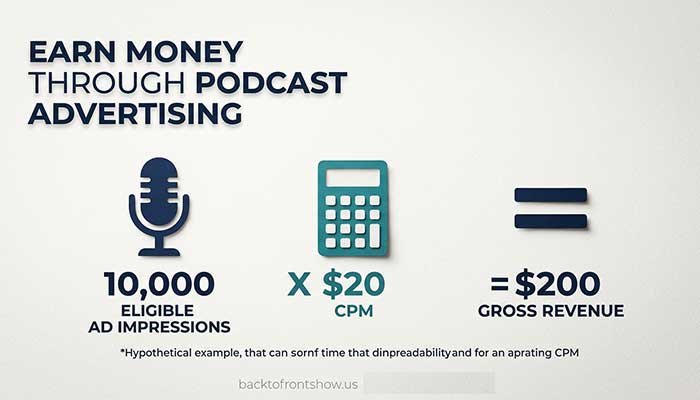
Imagine a weekly podcast generates 10,000 eligible advertising impressions per episode.
At a hypothetical $20 CPM:
10,000 ÷ 1,000 × $20 = $200 per episode.
With four monetized episodes per month, gross advertising revenue could be $800.
However, this assumes that all 10,000 impressions per episode qualify and sell at that rate. Real campaigns may have lower fill rates, geographic restrictions, and other limitations.
An important distinction: 10,000 podcast downloads do not automatically equal 10,000 paid ad impressions.
Some listeners may not receive an ad, and not every ad opportunity will be sold.
For smaller podcasts, advertising revenue alone may not cover production costs. That’s why combining advertising with another monetization method can make sense.
Read More: How to Promote a Podcast on Spotify: 12 Strategies to Grow Your Audience
3. Make Money With Affiliate Marketing
Affiliate marketing is one of the most accessible podcast monetization strategies for a small, topic-focused audience.
Instead of receiving a fixed advertising payment, you earn a commission when a listener makes a qualifying purchase or completes another specified action through your referral.
Suppose you run a podcast about remote work.
You might recommend software for scheduling meetings, managing projects, or recording online interviews.
If a listener purchases that product through your affiliate link, you may receive a commission according to the program’s terms.
How to start affiliate marketing for podcasts
- Identify products directly relevant to your show’s topic.
- Research legitimate affiliate programs offered by those companies.
- Review the commission structure, eligibility rules, and payment requirements.
- Create a memorable referral URL or landing page.
- Explain the product’s benefits and limitations honestly.
- Add the referral link to your episode description.
- Track qualifying referrals and commissions.
For example, imagine a podcast recommends a $100 product that pays a hypothetical 20% commission.
If five listeners make qualifying purchases, the gross commission would be:
5 × $100 × 20% = $100
That example assumes all five purchases qualify and none are refunded.
Affiliate marketing can work with a relatively small audience because the potential revenue depends on purchasing behavior, not just downloads.
Federal Trade Commission’s endorsement guidance explains that creators should clearly disclose material relationships that could influence how people evaluate a recommendation.
If your podcast earns commissions from affiliate links, explain that connection clearly in the audio when appropriate and near the relevant links in show notes.
Some links in this episode’s description are affiliate links. If you purchase through them, I may earn a commission at no additional cost to you.
Don’t recommend a product solely because it offers a high commission. Protecting listener trust is more valuable than an occasional sale.
4. Offer Paid Podcast Memberships
Paid memberships allow listeners to support your podcast through recurring payments in exchange for additional content or benefits.
This model can work particularly well when your podcast has a smaller but dedicated community.
Instead of relying entirely on advertisers, you receive payments directly from subscribers.
Membership benefits might include early episode access, bonus interviews, ad-free listening, extended discussions, or members-only question-and-answer sessions.
Common membership options include Patreon, Apple Podcasts Subscriptions, and eligible Spotify subscription tools.
How much can memberships generate?
Consider a hypothetical podcast with 1,000 regular listeners.
If 30 people subscribe at $5 per month:
30 × $5 = $150 in monthly gross membership revenue.
If 100 people subscribe at that same price, gross monthly revenue becomes $500.
These examples do not predict conversion rates. The actual number of paying members can vary significantly depending on your audience and offer.
You’ll also need to account for platform and payment processing fees.
As of October 2026, Patreon’s standard platform fee for creators who published their pages after August 4, 2025, is 10%, plus applicable payment processing fees and other charges. Legacy creators may have different fee structures.
Apple Podcasts Subscriptions allows creators to offer monthly or annual subscriptions and qualifying premium benefits. Apple says creators generally receive 70% of the subscription price, minus applicable taxes, increasing to 85% after a subscriber accumulates one year of paid service. The Apple Podcasters Program’s listed annual fee in the United States is $19.99.
For example, a $5 monthly membership could include one bonus episode, access to a private community, and early access to regular episodes.
Avoid promising weekly premium content if your production schedule cannot support it.
From my perspective, a membership should deepen the listener’s experience without making the free podcast feel incomplete. Your free show still needs to deliver meaningful value.
5. Accept Listener Donations and Tips
Donations allow listeners to support your podcast without committing to a recurring membership.
This is especially suitable for independent podcasts, passion projects, and shows whose audiences appreciate their work but may not want premium content.
You can use a supported tipping or contribution service and share its link through your podcast website or episode descriptions.
For instance, you might invite listeners to contribute toward hosting expenses, equipment upgrades, or production costs.
Keep the message straightforward.
Explain what the contributions help fund, but avoid making listeners feel obligated to pay.
The biggest advantage is that donations don’t require a separate product or an ongoing stream of bonus episodes.
The main drawback is predictability. Some months might generate meaningful contributions, while others generate very little.
Treat donations as supplementary revenue unless you have evidence that listener support can sustain the podcast.
6. Sell Digital Products
Selling your own digital products gives you more control over pricing and what you offer.
Instead of earning a small commission on someone else’s product, you sell something you’ve created.
Possible digital products include ebooks, templates, worksheets, checklists, downloadable guides, and research resources.
Your product should solve a specific problem that your listeners already care about.
For example, a personal finance podcast could develop a budgeting spreadsheet, while a podcast for job seekers could offer an interview preparation workbook.
Example of digital product income
Imagine a podcast about freelance writing sells a $19 client onboarding template.
If 20 listeners purchase it in a month:
20 × $19 = $380 in gross sales.
That amount is before transaction fees, refunds, applicable taxes, and the costs of creating and marketing the product.
One advantage of digital products is that a well-designed resource can be sold repeatedly without manufacturing or shipping physical inventory.
However, creating the product requires work, and sales are not automatic.
Before building anything, ask your listeners what challenges they face. Their answers can help you identify a product they might actually want.
7. Offer Coaching or Consulting Services
If you have demonstrated expertise in a subject, your podcast can help potential clients understand how you work and whether your services fit their needs.
For example:
A podcast about career development might introduce listeners to resume consulting or interview coaching.
A podcast about small-business operations might lead to workflow consulting inquiries.
A podcast about language learning could help attract tutoring clients.
The podcast itself isn’t necessarily the product. It helps people discover your expertise, while your service generates revenue.
How this works
Start by defining a clear service you can competently provide.
Explain whom you help, what the service includes, and how interested listeners can inquire.
Create a simple service page with pricing information or a clear consultation process.
You don’t need to turn every episode into an advertisement. A brief, relevant mention is usually a better listener experience.
For example:
If you need personalized help creating your first podcast production workflow, you’ll find information about my consulting services in the episode description.
Coaching and consulting can produce meaningful revenue without a large audience, but they are not passive income.
You must deliver the service, manage clients, and maintain the professional skills your offer requires.
8. Sell Podcast Merchandise
Podcast merchandise allows fans to purchase physical products associated with your show.
Common options include T-shirts, mugs, hats, stickers, and tote bags.
Merchandise works best when listeners feel connected to your show’s identity, humor, recurring topics, or community.
A memorable phrase from your podcast may be more appealing than a generic logo printed on a shirt.
You can create a simple merchandise storefront or explore print-on-demand services, which produce items when customers place orders.
Advantages of podcast merchandise
Merchandise can strengthen your podcast’s identity and give loyal listeners a way to show support.
It may also introduce your show to people who encounter the merchandise outside your existing audience.
Limitations to consider
Physical products come with fulfillment, quality-control, shipping, customer service, and return considerations.
Margins can also be relatively small after production and storefront expenses.
For this reason, merchandise often makes more sense after you have an engaged audience than as your first monetization strategy.
Test interest before investing heavily in designs or inventory.
9. Create Online Courses or Paid Workshops
Educational podcasts can use courses and workshops to provide more structured learning experiences.
A podcast episode may explain a topic, while a paid course guides someone through a complete process.
For example, a podcast about photography might explain lighting techniques. A course could take learners through camera setup, practical exercises, editing workflows, and feedback.
Similarly, a podcast about starting a business could offer a workshop on creating a business plan.
There are two primary approaches.
Self-paced courses let students access prerecorded lessons and materials on their own schedule.
Live workshops allow participants to attend scheduled sessions, ask questions, and receive feedback.
Before creating a course, validate demand.
You might first offer a short workshop about one narrowly defined problem. Questions and feedback from participants can help you understand whether a more comprehensive course is worth developing.
A course requires planning, accurate subject knowledge, and learner support.
It isn’t necessarily easy income, especially if your subject changes frequently and lessons require updates.
10. Host Paid Events and Live Experiences
Live events offer a different way to monetize a podcast because they allow listeners to interact with you and one another.
Possible formats include live podcast recordings, ticketed interviews, virtual workshops, panel discussions, and community meetups.
A local history podcast might host a guided discussion with a guest historian.
A business podcast might organize a small networking event.
A comedy podcast could explore a live recording with audience participation.
Tickets can provide revenue, but events also introduce expenses.
Venue fees, equipment, event software, travel, insurance, accessibility, and other costs may affect profitability.
For example, selling 50 tickets at $20 creates $1,000 in gross ticket revenue.
If event expenses total $700, the amount remaining before other costs and taxes is only $300.
Start with smaller events, particularly virtual ones, before committing to an expensive in-person experience.
How Many Downloads Do You Need to Make Money From a Podcast?
There is no universal minimum number of downloads required to monetize a podcast.
The answer depends on how you plan to earn money.
If you’re selling advertising impressions, download volume matters because it affects available inventory.
If you’re selling a digital product or providing consulting services, a much smaller audience might be sufficient.
A podcast reaching 400 specialized professionals could be commercially valuable to a business serving those professionals.
Meanwhile, a general entertainment podcast with several thousand casual listeners might struggle to sell an unrelated product.
Here’s a practical way to think about audience size.
| Downloads per episode | Monetization strategies worth exploring |
|---|---|
| Under 500 | Affiliate marketing, donations, services, small digital products |
| 500–1,999 | Affiliate marketing, memberships, niche sponsorship outreach |
| 2,000–9,999 | Direct sponsorships, advertising opportunities, memberships, products |
| 10,000+ | Larger sponsorship packages, ad networks, memberships, multiple revenue streams |
These are suggested planning ranges, not official industry thresholds or guarantees. Different advertising platforms and campaigns may apply their own minimum requirements.
Also, compare downloads over a consistent period, such as the first 30 days after an episode is published. Lifetime downloads can make an old episode look more commercially attractive than its current audience warrants.
In my view, creators should spend less time chasing a particular download milestone and more time understanding who listens, why they return, and what problems they want to solve.
How Much Money Can You Make Podcasting?
Podcast income varies widely. Some shows earn nothing, some cover their production expenses, and others operate as substantial media businesses.
Your revenue depends on your business model, audience, sales performance, advertising demand, and expenses.
Consider three hypothetical monthly scenarios.
| Revenue source | Small niche podcast | Growing podcast | Established podcast |
|---|---|---|---|
| Advertising and sponsorships | $0 | $300 | $2,000 |
| Affiliate commissions | $60 | $200 | $500 |
| Memberships | $75 | $250 | $1,000 |
| Products or services | $150 | $400 | $1,500 |
| Total gross revenue | $285 | $1,150 | $5,000 |
These figures are illustrations of how revenue streams could combine. They are not industry averages, typical earnings, or forecasts.
The established podcast in this example earns from four different sources. But it also likely has costs associated with production and fulfilling paid offers.
It’s important to distinguish three things:
Revenue is the total amount earned before expenses.
Profit is the amount left after relevant business expenses.
Take-home income is what remains available to the owner after additional obligations, which can include taxes.
A podcast earning $1,000 per month in revenue isn’t necessarily generating $1,000 in personal income.
If your objective is to make money podcasting sustainably, track expenses just as carefully as revenue.
How to Start Monetizing Your Podcast: Step by Step
Knowing the different ways to earn money is useful, but putting them into practice requires a plan.
Here’s a straightforward approach for starting podcast monetization without overwhelming yourself.
Step 1: Understand Your Podcast Audience
Before choosing a monetization method, examine your audience data.
Review your podcast hosting dashboard and look for:
- Average downloads per episode over a consistent time period.
- Geographic distribution of listeners.
- Episodes that consistently perform well.
- Audience trends over the past several months.
- Listening completion or consumption data, when available.
- Topics that generate questions, messages, or other engagement.
These metrics help you understand your audience’s size, interests, and behavior.
However, podcast analytics won’t tell you everything.
You may also need to ask listeners directly what products, resources, or premium content they would find useful.
A short audience survey can be surprisingly informative.
Step 2: Choose One Primary Monetization Method
Don’t start with every available revenue model.
Choose one that matches your current audience and abilities.
For a new podcast with a small audience, affiliate marketing or a relevant service may be practical starting points.
For a podcast with an established community, paid memberships could be a better fit.
For a show with consistent download volume, direct sponsorships or advertising platforms may deserve attention.
Think about what you’re already equipped to deliver.
If you have relevant expertise, a small workshop might be more achievable than building a large membership community.
Step 3: Set Up Your Monetization Tools
Your setup will depend on the method you’ve selected.
For affiliate marketing, you’ll need approved affiliate accounts, referral links, and a reliable way to track results.
For paid memberships, you’ll need a subscription platform, a clear description of member benefits, and a realistic publishing schedule.
For sponsorships, you’ll need audience information, advertising packages, and a way to communicate with potential advertisers.
For direct product sales, you’ll need a purchase and delivery process.
Keep setup costs manageable until you’ve demonstrated demand.
Step 4: Create a Clear Offer
Listeners should understand what you’re offering without having to figure it out themselves.
A vague message such as “Support my podcast” may work for donations, but it’s less effective when you’re selling something specific.
Compare that with:
Get the complete podcast planning workbook, including an episode calendar, guest outreach templates, and a launch checklist, for $15.
The second offer explains the product, its contents, and its price.
A clear offer helps people decide whether it’s relevant to them.
Avoid exaggerated claims or artificial urgency.
Step 5: Promote Your Offer Naturally
Your podcast should remain valuable even when listeners don’t purchase anything.
Introduce paid offers where they make sense.
For example, an episode about organizing podcast interviews could naturally mention a related guest management template.
You can also add relevant purchase or subscription information to episode descriptions and your podcast website.
The goal is to make the offer easy to discover without interrupting the listening experience unnecessarily.
Step 6: Measure Results and Improve
Once you begin monetizing, monitor both earnings and listener response.
Useful metrics include:
| Metric | What it tells you |
|---|---|
| Gross revenue | Total income before costs |
| Net profit | Revenue remaining after relevant expenses |
| Affiliate conversion rate | Percentage of tracked referrals producing a qualifying conversion |
| Membership conversion rate | Percentage of a defined audience becoming paying members |
| Member churn rate | Percentage of members who cancel during a period |
| Sponsorship revenue per episode | Advertising revenue associated with an episode |
| Revenue per 1,000 downloads | A broad measure of monetization efficiency |
| Refund rate | Percentage of purchases refunded |
Be consistent about the periods, populations, and definitions you use.
For instance, revenue per 1,000 downloads is useful for internal performance comparisons, but it should not be confused with an advertiser’s CPM.
Review results regularly. If an offer receives little interest, investigate whether the problem is relevance, pricing, communication, or audience demand before investing more money.
Best Podcast Monetization Platforms to Consider
Several platforms offer tools for generating podcast income, although their features, eligibility requirements, and fees vary.
Best for eligible creators who want access to podcast advertising and subscription options through Spotify.
Spotify’s Partner Program currently requires at least three published episodes, 1,000 Spotify audience members in the past 30 days, and 2,000 Spotify hours consumed over that period. Additional market and hosting requirements apply.
Limitations: Not every creator or country qualifies, and advertising revenue isn’t guaranteed.
Patreon
Best for podcasters who want recurring supporter income, exclusive content, and community features.
New creators on the standard plan pay a 10% platform fee, with additional applicable fees.
Limitations: Membership benefits require ongoing work, and transaction costs reduce take-home revenue.
Best for creators whose audiences already listen through Apple Podcasts and want paid premium audio.
Creators can offer subscription benefits such as bonus episodes and ad-free listening.
Limitations: Requires joining the Apple Podcasters Program, and Apple retains a portion of subscription revenue.
Best for podcasters evaluating hosting with advertising and sponsorship monetization options.
Acast offers multiple hosting tiers and advertising solutions, including options for connecting podcasts with advertisers.
Limitations: Features depend on the plan, and monetization opportunities depend on factors such as audience and advertiser demand.
Before committing to any platform, confirm that it supports your location, preferred payment method, podcast hosting setup, and monetization goals.
Common Podcast Monetization Mistakes to Avoid
Monetization becomes more difficult when creators focus on immediate earnings without considering the listener experience.
Here are several mistakes worth avoiding.
Choosing Sponsors That Don’t Match Your Audience
A poorly matched advertisement can feel distracting and undermine credibility.
If your show focuses on beginner photography, a relevant camera accessory might make sense. An unrelated high-risk investment promotion probably doesn’t.
Evaluate potential sponsors for product relevance, reputation, and the accuracy of their advertising claims.
Promoting Too Many Products
Including several unrelated affiliate promotions in every episode can make a podcast sound more like a sales channel than a useful show.
Prioritize a small number of products you can discuss knowledgeably.
Give listeners meaningful reasons to consider them, including limitations.
Overestimating Advertising Revenue
Podcast advertising revenue is affected by more than download counts.
Campaign targeting, eligible impressions, ad fill, pricing, platform fees, and advertiser demand can all influence payments.
Avoid creating a production budget based on the assumption that every download will generate advertising income.
Ignoring Disclosure Requirements
Paid endorsements and affiliate relationships need appropriate transparency.
The FTC’s guidance requires disclosure of material relationships when their existence isn’t otherwise clear to consumers. The specific disclosure needed depends on the context.
An obviously commercial podcast ad may be recognizable as advertising, while an affiliate recommendation that sounds independent may require clearer disclosure.
Review the official guidance rather than assuming that placing a general disclaimer at the bottom of your website is sufficient.
Launching Paid Memberships Without a Content Plan
A paid membership creates expectations.
If you promise four bonus episodes every month but struggle to produce your regular show, subscriber satisfaction may suffer.
Begin with benefits you can deliver consistently.
Failing to Track Expenses
Podcast hosting, editing, equipment, software, payment processing, and marketing can reduce profitability.
Track your income and costs separately.
If you’re earning podcast income in the United States, understand your applicable tax obligations and maintain suitable financial records.
Neglecting Audience Growth
Monetization works best when it supports a podcast people genuinely want to hear.
If most of your time goes toward selling rather than publishing useful content, your audience may lose interest.
Continue improving episode quality, titles, descriptions, audio, and distribution while developing income sources.
A Simple 90-Day Podcast Monetization Plan
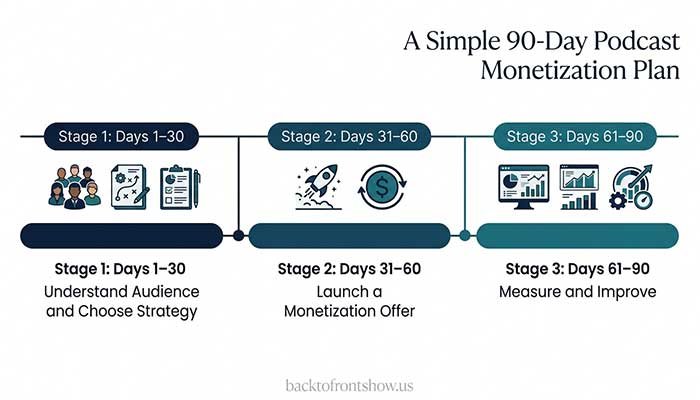
You don’t need to have every detail figured out before starting.
A 90-day test can help you discover whether a monetization model fits your podcast.
DAYS
1–30
Build your foundation
Review audience analytics, identify listener problems, survey your audience, and select one income strategy. Research the tools and costs involved.
DAYS
31–60
Launch your first offer
Publish your affiliate recommendation, launch a small digital product, introduce a membership tier, or begin personalized sponsorship outreach. Keep the offer focused and trackable.
DAYS
61–90
Evaluate and improve
Review revenue, expenses, conversions, listener feedback, and workload. Improve the existing offer before introducing a second revenue stream.
This plan isn’t a promise that you’ll earn money in 90 days.
It’s a practical way to test an income opportunity, collect feedback, and avoid spending months building an offer without knowing whether listeners want it.
Which Podcast Monetization Method Should You Choose?
The best approach depends on what makes your podcast valuable.
If your strength is a narrow, highly relevant audience, consider affiliate marketing or a specialized digital product.
If you’ve built a community of people who return regularly and actively engage with your work, paid memberships may be worth testing.
If you have consistent downloads and advertisers want to reach your audience, direct sponsorships or an advertising program could become a meaningful income source.
If your podcast demonstrates skills that businesses or individuals need, consulting and educational products may be a natural extension.
With more than two years of experience writing and researching podcast-related topics, I think the most practical way to evaluate monetization is to start with the listener’s needs rather than the payout method.
A relevant recommendation, useful resource, or well-designed membership has a stronger reason to exist than an offer created solely because a platform makes it easy to sell.
Start with the simplest method you can deliver well. Measure its results, improve it, and expand only when there’s a clear reason to do so.