How To find podcast sponsors, start by identifying brands that already serve your audience, prepare a simple media kit with credible listener data, and pitch a sponsorship package that clearly explains what the advertiser gets.
You don’t necessarily need a huge podcast to attract sponsors. A smaller show with a clearly defined audience can still be valuable if listeners match the customers a business wants to reach.
The key is to stop thinking only about the size of your podcast and start thinking about the value of your audience.
In this guide, I’ll walk through how to identify potential advertisers, prepare your podcast for sponsorships, build a media kit, write an effective sponsorship pitch, price your offer, and avoid some of the mistakes that make brands ignore podcast proposals.
Podcast advertising is also a meaningful and growing market. According to IAB and PwC, U.S. podcast advertising revenue reached about $2.86 billion in 2025, up 17.6% year over year.
That doesn’t mean every podcast will automatically get advertisers. It does mean brands are actively spending money in the medium, and independent podcasters have several ways to compete for that budget.
1. Make Your Podcast Sponsorship-Ready First
Before you start emailing brands, make sure you can answer a basic question:
Why should a company pay to reach your listeners?
A sponsor isn’t simply buying 30 or 60 seconds of your episode. It’s buying access to a particular audience through a creator those listeners already chose to hear.
You should be able to explain:
- What your podcast is about
- Who listens to it
- How often you publish
- Your average episode performance
- Where most listeners are located
- What topics perform particularly well
- What types of businesses are relevant to your audience
For example, imagine a weekly podcast about home improvement that gets 1,800 downloads per episode.
That number alone doesn’t tell a sponsor much.
But this is more useful:
The podcast reaches homeowners and DIY enthusiasts, most listeners are in the United States, episodes about renovation tools and home projects consistently perform well, and new episodes publish every Thursday.
Now a hardware retailer, power-tool company, home-insurance provider, or renovation app can immediately understand why the audience may matter to them.
Use reliable podcast analytics
Whenever possible, use statistics from your podcast hosting provider rather than estimates you’ve created yourself.
Podcast measurement can differ from ordinary website or social media analytics because podcast delivery often depends on server-side downloads. IAB Tech Lab maintains technical guidelines specifically to standardize measurements such as podcast downloads, audience, and ad delivery. Its latest Podcast Measurement Guidelines, version 2.3, were finalized in September 2026.
For advertisers, that consistency matters.
In my experience, it’s better to show a sponsor a smaller number you can explain confidently than a larger number built from several unrelated metrics.
2. Know Which Sponsors Actually Fit Your Podcast
One of the biggest mistakes podcasters make is pitching almost every company they can find.
A better question is:
Which companies would genuinely want access to my particular audience?
Start with your listeners.
Think about:
- Their likely interests
- Problems they want to solve
- Products they already buy
- Services they may need
- Their professions or industries
- Their hobbies
- Their stage of life
- The topics that bring them to your show
Then build your potential sponsor list around those characteristics.
Example sponsor matches
| Podcast topic | Potential sponsor categories |
|---|---|
| Personal finance | Budgeting apps, banks, tax software, investing tools |
| Fitness | Athletic clothing, fitness apps, equipment, nutrition brands |
| Business | SaaS companies, accounting tools, productivity software |
| Parenting | Family products, educational services, meal services |
| Gaming | Gaming accessories, software, computers, online services |
| Travel | Luggage, travel apps, booking services, travel insurance |
| Home improvement | Tools, hardware stores, home services, smart-home products |
| Technology | Software, cybersecurity, hosting, hardware, online services |
These are categories, not automatic recommendations.
You still need to determine whether an individual advertiser is appropriate for your audience and whether you’re comfortable promoting it.
One thing I’ve found useful is asking:
Would I be comfortable explaining to my listeners why this product belongs on this podcast?
If the answer is difficult, the sponsor probably isn’t a great match.
3. Look at Sponsors on Similar Podcasts
One of the simplest ways to find podcast advertisers is to listen to other shows in your niche.
Pay particular attention to podcasts that are slightly larger than yours but still serve a similar audience.
Write down:
- The sponsor’s name
- The product being promoted
- The type of podcast
- Whether the ad is host-read
- Where the ad appears
- Whether there is a promo code or custom URL
- Whether the company sponsors several similar shows
If a company regularly sponsors podcasts about entrepreneurship, for example, it may already understand podcast advertising and have a budget for that audience.
That makes it a more promising prospect than a company that has never advertised through podcasts at all.
Don’t copy another show’s pitch or simply tell the brand that you deserve the same deal. Use the research to identify businesses that already appear comfortable with the medium.
4. Research Brands That Serve Your Audience
You don’t have to limit yourself to existing podcast advertisers.
Another good approach is to make a list of businesses already marketing to people like your listeners.
Search places such as:
- YouTube
- Industry newsletters
- Trade publications
- Conferences in your niche
- Affiliate programs
- Competitor websites
- Products mentioned naturally by your listeners or guests
Suppose your podcast focuses on independent photography.
Potential sponsor research could include:
- Camera accessory companies
- Editing software
- Cloud storage providers
- Website builders
- Print services
- Photography education platforms
- Business-management software for freelancers
The goal is not to create a list of 1,000 businesses.
A list of 30 highly relevant prospects is usually much more useful than hundreds of random companies.
5. Build a Podcast Media Kit
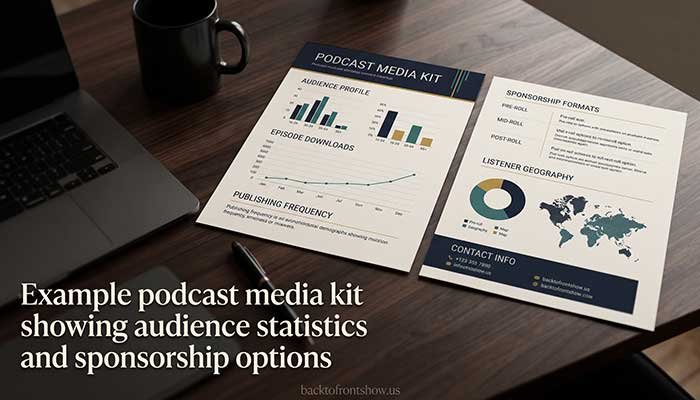
A podcast media kit is a short document that helps an advertiser quickly understand your show.
It doesn’t need to be complicated.
A clean one- or two-page PDF can be enough.
What to put in a podcast media kit
Include:
Podcast overview
Explain what the podcast covers and who it serves.
Audience
Describe your listeners as specifically as your real data allows.
Downloads or audience size
Use a consistent measurement, such as average downloads per episode after a defined number of days.
Geographic information
If the majority of your audience is in the United States, say so if your analytics support that claim.
Publishing schedule
For example: weekly, twice monthly, or daily.
Relevant platform presence
You can include YouTube subscribers, newsletter subscribers, or social followers if they are genuinely relevant to the sponsorship package.
Advertising formats
Explain what you can offer, such as:
- Pre-roll
- Mid-roll
- Post-roll
- Host-read sponsorship
- Sponsored segment
- Video sponsorship
- Newsletter inclusion
- Social media package
Contact information
Make it easy for the advertiser to respond.
Don’t inflate your numbers
Sponsors can ask for screenshots, hosting analytics, campaign reports, or other evidence.
More importantly, trust matters.
If a show has 2,500 real downloads per episode, present 2,500.
Don’t turn that into “10,000 impressions” by combining downloads, followers, views, and subscribers unless you’re clearly explaining what each number represents.
6. Create a Sponsorship Offer Before You Pitch
A sponsor shouldn’t have to figure out what you’re selling.
Create one or two clear packages.
For example:
Starter sponsorship
- One 30- to 60-second host-read ad
- Mid-roll placement
- Sponsor link in episode notes
- Campaign reporting after the episode
Multi-episode sponsorship
- Host-read ad in four episodes
- Link in each episode description
- Brand mention in one newsletter
- Campaign summary after completion
You can adapt packages to your podcast.
The important part is making the offer easy to understand.
From my experience, a simple proposal usually works better than giving a potential sponsor ten different packages with complicated combinations.
7. Decide How You Will Price Podcast Sponsorships
Podcast sponsorships can be priced in several ways.
CPM pricing
CPM means cost per thousand impressions or ad deliveries.
A simplified pricing formula is:
Downloads or ad deliveries ÷ 1,000 × CPM = sponsorship price
For example, imagine a podcast expects 5,000 qualifying downloads for an episode.
If both sides agree to a $25 CPM:
5,000 ÷ 1,000 × $25 = $125
That is only a hypothetical example, not a recommendation for what you should charge.
Actual pricing can vary according to:
- Audience size
- Niche
- Audience demographics
- Ad placement
- Host-read versus pre-recorded creative
- Campaign length
- Purchase intent
- Exclusivity
- Video or social components
- Advertiser demand
- Your negotiating position
Flat-rate sponsorships
You can also charge a fixed amount.
For smaller independent podcasts, this can sometimes be easier because everyone knows the exact cost before the campaign starts.
For example:
Four-episode sponsorship: $600
Instead of calculating the final invoice from individual episode downloads, the sponsor pays for the complete package.
Value-based packages
A niche podcast may also sell a larger package combining several channels.
For example:
- Two podcast ad reads
- One newsletter placement
- One YouTube mention
- One social post
Here, pricing isn’t based solely on podcast downloads.
Don’t copy a random CPM from the internet
Podcast advertising rates aren’t universal.
Even advertising marketplaces allow pricing to depend on the show and campaign. Libsyn Ads, for example, says accepted podcasts work with its team to establish ad spots and CPM/cost information.
I usually recommend starting with a price you can explain and defend rather than worrying about finding a supposedly perfect industry rate.
8. Write a Short Sponsorship Pitch
Brands receive a lot of sales emails.
Don’t send a five-paragraph autobiography.
A good sponsorship pitch can be short.
It should explain:
- Who you are
- What your podcast is about
- Who listens
- Why the company is relevant
- What you’re proposing
- What the next step is
Podcast sponsorship pitch example
Subject: Sponsorship opportunity with [Podcast Name]
Hi [Name],
I’m BK Firuz, host of [Podcast Name], a podcast about [topic] for [audience].
Our episodes typically reach approximately [verified number] downloads within [time period], with a large portion of our audience interested in [relevant interest].
I thought [Brand] could be a strong fit because [specific reason connected to the audience].
I’m currently opening a few sponsorship opportunities that can include host-read podcast placements and [other relevant placement].
I’d be happy to send our media kit and sponsorship options if you’re interested.
Best,
[Name]
[Website]
[Email]
The most important sentence is usually the one explaining why that particular brand makes sense.
A generic email saying “I love your company and think we’d make a great partnership” doesn’t give the advertiser much reason to respond.
9. Find the Right Person at the Company
Sending a sponsorship pitch to a company’s general customer-service inbox is rarely ideal.
Look for people working in areas such as:
- Marketing
- Partnerships
- Influencer marketing
- Creator partnerships
- Media buying
- Advertising
- Brand marketing
- Growth marketing
- Affiliate marketing
- Communications
LinkedIn can be useful for identifying the appropriate person.
For a smaller company, the founder or marketing manager may handle sponsorships directly.
For larger companies, the advertising budget may be managed by an agency rather than the brand itself.
10. Make the Pitch About the Advertiser
A weak sponsorship pitch focuses entirely on the podcast:
“We’ve been publishing for two years.”
“We have amazing guests.”
“We’ve made 100 episodes.”
Those things can be useful context, but the advertiser is primarily interested in what your show can do for them.
A stronger pitch emphasizes the match:
Our listeners are independent accountants and small-business owners, which closely overlaps with the customers your bookkeeping software is designed to serve.
You’re connecting the audience to the advertiser’s business.
That is far more persuasive than simply saying your podcast is great.
11. Offer a Small Test Campaign
Some advertisers may hesitate to commit to a long sponsorship with a podcast they’ve never worked with.
A short test reduces the risk.
For example:
- One episode
- Two episodes
- A 30-day campaign
- A limited promotional code campaign
Then review the results.
If the campaign performs well, you have a stronger reason to discuss a longer partnership.
Don’t promise sales you can’t guarantee.
Instead, define what you’ll actually provide.
12. Give Sponsors a Way to Measure Results
Advertisers care about outcomes.
Depending on the campaign, you might measure:
- Ad downloads or deliveries
- Unique promo-code uses
- Visits to a custom landing page
- Sign-ups
- Purchases
- Leads
- Brand-lift research for larger campaigns
A simple direct-response campaign might use a memorable promo code such as:
BRAND20
or a custom page:
example.com/podcastname
Measurement is especially useful when you want to renew the deal.
Instead of saying, “I think the sponsorship went well,” you can discuss real campaign data.
13. Follow Up Without Becoming Annoying
Brands don’t always respond to the first email.
People are busy. Messages get buried.
A polite follow-up is reasonable.
For example:
Hi [Name], just following up on my sponsorship note from last week. I think [Brand] could be relevant to our audience because [short reason]. Happy to send the media kit if useful.
Keep it short.
If there’s still no response after a reasonable number of attempts, move on.
A common mistake I’ve seen is spending too much time trying to convince one uninterested advertiser instead of continuing to build a wider pipeline.
14. Use Podcast Advertising Marketplaces
You don’t have to find every sponsor manually.
Podcast advertising platforms and networks can connect advertisers with creators.
Availability, requirements, commissions, and eligibility can change, so always check the current terms before joining.
Acast
Acast operates a podcast advertising marketplace with ads, sponsorships, and branded-content opportunities. Its current platform includes creator monetization tools and sponsorship management.
Acast also distinguishes between pre-recorded ads and host-read sponsorships. In its marketplace terms, a sponsorship is a commercial message specifically created for a podcast and delivered by its host or creator.
Libsyn Ads
Libsyn Ads currently operates a podcast advertising marketplace connecting advertisers with participating shows. Its public podcaster page says its main marketplace requires at least 20,000 downloads per episode, so it won’t be suitable for every smaller podcast.
Spotify for Creators
Spotify also offers podcast monetization options.
As of October 2026, Spotify says eligible creators in select markets can participate in the Spotify Partner Program, which can provide ad revenue and, for qualifying video content, Premium video revenue. Spotify’s published eligibility criteria include at least 1,000 Spotify audience members and 2,000 hours consumed during the previous 30 days, plus at least three published episodes. Availability depends on market and eligibility.
Spotify also supports management of creator sponsorship segments in eligible video episodes.
Marketplaces can save time, but I wouldn’t rely on them as your only sponsorship strategy.
Direct outreach gives you more control over which brands you work with and how you build longer-term relationships.
15. Don’t Ignore Local Businesses
You may not need a national company.
If your podcast has a strong audience in one city or region, local businesses can be excellent prospects.
Potential examples include:
- Real estate companies
- Restaurants
- Financial advisors
- Law firms
- Fitness studios
- Medical practices
- Event organizers
- Local retailers
- Home-service companies
- Colleges or training providers
A show with 800 listeners concentrated in one metropolitan area may potentially be more interesting to a local business than a podcast with several thousand listeners spread across the entire country.
Relevance matters.
16. Consider Niche Sponsors Before Huge Brands
New podcasters often start with companies like Nike, Apple, Amazon, or Coca-Cola.
Those companies have enormous advertising operations and receive countless partnership requests.
A smaller business that sells directly to your audience may be a much better target.
Imagine you host a podcast specifically for independent HVAC contractors.
A specialized field-service software company serving HVAC businesses could potentially care much more about 2,000 highly relevant listeners than a general consumer brand would.
This is why niche audience quality can be more important than raw scale.
17. Make Host-Read Sponsorships Sound Natural
Podcast advertising is unusual because the host can become part of the creative.
Acast, for example, describes host-read sponsorships as messages delivered in the creator’s own voice rather than simply inserting the same pre-produced advertisement everywhere.
That creates an opportunity—but also a responsibility.
A sponsor may give you:
- Key talking points
- Required claims
- A URL
- Promo code
- Legal language
- Product benefits
You can often build the read around those requirements while keeping your normal speaking style.
However, don’t claim personal experience you haven’t had.
If you’ve never used the product, don’t tell listeners you use it every day.
The Federal Trade Commission states that endorsements must be truthful and not misleading, and an endorser shouldn’t describe personal experience with a product they haven’t actually had.
18. Clearly Disclose Sponsorships
If you’re being paid or receiving something of value to promote a company, make the commercial relationship clear.
The FTC’s Endorsement Guides apply across media, including podcasts. The FTC says material connections between endorsers and marketers that may affect how consumers evaluate an endorsement should be disclosed.
Simple language is often clearest:
- “This episode is sponsored by…”
- “Thanks to [Brand] for sponsoring today’s episode.”
- “This segment is brought to you by…”
If your podcast is also published as a YouTube video, YouTube has additional branded-content rules. Creators must identify paid promotions in Studio when content contains sponsorships or other qualifying commercial relationships.
Disclosure shouldn’t feel like something you’re trying to hide.
19. Protect Your Audience’s Trust
Not every sponsorship is worth accepting.
Before agreeing to a campaign, consider:
- Does the product fit the audience?
- Is the company legitimate?
- Can I verify important claims?
- Would I be comfortable hearing this recommendation as a listener?
- Are there legal or regulatory issues involved?
- Does the advertiser expect me to say something I don’t believe?
- Does the agreement restrict future sponsors?
- Does the company want control over unrelated editorial content?
Your listeners are the reason sponsorship has value in the first place.
Losing their trust for a short-term payment is usually a bad trade.
In my experience, being selective can actually make a podcast more attractive over time because sponsorships feel more credible when they make sense.
20. Negotiate the Details Before Recording
Don’t rely on a casual email saying, “Sounds good.”
Agree on the important details first.
Your agreement should normally clarify:
- Payment amount
- Payment schedule
- Number of episodes
- Ad length
- Ad placement
- Required talking points
- Promo code
- Landing page
- Publication dates
- Approval process
- Reporting
- Usage rights
- Exclusivity
- Cancellation terms
- Make-good policy
- Whether the advertiser can reuse your recording elsewhere
Usage rights deserve particular attention.
A sponsor paying for a host-read inside your podcast doesn’t automatically mean you should assume they can run your voice in paid social ads indefinitely.
Make those rights explicit.
21. Deliver Professional Campaign Reports
After the sponsorship runs, send a short report.
Include whatever verified information is relevant:
- Episode publication date
- Downloads after an agreed period
- Ad delivery data
- Promo-code usage
- Landing-page results supplied by the advertiser
- Any agreed social or newsletter metrics
You don’t need a 20-page presentation.
A clean summary shows the sponsor that you’re organized and makes renewal easier.
22. Ask Good Sponsors to Renew
Finding a new advertiser takes work.
Keeping a good advertiser is often easier.
When a campaign performs well, don’t wait for the company to contact you months later.
Send a follow-up.
For example:
The four-episode campaign has now finished. The sponsored episodes generated approximately [verified number] downloads during the reporting period. If you’d like to continue, I can reserve another four-episode package for next month.
Keep the relationship practical.
If the advertiser isn’t ready to renew, ask whether they would like you to check back later.
Read More: How to Get More Podcast Listeners: A Practical Growth Guide
Common Mistakes When Looking for Podcast Sponsors
Pitching brands before understanding your audience
Sponsors want to know who they’re reaching.
Know your listener profile first.
Sending generic mass emails
A short personalized email to a well-matched company is usually more useful than hundreds of identical messages.
Making audience numbers look bigger than they are
Use transparent metrics.
Waiting until your podcast is “big enough”
There is no single audience threshold for all sponsorships.
Some marketplaces impose minimum requirements, but direct sponsorships are negotiated individually.
Choosing sponsors only because they pay
Audience trust matters more than one campaign.
Offering too many packages
Keep the decision simple.
Promising guaranteed sales
You can guarantee placements and deliverables.
You usually cannot guarantee customer behavior.
Forgetting to follow up
A good prospect may simply have missed your first message.
Not tracking results
Campaign data makes future sponsorship conversations much easier.
A Simple Podcast Sponsorship Workflow
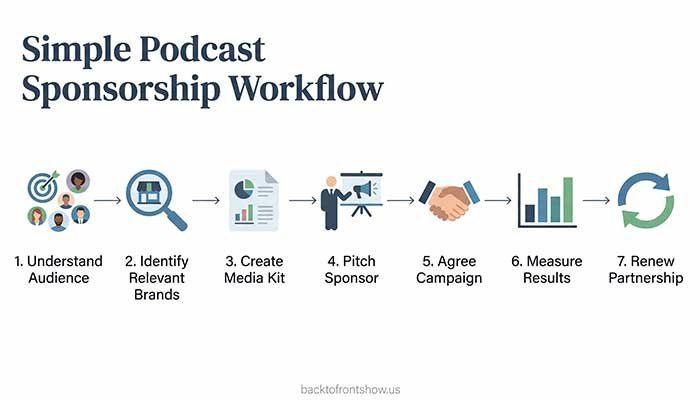
If you’re starting from zero, use this process:
- Review your analytics.
Record your average episode downloads and relevant audience information. - Define your audience.
Write one paragraph explaining who the show serves. - Choose sponsor categories.
Identify products and services your listeners may genuinely need. - Build a prospect list.
Start with 25–50 relevant companies. - Research each company.
See whether it advertises through podcasts, creators, newsletters, or other media. - Prepare your media kit.
- Create one or two sponsorship packages.
- Find the appropriate contact.
- Send personalized pitches.
- Follow up.
- Run a test campaign when appropriate.
- Report the results.
- Ask successful sponsors to renew.
You don’t have to complete all of this in one day.
The important part is treating sponsorship like an ongoing sales process rather than sending three emails and assuming nobody wants to advertise.
Podcast Sponsorship Outreach Checklist
Before contacting a potential sponsor, check that you have:
- A clear description of your audience
- Verified podcast analytics
- Average episode performance
- Geographic data when available
- A simple podcast media kit
- One or two sponsorship packages
- A reason the brand fits your listeners
- The correct marketing or partnership contact
- A short personalized pitch
- A method for measuring results
- Clear sponsorship disclosure
- Basic campaign terms
Read More: How to Promote a Podcast on Spotify: 12 Strategies to Grow Your Audience
How to Attract Sponsors Instead of Always Chasing Them
Direct outreach is useful, but eventually you want advertisers to be able to discover you.
Make sponsorship information easy to find.
You could create a page on your website that briefly includes:
- What your show covers
- Who the audience is
- Available sponsorship formats
- Contact information
- A link to request the media kit
You can also mention that sponsorship opportunities are available in your podcast description or business contact information.
Just don’t let the show feel like one long advertisement.
The content still has to come first.
Final Thoughts
Learning how to find podcast sponsors is mostly about matching the right audience with the right advertiser.
You don’t need to start by convincing the largest brands in America to sponsor your show.
Start with businesses that clearly serve your listeners. Understand your analytics, prepare a professional podcast media kit, make your offer easy to understand, and send personalized sponsorship pitches.
Then treat each campaign professionally: disclose the relationship, deliver what you promised, report the results, and try to turn successful tests into longer partnerships.
What I’ve learned is that sponsorship becomes much easier when you stop asking, “How big is my podcast?” and start asking, “Which advertiser would genuinely value this audience?”
That is the question that should guide your sponsor search.
FAQs:
Sources
- IAB / PwC — Internet Advertising Revenue Report, Full Year 2025: U.S. podcast advertising revenue and market growth data.
- IAB Tech Lab — Podcast Measurement Technical Guidelines: Current standards for podcast downloads, audience, and advertising measurement.
- Federal Trade Commission — Advertisement Endorsements: U.S. guidance covering disclosure, truthful endorsements, and material connections.
- Spotify for Creators — Monetization: Current Spotify Partner Program requirements and podcast monetization options.
- Acast — Podcast Monetization and Marketplace: Information about creator advertising, sponsorships, and marketplace formats.
- Libsyn Ads — Monetize Your Podcast: Current marketplace eligibility and sponsorship information.
- YouTube Help — Branded Content Policies: Disclosure requirements for podcasts or video content containing paid promotions on YouTube.