The best way to grow a podcast on YouTube is to treat YouTube as a discovery platform, not simply another place to upload your audio.
Publish complete episodes, but build your YouTube strategy around what makes people find, click, watch, and return: strong episode topics, clear titles, compelling thumbnails, engaging openings, searchable descriptions, podcast clips, Shorts, and consistent analysis of your YouTube data.
That distinction matters because YouTube has become a major podcast destination. In February 2025, YouTube announced that podcast content had more than 1 billion monthly active viewers. The company reiterated that figure in May 2026.
For podcasters, that creates an opportunity beyond your existing subscribers. Someone who has never heard of your show can discover an interview through Search, a Short, the Home page, Suggested Videos, or another recommendation and eventually become a regular listener.
In my experience working with podcast-related content for more than two years, one of the biggest mistakes is thinking that uploading the same episode every week is a complete YouTube strategy. Uploading is the starting point. Growth comes from how well each episode is packaged, distributed, and improved over time.
Here is how to build that system.
1. Set Up Your Podcast Correctly on YouTube
Start by making sure YouTube understands which content represents your actual podcast.
On YouTube, a podcast is essentially a playlist containing the show’s full episodes. You can create a new podcast in YouTube Studio or add podcast features to an existing playlist. YouTube recommends using that podcast playlist only for complete episodes—not clips, unrelated videos, or separate collections of highlights.
A clean structure might look like this:
| Content | Where it belongs |
|---|---|
| Full podcast episodes | Main podcast playlist |
| Short highlight videos | Separate clips playlist |
| YouTube Shorts | Shorts section |
| Behind-the-scenes videos | Separate playlist |
| Tutorials or related content | Topic-specific playlists |
YouTube also recommends using your actual show name as the podcast title rather than adding unnecessary words around it. A detailed podcast description can further help potential listeners understand and discover the show.
If You Have an Audio-Only Podcast
You don’t necessarily need to start filming immediately.
Eligible creators can connect a podcast RSS feed to YouTube. YouTube can turn each selected audio episode into a static-image video using the podcast’s show artwork. New episodes added to the RSS feed can then be uploaded automatically. Availability of RSS ingestion depends on country or region.
A static-image version gives you a presence on YouTube, but if YouTube growth is a serious goal, I would usually consider video when your budget and workflow allow it. Video gives you more visual material for clips, Shorts, thumbnails, and moments that can capture attention.
2. Choose Episode Topics People Actually Want to Watch
YouTube growth often begins before you record anything.
A well-produced episode about a topic few people care about may struggle. An episode built around a strong question, problem, story, guest, or timely discussion has a much better chance of attracting someone who doesn’t already know your podcast.
Instead of thinking only:
“What should we talk about this week?”
also ask:
“Why would someone who has never seen this show click this episode?”
Imagine a personal finance podcast.
A generic episode might be titled:
Money Talk With Sarah — Episode 37
A discovery-focused topic could instead be built around:
Why Your Grocery Bill Keeps Rising—and 7 Ways to Cut It
The second version immediately communicates a problem and a reason to watch.
You don’t need to turn every podcast into clickbait. The goal is to make the value of the conversation obvious.
YouTube Analytics also includes a Trends area designed to help creators see what audiences are searching for and identify possible content gaps.
Use that information alongside:
- questions your listeners repeatedly ask;
- comments on previous episodes;
- Google and YouTube autocomplete ideas;
- recurring problems in your niche;
- popular discussions in your industry;
- topics already performing well on your channel.
3. Create Titles for YouTube, Not Just Podcast Apps
Podcast episode titles frequently need different treatment on YouTube.
A title such as:
Episode 84: John Smith
may work for people already following your RSS feed. It gives a new YouTube viewer almost no reason to click.
A stronger title might be:
How John Smith Built a $1M Business Without Outside Funding
The exact title depends on what the episode genuinely contains, but the principle is simple:
Lead with the viewer’s reason to care.
YouTube says Search considers how well the video’s title, description, and actual video content match the viewer’s query, along with engagement for that search.
YouTube also recommends making titles accurate and relatively concise, with important words toward the beginning because viewers may not see the entire title on every device.
Searchable vs. Curiosity-Driven Titles
Both approaches can work.
A searchable title directly answers a known query:
How to Start a Podcast With No Audience
A curiosity-focused title creates an information gap:
We Were Making This Podcast Mistake for 2 Years
The right approach depends on the episode.
For educational podcast episodes, I usually lean toward clear, searchable titles when the topic matches something people actively look for. Interviews, stories, entertainment, and commentary may benefit more from curiosity.
Accuracy should come first either way.
4. Treat Your Thumbnail as Part of the Episode
Your thumbnail and title work together.
Before clicking, a potential viewer often knows almost nothing about your episode except those two elements.
YouTube says 90% of its best-performing videos have custom thumbnails. It recommends thumbnails that are clear rather than overly complicated and titles that accurately reflect the video.
For a video podcast, an effective thumbnail could include:
- a clear image of the guest or host;
- an expressive but natural facial expression;
- a simple visual related to the topic;
- a few readable words when text adds context;
- consistent design elements that make your show recognizable.
Avoid trying to summarize the entire episode inside the thumbnail.
For example, if the title is:
Why Most New Businesses Fail in Their First Years
the thumbnail doesn’t need to repeat that entire sentence.
Something simple such as:
THE REAL PROBLEM
may complement the title better.
Most importantly, don’t promise something the episode doesn’t deliver. A misleading thumbnail may produce a click, but disappointing the viewer can hurt retention.
5. Win the First 30 Seconds
A podcast intro that works for loyal audio subscribers isn’t always ideal for a new YouTube viewer.
Long theme music, sponsor messages, introductions, housekeeping, and five minutes of small talk can cause new viewers to leave before the interesting conversation begins.
YouTube’s audience-retention report specifically tracks how many viewers are still watching after the first 30 seconds. YouTube recommends checking whether the opening fulfills the expectation created by the title and thumbnail and experimenting with the intro when viewers leave early.
Try opening with one of these:
- the strongest statement from the conversation;
- an intriguing question;
- a preview of what the viewer will learn;
- a brief cold open;
- a compelling exchange from later in the interview.
For example:
“Most people think you need thousands of podcast downloads before sponsors will talk to you. That’s not always true. In this episode, we’re breaking down what sponsors actually look for.”
Then move into the show.
I’ve found that getting to the point quickly is usually more useful than trying to make every podcast opening sound highly produced. A clear promise followed by useful content can be enough.
6. Use Podcast Clips to Create More Discovery Opportunities
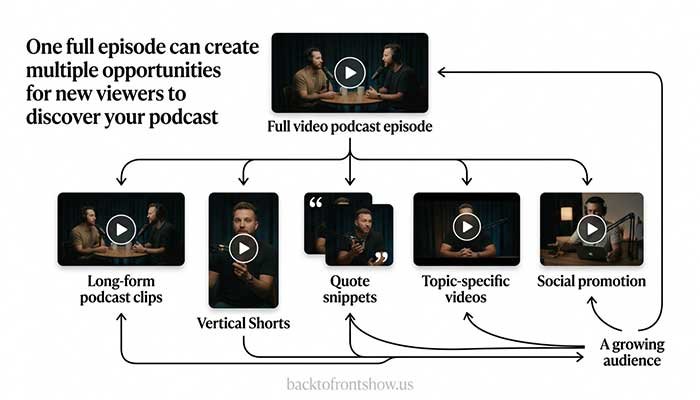
One full episode gives you one major piece of content.
It may also contain five, ten, or twenty individual ideas that could stand on their own.
That’s why podcast clips can be so valuable.
A 60-minute interview might generate:
- a 6-minute discussion about a specific problem;
- a 3-minute surprising story;
- a 90-second explanation;
- several vertical Shorts;
- a quote or insight for social promotion.
Each piece can attract a different type of viewer.
Instead of naming a clip:
Best Moments From Episode 51
make it useful as an independent video:
Why Most Podcast Ads Don’t Convert
Someone searching for that topic doesn’t need to know what Episode 51 is.
The clip should make sense even if the viewer has never encountered your podcast before.
Don’t Put Clips in the Main Podcast Playlist
Keep your official podcast playlist focused on complete episodes. YouTube specifically recommends against mixing clips with the full podcast.
Create a separate playlist for clips instead.
That keeps the podcast experience cleaner while allowing clips to act as discovery content.
7. Turn Strong Moments Into YouTube Shorts
Shorts give podcasters another way to reach people who aren’t ready to commit to a 60-minute episode.
A good podcast Short usually contains one complete moment rather than a random excerpt.
Look for:
- a surprising statement;
- a useful answer;
- a controversial but well-supported opinion;
- a funny exchange;
- an emotional story;
- a concise tip;
- a strong question-and-answer moment.
YouTube lets creators turn portions of eligible public long-form videos into Shorts. Shorts created from your own videos can link viewers back to the original video, creating another path toward the complete episode.
Make Each Short Understandable on Its Own
Don’t start with:
“And that’s why I think the second option is better.”
A person encountering the Short has no context.
Instead, edit or caption it so viewers immediately understand the subject.
For example:
“What’s the biggest mistake first-time podcasters make?”
Then show the answer.
That small amount of context can make the clip much easier to follow.
8. Use YouTube Podcast SEO Without Keyword Stuffing
YouTube podcast SEO isn’t about repeating the same phrase 15 times.
It is about making the episode easy for both viewers and YouTube to understand.
YouTube says Search considers the title, description, video content, and engagement relative to a viewer’s search. YouTube’s own guidance also says tags aren’t essential for discovery; they are mainly useful for issues such as common misspellings.
Focus your optimization on the elements that matter most.
Title
Describe the episode clearly while giving people a reason to watch.
Description
Explain:
- what the episode covers;
- who the guest is, if applicable;
- major questions discussed;
- important topics;
- useful resources where appropriate.
Write naturally rather than filling the description with repetitive keyword variations.
Spoken Content
YouTube considers the content of the video when matching videos with searches. That means a focused conversation that actually addresses its stated topic matters more than trying to manipulate metadata.
Podcast Description
Write a useful description of the overall show as well. YouTube recommends a detailed description because it can help new listeners discover the podcast through searches.
9. Build Episodes for Watch Time Without Making Them Artificially Long
You don’t need to turn a 20-minute conversation into a 90-minute episode simply because long videos can generate more watch time.
Length isn’t the goal.
Attention is.
YouTube Analytics provides metrics including watch time, average view duration, audience retention, and the specific points where viewers stay, rewatch, skip, or leave.
Suppose you publish a hypothetical 50-minute interview.
Your retention graph shows:
- viewers stay through the opening;
- a large drop happens during a 4-minute host introduction;
- retention becomes stable during the main interview;
- a spike appears during a story at minute 31.
That gives you several useful signals.
You might:
- shorten the host introduction next time;
- move into the main conversation faster;
- turn the minute-31 story into a clip;
- consider a future episode around the subject that created the spike.
That’s much more useful than simply saying, “This episode didn’t get enough views.”
10. Learn Which Traffic Sources Are Actually Growing Your Podcast
YouTube gives you several ways to understand how viewers discovered an episode.
The Reach area can show sources such as:
- YouTube Search;
- Suggested Videos;
- external websites and apps;
- other YouTube surfaces.
You can also see impressions and thumbnail click-through rate.
This helps you diagnose different growth problems.
High Impressions, Low Click-Through Rate
People are seeing the episode but not clicking.
Review:
- title;
- thumbnail;
- topic positioning;
- whether the episode looks interesting to a new viewer.
Good Click-Through Rate, Weak Early Retention
The packaging works, but the opening may not deliver on the promise quickly enough.
Review:
- first 30 seconds;
- long intros;
- title-to-content alignment;
- unnecessary setup.
Strong Search Traffic
You may have found a topic your audience actively wants.
Consider creating additional episodes around closely related problems.
Strong Suggested Traffic
Look at which videos are suggesting yours.
That information can reveal what viewers associate your content with and what subjects may have more growth potential.
YouTube’s recommendation system is heavily personalized. The platform says videos are selected based on audience relevance and performance rather than simply “promoting” every upload from a channel.
11. Pay Attention to Returning Viewers, Not Only Subscribers
Subscribers matter, but they aren’t the only sign of a healthy YouTube podcast.
You want people to come back.
YouTube Analytics lets creators examine new and returning viewers as well as broader audience behavior. Its current Audience reports can also separate viewers into new, casual, and regular audience groups.
A channel that repeatedly brings the same viewers back is building a real audience.
Ways to encourage that include:
- publishing on a recognizable schedule;
- maintaining a clear topic or positioning;
- creating recurring episode formats;
- referring naturally to related past discussions;
- replying to relevant comments;
- asking questions that encourage thoughtful discussion;
- creating follow-up episodes when a topic performs well.
One thing I’ve noticed is that creators can become overly focused on getting one video to “go viral.” A smaller group of people who reliably return for new episodes can be more valuable to the long-term health of a podcast.
Read More: Podcast Advertising: A Complete Guide
12. Design Your Podcast for TV Viewing Too
Don’t assume everyone is watching on a phone.
In December 2025, YouTube reported that viewers watched more than 700 million hours of podcasts on living-room devices during October 2025, compared with 400 million hours a year earlier.
That makes television viewing worth considering when you design a video podcast.
For example:
- avoid tiny on-screen text;
- use clean camera framing;
- make captions readable;
- don’t overcrowd the screen with graphics;
- use good lighting;
- prioritize clear audio;
- make thumbnail elements visible at smaller display sizes.
Your podcast doesn’t need an expensive television studio.
It should simply remain comfortable to watch on different screens.
A Practical YouTube Podcast Growth Workflow
You don’t need to perform 30 marketing tasks every time you publish an episode.
A repeatable system is more useful.
Before Recording
- Choose a clear audience problem, question, guest, or story.
- Identify several potential episode angles.
- Think about possible title and thumbnail ideas before recording.
- Prepare questions likely to create useful standalone moments.
During Recording
- Get to the main subject quickly.
- Ask clear questions.
- Avoid unnecessary repetition.
- Notice statements or stories that could become clips.
- Capture high-quality audio even if your video setup is simple.
After Recording
- Edit the full episode.
- Create a strong YouTube-specific title.
- Design a custom thumbnail.
- Write a useful description.
- Add the episode to the main podcast playlist.
- Extract several standalone clips.
- Create Shorts from your strongest moments.
- Promote the episode where your existing audience already spends time.
After Publishing
Check:
- impressions;
- click-through rate;
- views;
- watch time;
- average view duration;
- first-30-second retention;
- retention dips and spikes;
- YouTube Search terms;
- Suggested Video traffic;
- returning audience behavior.
Don’t panic over the first few hours.
Collect enough information to identify patterns across multiple episodes.
Read More: How to Monetize a Podcast: 10 Ways to Make Money
What Metrics Should You Track?
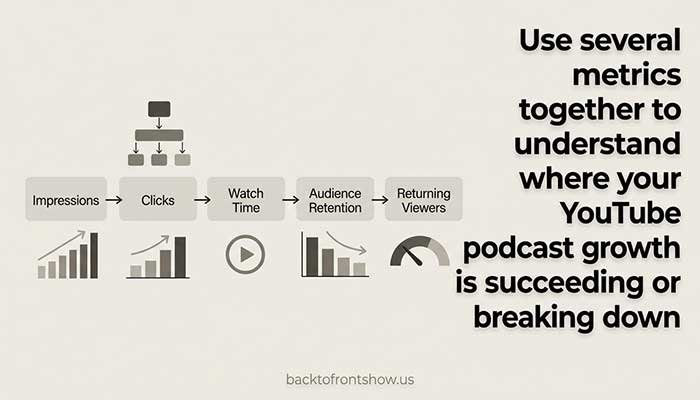
You don’t need to monitor every number in YouTube Studio.
Start with these:
| Metric | What it helps you understand |
|---|---|
| Impressions | How often YouTube is showing your thumbnail |
| Click-through rate | Whether people choose your video after seeing it |
| Watch time | Total viewing generated by the episode |
| Average view duration | How long viewers typically stay |
| Audience retention | Where viewers continue, leave, skip, or rewatch |
| Traffic sources | Where viewers discovered the episode |
| Search terms | Queries bringing people to your content |
| New vs. returning viewers | Whether you’re attracting and retaining an audience |
| Subscribers gained | Which content converts viewers into subscribers |
No single metric tells the entire story.
A highly searchable educational episode may perform differently from an interview that receives most of its traffic from Suggested Videos.
Compare similar episodes whenever possible.
Common YouTube Podcast Growth Mistakes
Uploading and Doing Nothing Else
A full episode is only one opportunity for discovery.
Use clips and Shorts to expose individual ideas to new audiences.
Using Audio-Style Episode Titles
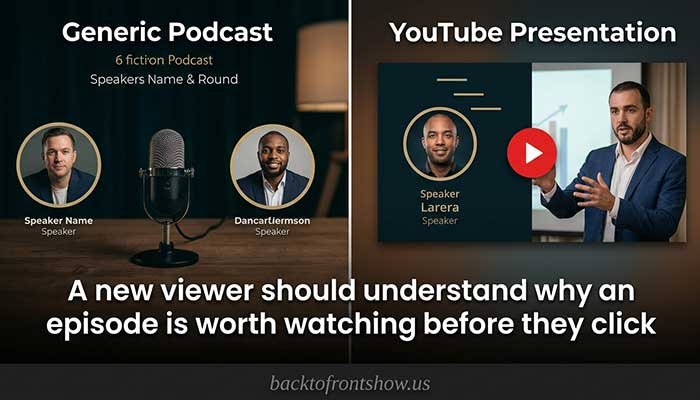
“Episode 42 With Mike” doesn’t tell a stranger why they should care.
Lead with the subject or value.
Spending Too Long on the Intro
A new viewer hasn’t developed loyalty yet.
Earn their attention before asking for patience.
Treating Clips as Random Leftovers
A clip should feel like a useful piece of content, not an unfinished excerpt.
Ignoring Thumbnails
Even a great interview may struggle if the packaging gives viewers no reason to click.
Chasing Tags
YouTube itself says tags aren’t essential for discovery. Spend more effort on topics, titles, thumbnails, content quality, and audience response.
Mixing Full Episodes and Clips in the Podcast Playlist
YouTube recommends keeping the podcast itself focused on full episodes. Use other playlists for clips.
Copying Whatever Large Podcasts Do
A major celebrity podcast may attract millions of views with a guest’s name alone.
A new podcast usually needs to communicate much more clearly why an unknown viewer should click.
Study successful channels, but adapt what you learn to your own audience.
How Long Does It Take to Grow a Podcast on YouTube?
There is no reliable number of weeks, episodes, or uploads that guarantees YouTube podcast growth.
Growth depends on factors such as:
- your niche;
- topic demand;
- competition;
- guest recognition;
- publishing consistency;
- title and thumbnail quality;
- viewer satisfaction;
- retention;
- how often people return;
- how well YouTube can match your videos with interested viewers.
A better goal is to improve your publishing system every month.
For example:
Month 1: establish consistent full-episode publishing.
Month 2: improve titles and thumbnails.
Month 3: create clips and Shorts consistently.
Month 4: analyze retention and traffic-source patterns.
Month 5: produce more episodes around subjects that consistently attract viewers.
That doesn’t mean growth will follow this exact timeline. It gives you a process you can control.
Final Takeaway
If you want to grow a podcast on YouTube, don’t think of YouTube as a storage location for episodes.
Build a content system.
Publish your complete podcast correctly, choose topics with clear viewer value, create strong titles and thumbnails, get to the point quickly, turn important moments into clips and Shorts, and use YouTube Analytics to determine what your audience actually responds to.
You don’t need to master every YouTube feature at once.
I usually recommend improving one part of the process at a time. Better topics make better episodes. Better packaging earns more clicks. Better openings improve retention. Better clips create additional discovery opportunities. And better analytics decisions help you repeat what works.
That’s a much more sustainable YouTube podcast strategy than simply uploading more videos and hoping one takes off.