The best way to promote a podcast on social media is to turn each episode into multiple pieces of native social content instead of repeatedly posting a link to the full episode.
Take the most interesting ideas, stories, disagreements, questions, or useful moments from an episode and turn them into short videos, quote posts, carousels, Stories, discussion posts, and other platform-friendly content. Give people something valuable before asking them to listen.
A practical podcast social media strategy looks like this:
- Choose the platforms where your potential listeners already spend time.
- Create several pieces of content from every episode.
- Lead with a strong hook instead of the podcast title.
- Post short video clips with captions.
- Make each social post useful on its own.
- Include a simple call to action when appropriate.
- Engage with comments instead of only publishing.
- Track which posts actually lead to meaningful audience growth.
- Repeat formats and topics that consistently work.
You don’t need to be everywhere. A smaller, consistent strategy on two platforms is usually more manageable than trying to maintain five accounts poorly.
After working with podcast-related content for more than two years, one thing I’ve found especially important is this: promotion works better when the social content feels like content, not an advertisement for content.
Here’s how to put that into practice.
Why Social Media Can Help Grow a Podcast
Podcast discovery has traditionally been difficult because an audio episode isn’t as easy to sample while scrolling as a short video, image, or text post.
Social media solves part of that problem.
A strong podcast clip can introduce someone to:
- your personality
- your guest
- an interesting opinion
- a useful piece of advice
- a surprising story
- the subject of an episode
The person doesn’t need to commit to a 45-minute episode first. They can experience 20, 30, or 60 seconds of your content and decide whether they want more.
That makes social media especially useful at the discovery stage of podcast marketing.
Short-form content is also becoming increasingly connected to podcast platforms themselves. Spotify, for example, allows creators to attach short video Clips to episodes. Spotify says these Clips can appear on a show’s page and may also be recommended across areas including Home, podcast feeds, Browse, and Now Playing. Current Spotify documentation allows one Clip per episode and specifies a 15- to 90-second duration.
YouTube also gives podcasts dedicated discovery features. According to YouTube, eligible podcasts can appear in YouTube Music, receive podcast badges, surface on its podcast destination, and receive recommendations to people interested in similar content.
The opportunity is not simply to tell your existing followers that a new episode is available. It is to use individual moments from your podcast to reach people who have never heard of you.
1. Choose the Right Social Platforms
You don’t need an account on every social network.
Start by asking:
Where is the type of person who would enjoy my podcast already consuming content?
For many podcasts, the most useful options will include some combination of:
| Platform | Particularly Useful For |
|---|---|
| Reels, Stories, carousels, visual branding, guest collaborations | |
| TikTok | Short clips, discovery, searchable educational content, personality-driven content |
| YouTube | Shorts plus full podcast episodes and searchable video |
| Existing communities, Groups, established audiences | |
| Business, career, B2B, leadership, and professional podcasts | |
| X | Commentary, news, ideas, quotes, and real-time discussions |
Don’t choose a platform just because another podcaster says you need to be there.
For example, a B2B sales podcast might get more value from LinkedIn and YouTube than from maintaining an elaborate TikTok strategy.
A comedy or pop-culture show may find short-form video on TikTok, Instagram Reels, and YouTube Shorts much more natural.
Start With Two Platforms
If you’re managing the show yourself, I usually recommend picking one primary social network and one secondary platform.
You could use:
- Instagram + YouTube
- TikTok + Instagram
- LinkedIn + YouTube
You can expand later.
The goal is to build a repeatable system you can actually maintain.
2. Turn Every Podcast Episode Into Multiple Posts
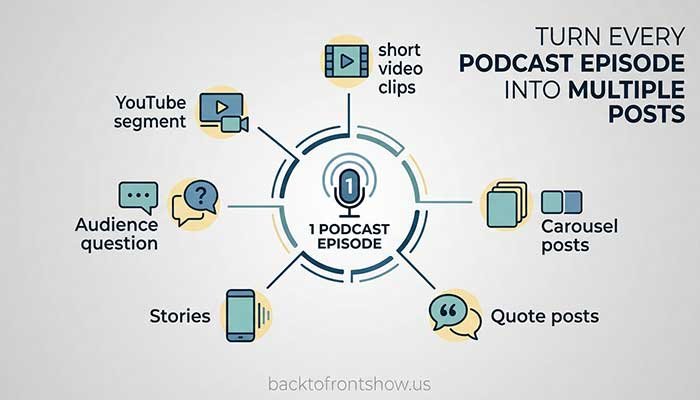
Publishing one “new episode out now” graphic wastes most of the promotional value hidden inside an episode.
Instead, think of the complete episode as your source material.
Imagine you’ve published a 50-minute episode about starting a small business.
That one recording might produce:
- 3 short video clips
- 1 controversial or surprising quote
- 1 carousel with five lessons
- 1 audience question
- 1 behind-the-scenes photo
- 1 short text post
- 3 Instagram Stories
- 1 guest collaboration post
- 1 longer YouTube segment
That gives you far more chances to reach people than a single episode announcement.
Look for “Social Moments”
While editing or reviewing an episode, mark moments containing:
- a strong opinion
- a surprising fact
- a useful answer
- a relatable mistake
- an emotional story
- a funny exchange
- a disagreement
- a counterintuitive statement
- a specific tip
- a question people frequently ask
These usually make better promotional material than randomly cutting 30 seconds from the middle of the conversation.
In my experience, the easiest mistake is choosing clips because they represent the episode accurately rather than because they’re interesting to someone who has no context.
Your social audience hasn’t heard the previous 25 minutes.
The clip has to make sense on its own.
3. Create Short Podcast Clips
Short video should be one of the first formats you test if you record your podcast on camera.
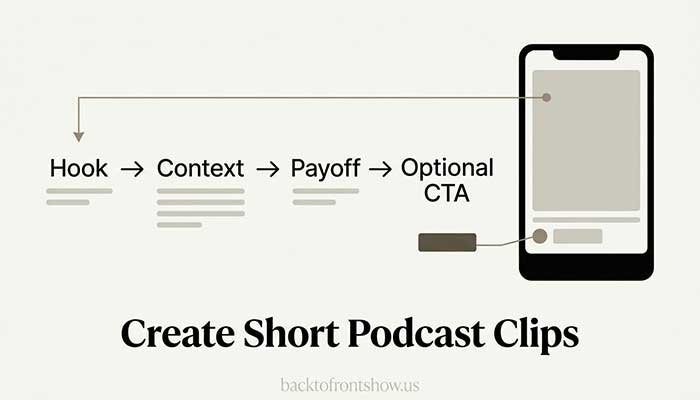
A useful podcast clip generally needs four things:
Hook → Context → Payoff → Optional CTA
For example:
“Most new podcasters worry about buying the wrong microphone. That’s usually not the problem…”
That creates curiosity immediately.
Compare it with:
“In episode 38 of our podcast, I talked with John about podcast equipment…”
The second version assumes viewers already care about your show.
Most don’t.
You have to earn their attention first.
Add On-Screen Captions
Many social videos benefit from readable captions, particularly when dialogue is central to the content.
Keep them:
- large enough to read on a phone
- synchronized reasonably well
- broken into short phrases
- away from areas covered by platform interface elements
Avoid covering the entire screen with unnecessary text.
Use Vertical Video
Vertical video is the natural format for TikTok, Instagram Reels, and YouTube Shorts.
TikTok’s own creator guidance has recommended vertical video and emphasizes holding viewer attention. TikTok also says watch time contributes to how videos are recommended.
TikTok has additionally introduced Smart Split in TikTok Studio Web, a tool designed to turn longer content—including podcast episodes—into shorter vertical clips with reframing, captions, and transcription.
You don’t need an automated tool, but the feature illustrates an important point: repurposing long-form podcasts into short-form content is now a mainstream creator workflow.
4. Don’t Give Away the Hook With a Long Introduction
The first few seconds of a social video matter.
Skip:
- animated podcast logos
- long musical intros
- “Hey guys, welcome back…”
- episode numbers
- lengthy guest introductions
Start close to the interesting part.
Suppose your guest says:
“I quit my $120,000 job without having another job lined up.”
The clip probably shouldn’t begin 15 seconds earlier with:
“So tell everyone a little bit about your career journey.”
Start with the statement that creates curiosity, then provide enough context for it to make sense.
This doesn’t mean using misleading clickbait.
Your hook should accurately represent the content that follows.
5. Make Your Social Posts Valuable Without the Podcast
One of the most useful rules in podcast content marketing is:
A person should get something from the post even if they never listen to the episode.
For an educational show, teach one useful idea.
For a comedy show, deliver the joke.
For an interview show, share the most compelling insight.
For a news show, explain one important development.
For a story podcast, create curiosity without making the post incomprehensible.
People are much more likely to follow an account that consistently gives them something interesting than an account that constantly says:
NEW EPISODE! LINK IN BIO!
Promotion should be built into worthwhile content.
6. Use Instagram to Promote Your Podcast
Instagram podcast promotion can include much more than episode-cover graphics.
You can use:
Reels
Turn strong podcast moments into vertical clips.
Consider testing:
- advice
- stories
- disagreements
- funny exchanges
- surprising opinions
- guest insights
Carousels
Convert part of an episode into a swipeable educational post.
For example:
Slide 1: 5 Mistakes New Freelancers Make
Slide 2: Mistake #1
Slide 3: Mistake #2
Slide 4: Mistake #3
Slide 5: Mistake #4
Slide 6: Mistake #5
Slide 7: Listen to the full conversation
The post remains valuable while naturally introducing the podcast.
Stories
Stories can help you reach the audience you already have.
Use them for:
- episode announcements
- polls
- questions
- behind-the-scenes footage
- recording-day content
- guest tags
- teasers
- listener feedback
You could ask:
“Which should we cover next: growing an email list or getting your first 100 customers?”
Now your audience is participating in future content decisions.
Spotify’s own social-promotion guidance also recommends using Instagram bios, calls to action, and Story Highlights to organize content such as episode snippets and guest features.
7. Use TikTok for Podcast Discovery
TikTok can be particularly useful when your podcast regularly produces short, self-contained moments.
Don’t think of TikTok simply as a place to repost clips.
Think:
What would someone search for, stop for, or share even if they have never heard of my podcast?
A personal finance podcast could create videos around:
- “How much emergency savings do you actually need?”
- “Why a high salary doesn’t automatically make you wealthy”
- “Three things to check before financing a car”
A relationship podcast could publish clips answering specific dating questions.
A sports podcast could publish a clear opinion after a major game.
Use Searchable Topics
TikTok has invested heavily in search discovery. Its Creator Search Insights feature can show creators frequently searched subjects and, in supported regions, topics where demand exists but relatively little content is available.
That means podcast clips don’t have to be positioned merely as “clips.”
They can answer real questions.
Instead of:
Podcast Episode 17 Clip
Try:
Why do new businesses run out of cash even when sales are growing?
The second version gives viewers an immediate reason to care.
Don’t Depend on #FYP
TikTok has specifically stated that hashtags such as #FYP or #ForYou do not automatically increase your chances of reaching the For You feed. Its recommendation is to use captions for useful context and choose hashtags relevant to the actual video.
So focus more on:
- the topic
- the opening
- viewer retention
- relevance
- useful captions
and less on stuffing generic hashtags into every post.
8. Use YouTube Shorts Alongside Full Podcast Episodes
YouTube has an advantage for podcasters because short-form discovery and long-form podcast consumption can happen within the same ecosystem.
You can publish:
Short:
“Why most people fail their first job interview”
and also publish:
Full episode:
“How to Interview Better: Recruiter Explains the Biggest Mistakes”
A viewer who discovers the Short can then explore the rest of your channel.
YouTube says Shorts that support a podcast won’t themselves appear in YouTube Music, but podcast playlists can receive other podcast-specific discovery features and recommendations.
The size of the audience is significant as well. In May 2026, YouTube reported that podcast content on the platform had more than 1 billion monthly active viewers.
That makes YouTube worth serious consideration rather than treating it as simply another place to upload clips.
9. Promote the Guest, Not Just the Episode
If your podcast includes guests, give them material that’s easy to share.
After an episode goes live, you might send the guest:
- one strong video clip
- a vertical Story graphic
- a quote image
- the episode link
- a suggested caption
Don’t demand that guests promote you.
Make sharing convenient.
You can also tag guests where relevant and create collaborative posts when the platform and guest relationship make that appropriate.
The best clips usually make the guest look knowledgeable, funny, interesting, insightful, or memorable.
A clip that makes someone look good is naturally more shareable than a generic promotional graphic with your podcast logo covering half the screen.
10. Write Better Calls to Action
Not every social post needs to end with:
Listen to the full episode now!
Repeated aggressive CTAs can make your account feel like an advertising feed.
Match the call to action to the post.
Examples include:
- “What’s your experience with this?”
- “Agree or disagree?”
- “Save this for later.”
- “Send this to someone starting a business.”
- “The full conversation is in episode 24.”
- “Watch the complete interview on YouTube.”
- “Listen to the full episode through the link in our profile.”
Sometimes the right CTA is simply a question that starts a conversation.
Spotify also provides direct sharing options for podcast shows and individual episodes, making it possible to share specific episode destinations rather than always sending people to a generic homepage.
11. Engage With the Audience After Posting
Social media promotion isn’t finished when you press Publish.
If someone comments thoughtfully, respond when you have something useful to add.
If someone asks a question, that question might become:
- your next TikTok
- your next Reel
- a podcast segment
- an entire episode
Pay particular attention to repeated questions.
They tell you what your audience actually wants to understand.
One approach I find practical is to treat the comments section as lightweight audience research.
If five people ask different versions of the same question, that’s a strong content signal.
12. Build a Simple Podcast Promotion Schedule
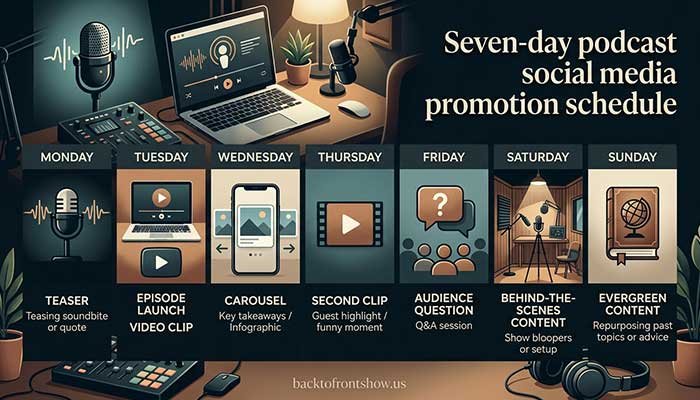
You don’t need to promote an episode once and immediately move on.
Spread the material across several days.
Here’s a hypothetical schedule for a weekly podcast:
| Day | Content |
|---|---|
| Monday | Teaser or question about the upcoming topic |
| Tuesday | Episode release + strongest short clip |
| Wednesday | Quote or carousel |
| Thursday | Second video clip |
| Friday | Audience question or poll |
| Saturday | Behind-the-scenes or guest content |
| Sunday | Evergreen lesson from an older episode |
This is only an example.
A podcast that releases twice a month would use a different schedule.
The important principle is to avoid treating promotion as a single announcement.
A good episode can remain useful for weeks, months, or sometimes years.
How Many Podcast Clips Should You Make Per Episode?
There is no universal number.
For many creators, two to five genuinely strong pieces of short-form content from one episode is a reasonable starting point.
But don’t force five clips from an episode that only contains two good social moments.
Quality matters more than hitting an arbitrary quota.
A 20-minute solo episode might produce:
- two short clips
- one carousel
- one text post
A two-hour interview might give you eight excellent clips.
Use what the content gives you.
Should You Post the Same Podcast Clip Everywhere?
You can reuse the underlying clip, but I wouldn’t automatically publish an identical version everywhere without considering the platform.
At minimum, review:
- video dimensions
- caption length
- title
- on-screen text placement
- CTA
- hashtags
- audio
- platform-specific interface elements
The idea can remain the same.
The packaging may need to change.
Also consider uploading content directly to each platform rather than relying on a post that visibly promotes another social network.
What Podcast Content Should You Promote?
Not every section of an episode deserves social promotion.
Prioritize content that creates one or more of these reactions:
“I didn’t know that.”
“That’s exactly what happened to me.”
“I completely disagree.”
“I need to send this to someone.”
“What happened next?”
“I want the full explanation.”
Those reactions are more useful than asking whether a clip accurately summarizes the complete episode.
Social content is an entry point.
The podcast provides the depth.
Read More: Podcast Advertising: A Complete Guide
Track What Actually Works
Views alone don’t tell you whether your podcast social media marketing is working.
A clip can receive thousands of views and generate almost no meaningful podcast growth.
Spotify has acknowledged this challenge in its own creator guidance, noting that a viral social clip doesn’t necessarily translate directly into streams of the related episode.
Track several signals instead.
Social Metrics
Look at:
- views
- watch time
- completion rate where available
- shares
- saves
- comments
- profile visits
- follows
Podcast Metrics
Also watch:
- episode plays or downloads
- followers
- audience retention
- new listeners
- traffic around promotional periods
Spotify for Creators, for example, provides show growth, audience retention, impression data, and analytics related to Clips.
The objective isn’t to prove that every individual Instagram Reel produced exactly 14 podcast listeners.
Attribution is rarely that simple.
Instead, look for patterns.
Do clips about one subject consistently outperform everything else?
Does a specific guest generate unusually high engagement?
Do educational clips create more saves while funny clips create more shares?
Does YouTube generate more long-form consumption than another platform?
Use those patterns to improve the next batch.
Common Podcast Social Media Promotion Mistakes
Only Posting Episode Artwork
Podcast artwork can communicate that a new episode exists, but it gives strangers little reason to care.
Pair announcements with an actual idea from the episode.
Making Every Post Promotional
If every post asks people to leave the platform and listen somewhere else, your feed can become repetitive.
Give people value where they already are.
Using Clips That Need Too Much Context
A conversation can be excellent inside a 60-minute episode and confusing as a 30-second clip.
Choose self-contained moments.
Adding Long Intros to Short Videos
You don’t need your animated podcast logo before every Reel.
Get to the interesting part.
Chasing Every Trend
Trends can occasionally make sense, but forcing your podcast into unrelated memes won’t necessarily attract people interested in your actual show.
Audience relevance matters more.
Obsessing Over Hashtags
Hashtags can provide context and categorization, but they cannot rescue weak content.
TikTok itself recommends relevant hashtags rather than assuming generic #FYP-style tags will increase distribution.
Giving Up After a Few Posts
Short-form results can vary dramatically from one post to another.
You need enough publishing history to identify patterns rather than judging your entire strategy from three clips.
A Simple Podcast Social Media Workflow
If you’re doing everything yourself, keep the system manageable.
Step 1: Record the Episode
If practical, record video as well as audio.
Step 2: Mark Strong Moments
Identify several useful, surprising, emotional, or entertaining sections.
Step 3: Edit the Best Clips
Create vertical versions and add readable captions.
Step 4: Write Platform-Specific Hooks
Don’t simply copy the episode title.
Tell people why the moment matters.
Step 5: Publish the Full Episode
Make sure listeners can easily find the complete conversation.
Step 6: Spread Social Posts Across Several Days
Don’t dump every promotional asset on release day.
Step 7: Respond to Engagement
Use comments and questions as audience research.
Step 8: Review Performance
After several episodes, identify your strongest topics, formats, and openings.
Step 9: Repeat What Works
Turn successful formats into repeatable series.
This is much easier to sustain than reinventing your entire marketing strategy every week.
Example: Turning One Podcast Episode Into a Week of Social Content
Imagine a hypothetical weekly entrepreneurship podcast publishes an episode called:
“Why Your First Business Might Fail—and What to Do About It.”
The host could create:
Reel/TikTok/Short #1
Hook:
“The biggest reason a profitable business can still run out of money.”
The clip explains cash flow.
Carousel
Title:
“5 Warning Signs Your Business Is Running Out of Cash”
Each slide explains one sign discussed in the episode.
Short Video #2
Hook:
“If I were starting my first business again, I’d track this number every week.”
Discussion Post
Question:
“What was the hardest financial lesson you learned from running a business?”
Story
Run a poll:
What causes more new-business problems?
- Not enough sales
- Poor cash flow management
Final CTA Post
Share another useful insight and add:
“We unpack the complete cash-flow discussion in this week’s episode.”
Now one podcast episode has become a small content campaign rather than one promotional link.
How to Promote a Podcast on Social Media With a Small Audience
Don’t wait until you have thousands of followers.
A small audience can actually make community building easier because you have more time to interact personally.
Focus on:
- narrowly relevant topics
- useful clips
- questions people want answered
- conversations in comments
- consistent publishing
- collaborations with relevant guests
- searchable content
You are not trying to reach everyone.
You are trying to become useful or entertaining to the type of person who would genuinely enjoy your podcast.
I’ve found that this mindset makes podcast promotion much simpler. Instead of asking, “How do I make this post go viral?” ask:
“What would make the right person stop and care?”
That’s a much more useful question.
Read More: How to Grow a Podcast on YouTube
Should You Pay to Promote Podcast Content?
Paid social promotion can be useful, but it shouldn’t be the first solution to weak organic content.
YouTube, for example, offers a Promote feature that lets creators run campaigns for videos and Shorts and target factors such as location, language, and interests.
But advertising can’t automatically make an uninteresting clip compelling.
Before spending money, identify organic content that already shows evidence of:
- strong retention
- saves
- shares
- meaningful comments
- profile visits
Then decide whether amplifying proven content supports your goal.
For most new podcasters with limited budgets, improving the content and distribution system first is usually the more practical priority.
Final Takeaway
Learning how to promote a podcast on social media isn’t mainly about posting more links.
It’s about turning your podcast into content people can discover before they know your show exists.
Start with the strongest ideas in each episode. Turn them into short, platform-native pieces of content. Use strong hooks, make clips understandable without context, engage with the people who respond, and measure what consistently generates interest.
You don’t need to create twenty posts from every episode.
You need a sustainable system that takes one good podcast conversation and gives it several opportunities to reach the right audience.
The basic formula is simple:
Create a valuable podcast → find the strongest moments → package them for social media → learn from the response → do more of what works.