As of early 2026, about 167 million Americans age 12 and older listen to a podcast at least once a month, and roughly 230 million have listened to or watched one at some point in their life. That’s according to Edison Research’s Infinite Dial 2026 study, the most widely cited benchmark for Podcast Statistics in the US.
If you’re trying to figure out whether podcasting is still worth your time — as a listener, a creator, or a marketer — the short answer is yes. The audience keeps growing, older listeners are joining faster than ever, and advertisers are spending more on the format every year. But the details matter more than the headline number, so let’s get into what’s actually happening.
In this article, I’ll walk through how many people listen to podcasts in the US, who they are, how they listen, and what the money side of the industry looks like. I’ll also flag where numbers get misused, since that happens a lot with podcast stats.
Quick Answer: Podcast Statistics in the US at a Glance
| Metric | Figure | Source |
|---|---|---|
| Americans who have ever listened to/watched a podcast | 80% (~230 million) | Edison Research, Infinite Dial 2026 |
| Monthly podcast consumers | 58% (~167 million) | Edison Research, Infinite Dial 2026 |
| Weekly podcast consumers | 45% (~130 million) | Edison Research, Infinite Dial 2026 |
| US podcast ad revenue (2025) | $2.86 billion | IAB/PwC, April 2026 |
| Podcast ad revenue growth (2025 vs. 2024) | 17.6% | IAB/PwC, April 2026 |
| Top platform for weekly listeners | YouTube (39%), then Spotify (20%), Apple Podcasts (11%) | Edison Research Podcast Metrics, 2026 |
These are national averages. In my experience helping people make sense of podcast numbers, the biggest mistake is treating a national stat as if it describes a specific show’s audience. A national figure tells you where the overall market stands — it doesn’t tell you who’s actually listening to your podcast or how big your audience “should” be. Your own analytics will always matter more than any industry benchmark.
Read More: Best Podcast Hosting Platforms for Beginners in 2026
How Many People in the US Listen to Podcasts?
The most reliable, long-running source for this question is Edison Research’s Infinite Dial study, which has tracked podcast listening in the US since 2006. The 2026 edition found that 80% of Americans age 12 and older, an estimated 230 million people, have ever listened to or watched a podcast — an all-time high.
Within that larger group, listening frequency breaks down like this:
- 58% of Americans listen to a podcast monthly, and 45% listen weekly — both record highs.
- The number of Americans who have ever consumed a podcast grew by about 20 million in a single year, the largest one-year jump Edison has recorded since it began tracking podcasts in 2006.
It’s worth noting that these figures now include people who watch video podcasts, not just those who listen to audio. Edison broadened its definition to reflect how much podcast consumption now happens on video platforms — something to keep in mind if you’re comparing this year’s numbers to older reports that only counted audio listening.
For context, podcast listening sits inside a bigger digital audio picture. 81% of the US population, about 233 million people, reported listening to some form of digital audio (podcasts, streamed radio, or streaming music) in the past month, and 76% listened in the past week.
Who Is the US Podcast Audience? (Demographics)
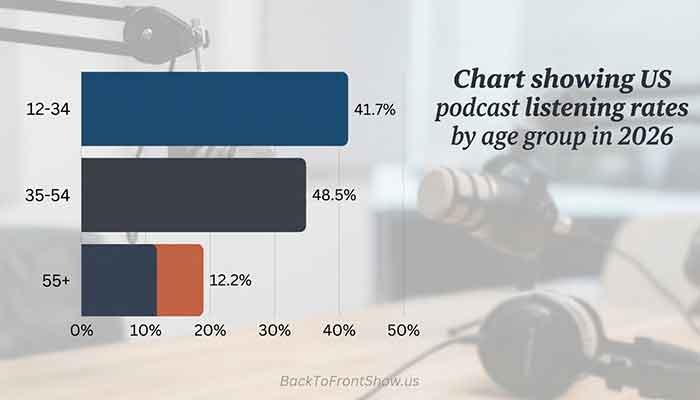
Podcast listening in the US is no longer a young-adult habit — it’s mainstream across age groups, though growth is coming from an unexpected place.
- 35- to 54-year-olds now lead monthly podcast consumption at 68%, edging ahead of 12- to 34-year-olds, who dipped slightly to 64%.
- Adults 55 and older reached 44% monthly consumption, up 6 points — the fastest-growing age group in podcasting.
- Online audio listening overall among the 55+ group jumped from 52% in 2024 to 70% in 2026, a nearly 20-point gain in two years.
- The gap between men and women in podcast consumption is much narrower than the gap between age groups.
What this means for creators: if you assumed your podcast audience skews young by default, it’s worth checking that assumption. In my experience, a lot of new podcasters build their show and their marketing around a 20-something audience out of habit, without actually confirming that’s who’s listening. The fastest-growing segment of the entire industry right now is 55 and older.
Listening in the Car
Among Americans who drive, AM/FM radio remains the most-used in-car audio source, with 73% having listened to it in their vehicle in the past month, while podcasts came in at 37%. That number is higher among younger drivers — 55% of drivers aged 18 to 34 listened to podcasts in the car in the past month. If your show targets a younger, commuting audience, in-car listening is worth designing for — shorter cold opens and clear audio cues matter more when someone can’t look at a screen.
Where Americans Listen to Podcasts (Platform Data)
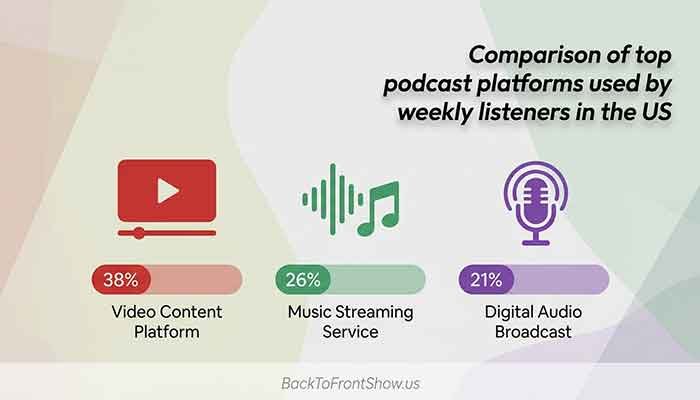
This is where the numbers get more interesting, and where a lot of outdated advice is still floating around.
According to Edison’s ongoing Podcast Metrics study, 39% of weekly podcast consumers now name YouTube as the platform they use most, ahead of Spotify at 20% and Apple Podcasts at 11%. Edison’s Share of Ear diary study also puts YouTube at 32% of all podcast listening time.
That doesn’t mean audio is dying. Over 70% of people who started listening to podcasts in the past year say they moved from watching video to listening to audio versions of the same show, and nearly seven in 10 longtime listeners have done the same. Video is increasingly how people discover shows; audio is often still how they consume them day to day.
A word of caution here: you’ll see some blog posts citing very specific global platform “market share” numbers (like exact percentages for Spotify’s worldwide podcast market share) attributed loosely to “Edison Research.” I couldn’t verify several of those figures against an actual Edison or IAB report, so I’ve left them out. If a statistic doesn’t have a clear original source attached, I’d treat it with some skepticism — this happens a lot in podcast stat roundups that recycle numbers from each other.
What I’d recommend: if you’re launching a new show in 2026, don’t treat YouTube as optional. Publishing video, even a simple static-image or single-camera version of your episode, is now a mainstream way people find and watch podcasts — especially in the interview, news, and comedy genres where video has become common practice.
Podcast Advertising and Revenue in the US
Podcasting has grown from a niche ad category into a real line item in US media budgets.
- US podcast advertising revenue reached about $2.9 billion in 2025, up 17.6% year-over-year, according to the IAB/PwC Internet Advertising Revenue Report released in April 2026.
- That growth outpaced the broader digital audio category (podcasts, streaming music, and streaming radio combined), which grew 10.2% to reach $8.4 billion.
- By comparison, traditional (non-digital) audio advertising grew just 1.3%, and TV advertising actually declined 13.4% over the same period.
In dollar terms, that’s real money, but it’s still a small slice of the overall pie. Digital audio as a whole makes up only about 2.8% of total US digital advertising spend, even at $8.4 billion.
Why this matters if you’re monetizing a show: the ad market is growing, but it’s still concentrated around shows with meaningful, verifiable audiences. In my experience, new podcasters are often surprised by how much of the revenue conversation depends on measurable downloads and engagement, not just having a podcast that exists. Building a consistent, engaged audience will get you further than chasing sponsorship deals early.
How People Discover New Podcasts
Personal recommendations remain the single biggest way people find new shows — word of mouth from friends and family is still the top discovery method for podcast listeners. Search, social platforms, and in-app browsing all play a role too, but they tend to support word of mouth rather than replace it.
That lines up with something I’ve noticed consistently: shows rarely grow because of a clever hashtag or a one-off viral clip. They grow because listeners tell other people about them. That’s slower than a lot of “growth hack” advice suggests, but it’s also more durable — an audience that arrives through a friend’s recommendation tends to stick around longer than one that clicks a random link.
Practical takeaway for creators:
- Make it genuinely easy for listeners to share a specific episode, not just your show’s homepage.
- Ask directly, but sparingly — a single clear ask near the end of an episode works better than repeated pleas throughout.
- Don’t ignore YouTube and short-form video clips as a discovery layer, even if your show is primarily audio.
A Note on Reading Podcast Statistics Critically
If you spend any time researching podcast stats, you’ll notice the numbers don’t always agree. Different studies use different definitions (does “podcast” include video-only shows? does “listener” mean someone who tuned in once, or someone who listens weekly?), different age ranges, and different survey methods.
A few things I’d suggest keeping in mind:
- Check the population. “80% of Americans” and “80% of monthly podcast listeners” are very different claims. Always check who was actually surveyed.
- Check the date. Podcast stats from even 18 months ago can be meaningfully out of date, given how fast the medium is changing.
- Prefer the original source. When a number is attributed to “Edison Research” or “IAB,” it’s worth checking Edison’s or IAB’s own site rather than trusting a secondhand summary — including this one. Numbers get rounded, mislabeled, or quietly changed as they get repeated across blogs.
Key Takeaways
- Podcast listening in the US is at an all-time high: about 167 million monthly listeners and 230 million people who’ve tried the format at least once.
- The audience is aging up. Listeners 35–54 now lead monthly consumption, and 55+ is the fastest-growing group.
- YouTube has become the platform most weekly listeners use most, which makes at least a basic video version of your show worth considering.
- Podcast advertising crossed $2.9 billion in 2025 and is growing faster than most other digital ad formats.
- Word of mouth is still the top way people discover new shows — no algorithm has replaced it.
- Always check the source and the date behind any podcast statistic before you build a strategy around it.