Podcast advertising in the United States has grown into a $2.86 billion annual market, according to the latest full-year data from IAB and PwC. U.S. podcast advertising revenue reached $2.862 billion in 2025, up 17.6% from 2024.
The growth hasn’t stopped in 2026. Magellan AI, which tracks advertising activity across thousands of U.S. podcasts, reported estimated podcast ad spending rising 28% year over year in Q1 2026 and another 23% in Q2 2026.
For advertisers, the important story isn’t simply that brands are spending more. Podcast audiences are also larger than ever, host-read ads continue to command premium CPMs, and research suggests heavy podcast consumers pay unusually high attention to advertising.
Here are some of the most useful podcast advertising statistics to know in 2026.
Key Podcast Advertising Statistics for 2026
| Statistic | Latest figure |
|---|---|
| U.S. podcast advertising revenue in 2025 | $2.862 billion |
| 2025 podcast ad revenue growth | 17.6% YoY |
| 2024 U.S. podcast ad revenue | $2.433 billion |
| Q1 2026 estimated podcast ad spending growth | 28% YoY |
| Q2 2026 estimated podcast ad spending growth | 23% YoY |
| Average baked-in 60-second host-read CPM on Libsyn Ads | $24–$26 |
| Average baked-in 30-second host-read CPM | $18–$22 |
| Programmatic podcast CPM benchmark on Libsyn Ads | $12–$15 |
| U.S. monthly podcast consumers age 12+ | 58% |
| U.S. weekly podcast consumers age 12+ | 45% |
| Heavy podcast users recalling an ad in the previous week | 86% |
| Heavy podcast users who trust podcast ads | 80% |
| Average Q1 2026 advertiser ad load in Magellan AI data | 8.24% |
Sources include IAB/PwC, Edison Research, Libsyn Ads, Magellan AI, and Sounds Profitable.
U.S. Podcast Ad Revenue Reached $2.86 Billion in 2025
The clearest measure of the podcast advertising market is actual advertising revenue.
IAB and PwC reported that U.S. podcast advertising revenue reached $2.862 billion in 2025, compared with $2.433 billion in 2024. That represents 17.6% year-over-year growth.
That followed an even stronger rebound in 2024, when podcast advertising revenue increased 26.4% from approximately $1.93 billion in 2023.
U.S. Podcast Advertising Revenue by Year
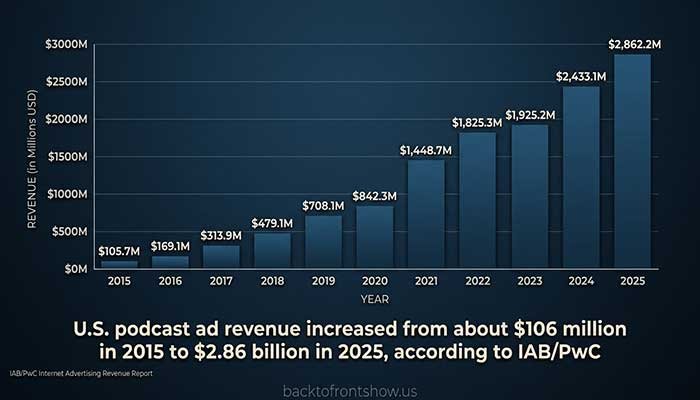
| Year | U.S. podcast ad revenue | Approx. YoY growth |
|---|---|---|
| 2015 | $105.7 million | — |
| 2016 | $169.1 million | 60% |
| 2017 | $313.9 million | 86% |
| 2018 | $479.1 million | 53% |
| 2019 | $708.1 million | 48% |
| 2020 | $842.3 million | 19% |
| 2021 | $1.449 billion | 72% |
| 2022 | $1.825 billion | 26% |
| 2023 | $1.925 billion | 5% |
| 2024 | $2.433 billion | 26% |
| 2025 | $2.862 billion | 18% |
Revenue figures are from the IAB/PwC Internet Advertising Revenue Report; growth percentages above are rounded from the reported annual revenue totals.
The long-term growth is striking. Podcast ad revenue was only about $106 million in 2015. Ten years later, it was nearly $2.9 billion.
Growth hasn’t been perfectly smooth. The market slowed significantly in 2023 as advertisers dealt with broader economic and advertising-market pressure, but podcast advertising returned to double-digit growth in 2024 and continued growing in 2025.
One thing I’ve learned from following podcast metrics is that a single year’s percentage can give the wrong impression. Looking at the longer trend is usually more useful. Podcast advertising has gone through slower periods, but the overall market has continued expanding substantially.
Podcast Advertising Growth Is Continuing in 2026
Full-year 2026 U.S. podcast advertising revenue hasn’t been published yet, so any precise 2026 total should be treated as a forecast rather than a fact.
However, current campaign-tracking data points to continued growth.
Magellan AI analyzed 95,612 podcast episodes for its Q1 2026 benchmark report and found estimated podcast advertising spending increased 28% from the previous year. It also identified 1,318 brands advertising on podcasts for the first time during the quarter.
For Q2 2026, Magellan AI analyzed 94,823 episodes and reported another 23% year-over-year increase in podcast ad spending.
It’s important to understand the difference between these figures:
- IAB/PwC revenue figures measure U.S. podcast advertising revenue.
- Magellan AI figures are estimates based on the podcast advertising activity it tracks.
They shouldn’t be treated as identical measurements. Together, however, they show a market that remains active and growing.
Interestingly, a 2024 IAB/PwC study had projected podcast advertising revenue would reach nearly $2.6 billion by 2026. Actual 2025 revenue later reached $2.862 billion, exceeding that earlier projection one year ahead of schedule.
That illustrates why podcast advertising forecasts should always be dated and updated rather than repeated indefinitely.
Podcast CPM Statistics: How Much Do Podcast Ads Cost?
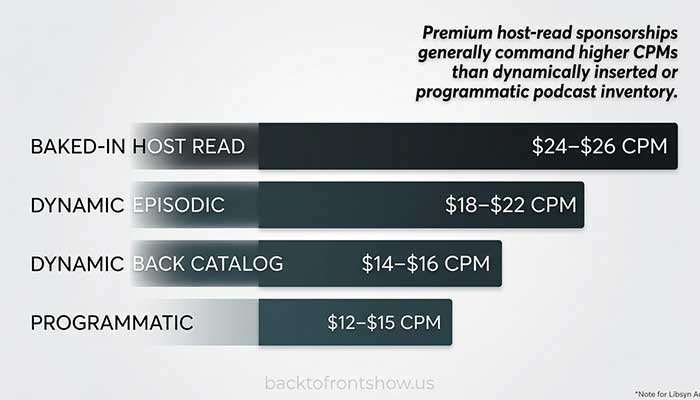
Podcast ads are commonly priced using CPM, or cost per thousand impressions/downloads.
Libsyn Ads currently lists the following podcast advertising rate benchmarks:
| Podcast ad format | CPM |
|---|---|
| Baked-in host-read, 60 seconds | $24–$26 |
| Baked-in host-read, 30 seconds | $18–$22 |
| Dynamic episodic ad | $18–$22 |
| Dynamic full/back-catalog ad | $14–$16 |
| Programmatic ad | $12–$15 |
Libsyn also says current live-read podcast advertising generally runs around $18–$25 CPM, although individual shows can cost more or less.
How Podcast CPM Pricing Works
The basic calculation is:
Advertising cost = downloads ÷ 1,000 × CPM
Imagine a podcast receives 20,000 downloads per episode and sells a 60-second host-read advertisement for a $25 CPM.
The calculation would be:
20,000 ÷ 1,000 × $25 = $500
So one ad placement would cost approximately $500.
If the advertiser purchased four episodes at the same rate and delivery level, the approximate campaign cost would be $2,000.
That’s a hypothetical example, not an industry average campaign budget.
Read More: Podcast Listener Statistics: How Many Americans Are Actually Listening in 2026
Podcast CPMs Vary by Category
Libsyn’s published benchmarks also show differences by podcast category.
| Podcast category | Baked-in host-read CPM benchmark |
|---|---|
| Business | $30 |
| Health & Fitness | $27 |
| Technology | $26 |
| Education | $26 |
| Fiction | $24 |
| Science | $23 |
| Comedy | $23 |
| Society & Culture | $23 |
| Games | $22 |
| Leisure | $22 |
A podcast with a valuable niche audience can therefore command a higher CPM than a larger but less targeted show.
In my experience, this is one of the most important points for smaller podcasters to understand. Download count matters, but it isn’t the only thing that determines sponsorship value. Audience fit, demographics, subject matter, ad format, placement, and the relationship between the host and listeners can all affect what an advertiser is willing to pay.
Host-Read Podcast Ads Still Command a Premium
Podcast advertising isn’t a single format.
An advertiser can buy:
- Host-read sponsorships
- Baked-in advertisements
- Dynamically inserted ads
- Pre-produced spots
- Programmatic inventory
- Pre-roll placements
- Mid-roll placements
- Post-roll placements
- Audio and video podcast integrations
Current Libsyn Ads pricing illustrates the difference in value.
Its baked-in host-read benchmark is $24–$26 CPM, compared with $12–$15 CPM for programmatic inventory.
The premium makes sense because a host-read sponsorship can feel much more closely connected to the program itself.
That doesn’t automatically mean host-read ads are always the best choice. Programmatic advertising can offer advantages such as geographic, demographic, behavioral, and time-based targeting. Advertisers need to match the ad format with the campaign objective rather than simply picking the highest-priced format.
Podcast Advertising Reaches a Record-High Audience
Advertising revenue becomes easier to understand when you look at how many Americans now consume podcasts.
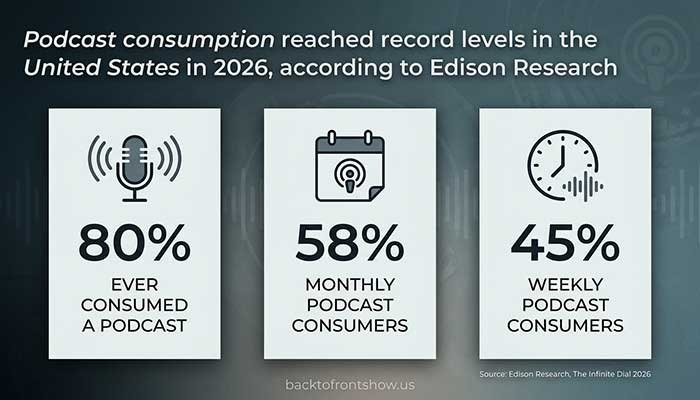
Edison Research’s Infinite Dial 2026 found:
- 80% of Americans age 12+, approximately 230 million people, have listened to or watched a podcast.
- 58%, approximately 167 million people, consumed a podcast during the previous month.
- 45%, approximately 130 million people, consumed a podcast during the previous week.
- Among Americans ages 35–54, monthly podcast consumption reached 68%.
- 57% of Americans age 12+ have both listened to and watched podcasts.
These are record levels in the Infinite Dial study.
The video figure is particularly important for advertisers. Podcast advertising increasingly isn’t limited to an audio file delivered through an RSS feed. Many campaigns now exist across audio and video environments.
Edison Research describes today’s podcast market as effectively a dual-format medium rather than treating audio and video audiences as completely separate groups.
Podcast Ads Have Strong Recall Among Heavy Users
Audience size is useful, but advertisers also care about whether people actually notice an advertisement.
Sounds Profitable’s 2025 U.S. Advertising Landscape research surveyed more than 5,000 U.S. adults and compared advertising across multiple media platforms.
Among the most active podcast users, 86% recalled hearing a podcast advertisement during the previous week. The research described this as the highest ad-recall level among the ad-supported media it tested.
The gender difference was also extremely small:
- 86% of male heavy podcast consumers recalled an ad.
- 85% of female heavy podcast consumers recalled an ad.
The same research reported that 80% of the most active podcast listeners trusted the advertising they heard on podcasts.
There is an important limitation here: these numbers describe the study’s most active podcast consumers, not every person who has ever listened to a podcast. They shouldn’t be interpreted as an 86% recall rate across the entire U.S. population.
Podcast Advertising Can Drive Measurable Actions
Sounds Profitable also examined what heavy podcast consumers reported doing after encountering advertising.
Among these highly active podcast consumers:
- 33% reported writing down a promotional code from a podcast ad during the previous six months.
- 27% reported researching a brand after encountering advertising on an ad-supported podcast.
- 22% said a podcast advertisement had prompted an immediate purchase.
These figures shouldn’t be treated as universal conversion rates. They come from survey responses among particularly active podcast users and measure reported behavior across a period of time.
For an advertiser evaluating a specific campaign, actual conversion rate still depends on factors such as:
- Product-market fit
- Audience relevance
- Offer
- Creative quality
- Host credibility
- Number of exposures
- Landing-page quality
- Attribution method
- Price
- Campaign duration
That’s why I wouldn’t use a broad industry statistic to promise that a specific campaign will produce the same result.
Read More: Podcast Statistics in the US (2026): Listeners, Growth & Ad Data
Podcast Ad Loads Are Around 8% in Recent Tracking Data
Another useful podcast sponsorship statistic is ad load, or how much of an episode consists of advertiser content.
Magellan AI reported an average advertiser ad load of 8.24% in Q1 2026, down from 8.79% in Q4 2025.
Its earlier data showed:
- Q1 2025: 8.01%
- Q2 2025: 8.13%
- Q3 2025: 8.34%
- Q4 2025: 8.82%
- Q1 2026: 8.24%
For publishers, this matters because adding advertisements isn’t automatically the same as increasing revenue sustainably.
A common mistake I’ve seen in podcast monetization discussions is focusing only on how many ad slots can fit into an episode. Listener experience matters too. A show that overloads episodes with sponsorships may create more available inventory while making the program less enjoyable.
The better goal is usually to find a balance between monetization and audience experience.
New Advertisers Continue to Enter Podcasting
Podcast advertising growth isn’t coming only from the same brands increasing their budgets.
Magellan AI identified substantial numbers of brands advertising on podcasts for the first time:
- 1,196 new brands in Q2 2025
- 1,689 new brands in Q3 2025
- 1,482 new brands in Q4 2025
- 1,318 new brands in Q1 2026
These quarterly numbers shouldn’t simply be added together to estimate unique annual advertisers because a methodology designed around quarterly first-time activity may not support that calculation.
But the trend demonstrates that brands continue to test podcast advertising rather than the market depending exclusively on established podcast advertisers.
Sports Podcasts Are Particularly Important to New Advertisers
Sports has repeatedly appeared as an important entry point for brands testing podcasts.
According to Magellan AI:
- Around 20% of new advertisers in Q2 2025 included sports podcasts in their media plans.
- Around 20% in Q3 2025 did the same.
- 18.6% in Q4 2025 included sports.
- 20.4% in Q1 2026 included sports.
That doesn’t mean sports is automatically the best category for every advertiser. The more useful takeaway is that recognizable audience communities can make podcast genres attractive places for brands to test campaigns.
What These Podcast Advertising Statistics Mean for Advertisers
The numbers point to a market with three important characteristics.
1. Podcast Advertising Is Still Growing
U.S. podcast advertising revenue moved from approximately $1.93 billion in 2023 to $2.43 billion in 2024 and $2.86 billion in 2025.
Current 2026 campaign tracking also shows double-digit year-over-year spending growth.
Podcasting isn’t the largest part of digital advertising, but it is no longer an experimental channel either.
2. Advertisers Are Paying for Audience Quality
A 60-second baked-in host read can cost around $24–$26 per thousand downloads on Libsyn’s current benchmarks, while programmatic inventory is listed at roughly $12–$15 CPM.
Advertisers aren’t simply paying for impressions. They’re also paying for context, host integration, audience targeting, and the listener relationship.
3. Measurement Still Matters More Than an Industry Average
An attractive CPM doesn’t guarantee a profitable campaign.
For direct-response advertisers, I usually recommend tracking at least:
- Unique landing-page visits
- Promotional-code usage
- Leads
- Purchases
- Customer acquisition cost
- Conversion rate
- Revenue attributable to the campaign
- Repeat purchases where applicable
Magellan AI’s Q2 2026 measurement benchmarks provide a useful reference point: among campaigns it measured, the median campaign produced a 2.23% response rate using a 30-day lookback window. Among listeners who reached an advertiser’s site, the median campaign recorded 4.65% lead conversion and 3.98% purchase conversion.
These are benchmarks, not promises. Your own campaign data should ultimately matter more.
What These Statistics Mean for Podcasters
For creators hoping to attract sponsors, the market data is encouraging, but having a podcast alone doesn’t guarantee sponsorship revenue.
Advertisers normally want evidence that a show can reliably reach the right people.
I’d recommend preparing a simple sponsorship package containing:
- Average downloads per episode within a consistent measurement window.
- Audience demographics if you have reliable data.
- Podcast topic and positioning.
- Publishing frequency.
- Available ad formats, such as pre-roll and mid-roll.
- Your CPM or flat-rate pricing.
- Previous sponsorship results, only when you have genuine data you can substantiate.
- Contact and booking information.
Don’t inflate download numbers or quote a high CPM simply because another show charges it.
A smaller podcast with a clearly defined audience can still be commercially attractive. An advertiser selling specialized business software, for example, may prefer 5,000 highly relevant listeners over a much larger audience with little connection to the product.
Podcast Advertising Trends to Watch
Video Podcast Advertising
Podcast consumption increasingly crosses audio and video. Edison Research found 57% of Americans age 12+ had both watched and listened to podcasts in 2026.
That means advertisers increasingly need to think beyond audio-only creative.
Signal Hill Insights’ 2026 benchmark analysis, based on 38,704 podcast listeners and viewers surveyed during 2024 and 2025, found only small differences between average audio and video podcast brand-lift performance. Video was one to two points higher on some mid-funnel and purchase-intent measures, while familiarity lift was identical.
The practical lesson isn’t that video automatically beats audio. It’s that advertisers now have two meaningful formats to work with.
More Programmatic Inventory
Programmatic podcast advertising gives advertisers more automation and targeting options, usually at a lower CPM than premium host-read sponsorships.
Libsyn’s current benchmark puts programmatic inventory around $12–$15 CPM, compared with $24–$26 for baked-in host reads.
Expect the market to continue supporting both models rather than one completely replacing the other.
Greater Pressure to Prove Results
As podcast advertising budgets grow, advertisers will increasingly expect measurement beyond download counts.
Response rates, site visits, conversions, brand lift, incremental sales, and customer acquisition costs are becoming increasingly important parts of campaign evaluation.
For podcasters, that means reliable analytics and clearly defined measurement windows will become more valuable—not less.
Key Takeaways
The latest podcast advertising data shows a market that is still expanding.
U.S. podcast advertising revenue reached $2.862 billion in 2025, representing 17.6% annual growth, while tracking data from Magellan AI indicates podcast ad spending continued growing at double-digit rates during the first half of 2026.
Podcast audiences are also at record levels. 58% of Americans age 12+ consume podcasts monthly, and 45% do so weekly.
For advertisers, premium host-read spots currently run roughly $24–$26 CPM for 60-second baked-in reads on Libsyn’s published benchmarks.
For podcasters, the takeaway is equally straightforward: audience size matters, but audience relevance, trust, ad format, measurement, and listener experience can be just as important when building a sustainable sponsorship business.
FAQs:
Sources
- IAB/PwC — Internet Advertising Revenue Report: Full Year 2025. Primary source for 2025 U.S. podcast advertising revenue and historical market figures. IAB/PwC Full Year 2025 Report
- IAB/PwC — Internet Advertising Revenue Report: Full Year 2024. Source for 2024 podcast ad revenue and growth. IAB/PwC Full Year 2024 Report
- IAB — U.S. Podcast Advertising Revenue Study. Historical podcast revenue and earlier growth projections. IAB Podcast Advertising Revenue Study
- Edison Research — The Infinite Dial 2026. Current U.S. podcast audience and consumption statistics. The Infinite Dial 2026
- Libsyn Ads — Podcast Advertising Rates. Current CPM benchmarks for host-read, dynamic, back-catalog, and programmatic ads. Libsyn Podcast Advertising Rates
- Magellan AI — Podcast Advertising Benchmarks Q1 2026. Spending growth, new advertiser, and ad-load data. Magellan AI Q1 2026 Benchmarks
- Magellan AI — Podcast Advertising Benchmarks Q2 2026. Latest available quarterly podcast advertising spending-growth benchmark at the time of writing. Magellan AI Q2 2026 Benchmark Report
- Magellan AI — Podcast Measurement Benchmarks Q2 2026. Response, lead-conversion, and purchase-conversion benchmarks. Magellan AI Measurement Benchmark Report
- Sounds Profitable — The Advertising Landscape 2025: Attention and Trust. U.S. podcast advertising recall and trust research. Sounds Profitable Attention and Trust Study
- Sounds Profitable — The Advertising Landscape 2025: Driving to Action. Research covering consumer actions following podcast advertising exposure. Sounds Profitable Driving to Action Study