Podcasting in 2026 is no longer a small or purely audio-focused medium.
Edison Research reports that 58% of Americans age 12 and older consumed a podcast in the past month in 2026, representing an estimated 167 million people. Weekly consumption reached 45%, or about 130 million Americans, while 80% have listened to or watched a podcast at some point. All three measures reached record highs in Edison’s 2026 study.
At the same time, the definition of podcasting is changing. Watching podcasts has become nearly as common as listening among regular consumers, YouTube has become a major podcast destination, and podcast advertising has grown into a multibillion-dollar U.S. business.
Here are some of the most useful podcast industry statistics for understanding where the market stands in 2026.
Podcast Industry Statistics 2026: Quick Overview
| Statistic | Latest figure |
|---|---|
| Americans age 12+ who have ever consumed a podcast | 80% |
| Americans age 12+ consuming podcasts monthly | 58% |
| Estimated U.S. monthly podcast consumers age 12+ | 167 million |
| Americans age 12+ consuming podcasts weekly | 45% |
| Estimated U.S. weekly podcast consumers age 12+ | 130 million |
| U.S. adults 18+ consuming podcasts monthly | 55% |
| U.S. adults 18+ consuming podcasts weekly | 39% |
| Weekly consumers actively watching podcast video | 82% |
| Weekly consumers listening to audio-only podcast content | 78% |
| Weekly podcast consumers who acted after hearing a podcast ad | 76% |
| 2025 U.S. podcast advertising revenue | $2.86 billion |
| 2025 podcast advertising revenue growth | 17.6% |
| YouTube monthly active viewers of podcast content globally | More than 1 billion |
Sources include Edison Research, Sounds Profitable, IAB/PwC, and YouTube.
One important point before comparing podcast statistics: not every research organization measures podcast consumption in exactly the same way.
For example, Edison Research’s Infinite Dial 2026 covers Americans age 12+, while Sounds Profitable’s 2026 Podcast Landscape study surveyed U.S. adults age 18+. That is why one credible study can report 58% monthly consumption while another reports 55%. The figures aren’t necessarily contradictory—they measure somewhat different populations and use different methodologies.
From my experience writing about podcast analytics, this is one of the easiest mistakes to make with industry statistics. I recommend checking the age group, survey date, and definition of “podcast consumer” before comparing two numbers directly.
How Many Americans Listen to Podcasts in 2026?
Podcast consumption in the United States reached new highs in Edison’s 2026 research.
According to The Infinite Dial 2026:
- 80% of Americans age 12+, or around 230 million people, have ever listened to or watched a podcast.
- 58%, or approximately 167 million people, consumed a podcast during the previous month.
- 45%, or approximately 130 million people, consumed a podcast during the previous week.
The monthly figure increased from 55% in 2025 to 58% in 2026 in Edison’s historical data.
That longer-term trend is especially impressive. Edison’s data show monthly podcast consumption at only 9% of Americans age 12+ in 2008. By 2019, it was 32%. It reached 47% in 2024 and 58% in 2026.
Podcasting has moved from a relatively specialized digital format to mainstream media consumption.
U.S. podcast reach among adults tells a similar story
Sounds Profitable’s Podcast Landscape 2026, based on a census-weighted survey of 5,473 U.S. adults conducted in August 2026, found:
- 74% of American adults have consumed a podcast.
- 55% consumed one within the previous month.
- 39% consumed one within the previous week.
Those figures were essentially unchanged from its 2025 study.
That doesn’t necessarily mean podcast growth has stopped. A mature medium can maintain very high overall penetration while gaining new users and losing occasional consumers at the same time.
In fact, Sounds Profitable reported that 34% of podcast consumers had started consuming podcasts within the previous year, up from 28% in its earlier data.
Read More: Podcast Advertising Statistics
Podcast Audience Growth Statistics
The long-term growth of podcasting is easier to see when we compare multiple years.
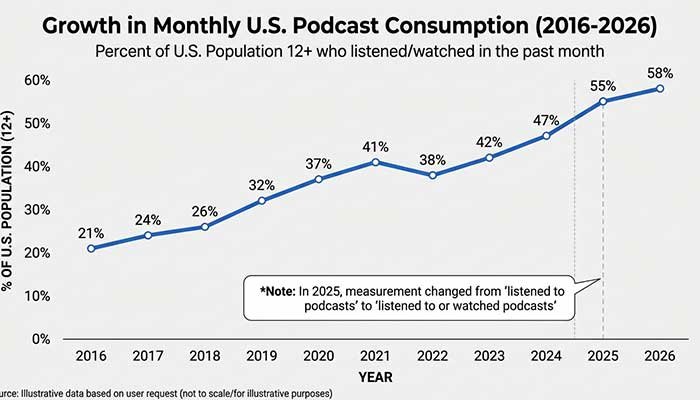
| Year | Monthly U.S. podcast consumption, age 12+ |
|---|---|
| 2016 | 21% |
| 2017 | 24% |
| 2018 | 26% |
| 2019 | 32% |
| 2020 | 37% |
| 2021 | 41% |
| 2022 | 38% |
| 2023 | 42% |
| 2024 | 47% |
| 2025 | 55% |
| 2026 | 58% |
Source: Edison Research’s Infinite Dial historical series. Beginning in 2025, Edison expanded this measure from listening to include people who listened to or watched podcasts. That methodological change matters when interpreting the jump between 2024 and 2025.
So I wouldn’t look at the table and conclude that podcast audiences suddenly increased eight percentage points solely because millions of new audio listeners appeared in one year.
Part of the change reflects how podcast consumption itself is changing.
That’s an important theme throughout the 2026 data: video is expanding what counts as podcast consumption.
Video Podcast Statistics in 2026
Video is now one of the biggest podcast industry trends.
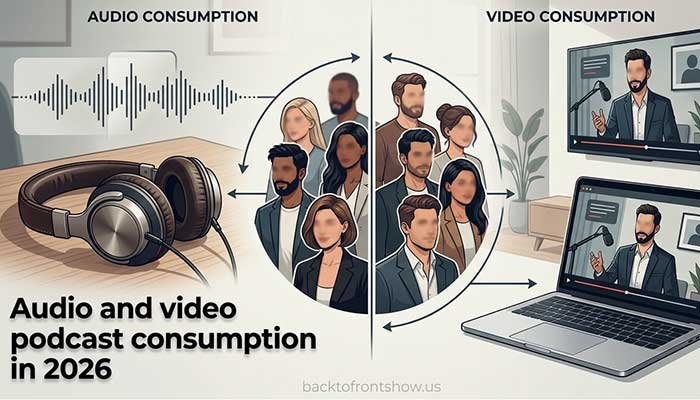
Edison Research found that podcast watching and listening among weekly podcast consumers have become almost equally common.
In Q3 2025 Edison Podcast Metrics data:
- 82% of weekly podcast consumers actively watched video podcasts.
- 78% listened to audio-only podcast content.
For comparison, in 2023, 73% watched video while 89% listened to audio-only podcast content.
That is a major change in only a few years.
But it would be misleading to say video is simply replacing podcast audio.
Edison’s Infinite Dial found that 57% of Americans age 12+ have both listened to and watched a podcast.
Triton Digital’s 2025 U.S. Podcast Report, released in February 2026, found a similar hybrid pattern. Among the podcast audience it studied:
- 80% both listen and watch.
- About 13% consume podcasts exclusively through audio.
- About 7% exclusively watch.
That’s why I think creators should be careful with the phrase “video versus audio.” For many listeners, it isn’t an either-or decision anymore.
A person might discover a podcast through a video clip, watch an interview on a television, and listen to another episode in the car.
Read More: Podcast Statistics in the US (2026): Listeners, Growth & Ad Data
Video Podcast Viewing Is Still Growing
Sounds Profitable’s 2026 research gives us another useful view of this trend.
Its survey found that 44% of podcast consumers watched a video podcast during the previous week, compared with 40% in 2025. The percentage who had never watched a podcast fell from 14% to 10%.
Just 17% of Americans in the study still expected a podcast to be audio-only.
For podcasters, the practical lesson isn’t that every show suddenly needs an expensive studio.
It’s that audiences increasingly expect flexibility.
A simple video version of a recording can create opportunities on YouTube, Spotify, connected TVs, and social platforms while the traditional audio feed remains available for people who prefer listening.
YouTube Has Become a Major Podcast Platform
One of the biggest changes in modern podcasting is the importance of YouTube.
YouTube announced in February 2025 that podcast content on its platform had surpassed 1 billion monthly active viewers globally. The company also described YouTube as the most frequently used service for listening to podcasts in the United States.
The 2026 Podcast Landscape provides newer evidence of YouTube’s position among American adults.
Among podcast consumers surveyed about services they had used for podcasts during the previous year:
- YouTube: 63%
- Spotify: 33%
- Netflix: 21%
- YouTube Music: 17%
- Apple Podcasts: 15%
Netflix’s appearance is particularly interesting. In its first year carrying podcasts, it became the third most-mentioned podcast platform in that study.
However, only 5% reportedly named Netflix as their most-used podcast platform.
So reach and primary-platform preference should not be treated as the same metric.
Traditional Podcast Apps Are Facing More Competition
Podcasting began around RSS feeds and dedicated podcast apps, but audience behavior is moving beyond that model.
Sounds Profitable found that the share of consumers naming a purpose-built podcast application as their most-used podcast platform declined from 19% in 2025 to 15% in 2026.
Apple Podcasts alone declined from 11% to 8% on that measure.
This doesn’t mean RSS or traditional podcast apps are disappearing.
It means creators increasingly compete for attention across ecosystems that weren’t originally designed as podcast players—including video platforms, music streaming services, social media, and television interfaces.
For a new podcaster, I usually think the practical response is distribution rather than choosing sides. Maintain a reliable audio feed, but don’t assume listeners will only discover you inside a traditional podcast app.
Spotify Podcast Statistics
Spotify remains one of the world’s major podcast platforms.
In January 2025, Spotify said more than 1 billion people had listened to a podcast on Spotify since the company entered podcasting in 2019.
Video is also becoming more important on Spotify.
In March 2025, Spotify reported:
- More than 250 million users had watched a podcast on Spotify.
- The number of creators actively publishing video each month had grown by more than 50% year over year.
Those figures are useful context for one of the biggest podcast industry trends: the major platforms increasingly treat a podcast as content that can move between audio and video rather than as an audio file alone.
Podcast Advertising Statistics 2026
Podcast advertising is now a multibillion-dollar market in the United States.
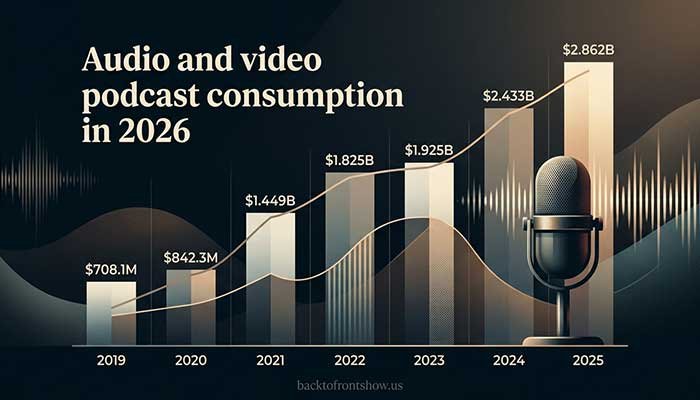
The IAB/PwC Internet Advertising Revenue Report: Full Year 2025, released in April 2026, reported $2.862 billion in U.S. podcast advertising revenue during 2025.
That represented 17.6% year-over-year growth, up from approximately $2.433 billion in 2024.
Here’s how U.S. podcast advertising revenue has changed:
| Year | U.S. podcast advertising revenue |
|---|---|
| 2019 | $708.1 million |
| 2020 | $842.3 million |
| 2021 | $1.449 billion |
| 2022 | $1.825 billion |
| 2023 | $1.925 billion |
| 2024 | $2.433 billion |
| 2025 | $2.862 billion |
Source: IAB/PwC.
The growth from roughly $708 million in 2019 to almost $2.9 billion in 2025 shows how dramatically advertiser investment has increased.
What about podcast advertising in 2026?
An older 2024 IAB/PwC forecast had projected approximately $2.56 billion in podcast ad revenue for 2026.
Actual industry growth moved faster than that forecast: reported 2025 revenue alone reached $2.86 billion, already exceeding the earlier 2026 projection.
This is a good example of why old market forecasts shouldn’t be presented as current facts.
More recently, IAB’s September 2026 U.S. advertising outlook projected 8.6% growth in podcast ad spending for 2026.
The exact final 2026 revenue figure won’t be known until full-year data are available.
Do Podcast Ads Actually Influence Listeners?
Industry revenue growth matters, but creators and advertisers also need to know whether audiences respond to the ads.
Edison Research’s Podcast Consumer 2026 found that 76% of weekly podcast consumers said they had taken some form of action after hearing a podcast advertisement.
Actions could include:
- Visiting a website
- Making a purchase
- Using a promotional code
- Recommending a product
Edison also cited a Nielsen Podcast Fusion media-mix analysis in which reallocating part of an existing advertising budget to podcasts increased reach among adults ages 18–54 by 41% without increasing overall spending.
These statistics don’t mean every podcast ad will perform well.
Creative quality, host fit, audience relevance, frequency, attribution method, and campaign goals still matter. But the data help explain why advertisers continue putting more money into podcasts.
Podcast Listeners Spend a Lot of Time With Audio
Podcast consumers aren’t only active podcast users. They’re also heavy audio consumers generally.
According to Edison’s Share of Ear data for Q1 2026, daily podcast consumers spent 5 hours and 11 minutes per day with all forms of audio.
The comparable figure for Americans age 13+ overall was 3 hours and 57 minutes.
Daily podcast consumers spent:
- 36% of their total daily audio time with podcasts.
- 51% of their daily ad-supported audio time with podcasts.
For advertisers, that helps explain podcasting’s value as an audio channel.
For creators, it also highlights the competition. Your podcast isn’t only competing against other podcasts. It’s competing with music, radio, audiobooks, YouTube, social media, and everything else demanding a listener’s time.
How Much Time Do People Spend With Podcasts?
Sounds Profitable reported a mean of 5.7 hours of weekly podcast consumption in its 2026 study, down from 6.3 hours in 2025.
However, the median remained at 4.0 hours per week.
Why does that distinction matter?
An average can be pushed upward by a relatively small group of extremely heavy consumers. A stable median suggests the typical consumer’s behavior didn’t change as dramatically as the decline in the mean might initially imply.
The study attributed much of the decrease to fewer very heavy consumers, with the share consuming 16 or more hours per week declining from 9% to 6%.
When you’re evaluating your own podcast, this is why I wouldn’t compare raw listening hours with an industry average and assume something is wrong. Your genre, episode length, publishing frequency, and audience habits can produce very different behavior.
Podcasts Are Becoming More Social
Podcasting has traditionally been described as an individual activity: one person wearing headphones.
That picture is becoming less complete.
Sounds Profitable found that 40% of podcast consumers at least occasionally consume podcasts with other people, up from 37% in the previous year.
Connected TVs and video podcasting may help encourage that behavior because a podcast can now become something people watch together rather than something consumed privately through earbuds.
That could affect everything from show formats to advertising creative.
Podcast Consumers Are Adopting AI, but They’re Cautious About It
Artificial intelligence is another important podcast industry trend in 2026.
Edison found podcast consumers relatively open to using AI for behind-the-scenes tasks.
Among weekly podcast consumers:
- 69% approved of AI being used for research.
- 69% approved of AI being used for brainstorming ideas.
However:
- 62% considered AI a threat to podcast credibility.
- 59% considered AI a threat to creativity.
That creates an important distinction for creators.
Listeners may accept AI as a production assistant while being much less enthusiastic about replacing the human voice, personality, judgment, or originality that makes a podcast worth following.
For beginners, I think that’s a useful rule: use technology to make production easier, but don’t remove the human qualities that give people a reason to care about the show.
Key Podcast Industry Trends to Watch in 2026
1. Podcasting is becoming a dual-format medium
Audio isn’t disappearing, and video isn’t a temporary side feature.
The audience increasingly uses both formats. The strongest strategy for many creators will be making content adaptable rather than declaring one format the winner.
2. YouTube is central to podcast discovery and consumption
YouTube’s billion-plus global monthly podcast audience and strong U.S. platform usage mean podcasters can no longer automatically treat YouTube as an optional secondary channel.
3. The U.S. audience is large and mature
With 58% of Americans age 12+ consuming podcasts monthly in Edison’s 2026 research, podcasting has achieved mass-market reach.
Future growth may increasingly come from attracting new demographics, improving discovery, expanding video consumption, and giving occasional consumers more reasons to return.
4. Advertising investment continues to rise
U.S. podcast advertising reached $2.86 billion in 2025 after growing 17.6%, while IAB’s September 2026 outlook anticipated further podcast ad-spend growth during 2026.
5. Platform fragmentation is increasing
Audiences can encounter podcasts through YouTube, Spotify, Apple Podcasts, Netflix, social clips, smart TVs, traditional RSS apps, and other services.
That makes distribution and consistent branding more important.
6. Clips are increasingly part of the podcast funnel
Long-form episodes remain the core product for many shows, but short clips can introduce people to creators before they commit to a full episode.
That means podcasters increasingly need to think about both content production and content packaging.
What These Podcast Statistics Mean for Creators
Statistics are most useful when they lead to better decisions.
For podcasters in 2026, I would focus on five practical priorities.
Keep audio easy to access. Video is growing quickly, but millions of people still want podcasts they can consume while driving, exercising, working, or doing household tasks.
Consider video where it makes sense. You don’t necessarily need a complicated multicamera setup. Even a straightforward video recording can create another distribution option.
Take YouTube seriously. Podcast discovery is no longer confined to podcast apps.
Measure your own audience instead of chasing industry averages. Industry data provides context, but your retention, downloads, watch time, completion rate, traffic sources, and returning audience matter more when deciding what to change.
Build around the content, not the trend. A strong show with a clear audience problem or entertainment value still matters more than using every new platform.
One thing I’ve learned from working with podcast topics and analytics is that big industry numbers can be encouraging, but they don’t guarantee growth for an individual show. A growing market creates opportunity. Creators still need useful content, consistent publishing, good packaging, and a reason for listeners to return.
Key Takeaways
The podcast industry in 2026 is both larger and more complicated than the traditional idea of downloadable audio episodes suggests.
Edison Research estimates that 167 million Americans age 12+ consume podcasts monthly, while 130 million consume them weekly.
Video consumption has become mainstream, but research consistently suggests it is expanding podcasting rather than simply eliminating audio.
YouTube, Spotify, connected TVs, and newer distribution channels are changing where people find and consume shows.
Meanwhile, U.S. podcast advertising generated $2.86 billion in 2025, representing 17.6% annual growth, and industry forecasts point to additional growth during 2026.
For creators and marketers, the main lesson is simple: podcasting is no longer one format on one type of app. It’s becoming a broader creator-media ecosystem built around spoken-word shows that audiences can listen to, watch, discover through clips, and consume across multiple screens and devices.
FAQs:
Sources
Edison Research — The Infinite Dial 2026
U.S. podcast reach, monthly and weekly consumption, audience estimates, and research methodology.
View The Infinite Dial 2026
Edison Research — The Podcast Consumer 2026
Video versus audio consumption, podcast ad response, listening time, and consumer attitudes toward AI.
View The Podcast Consumer 2026
Sounds Profitable — The Podcast Landscape 2026: Part One
October 2026 research covering U.S. adult podcast reach, platform usage, video consumption, and changing audience behavior.
View The Podcast Landscape 2026
IAB/PwC — Internet Advertising Revenue Report: Full Year 2025
U.S. podcast advertising revenue and year-over-year growth.
View the IAB/PwC report
IAB — 2026 U.S. Ad Spend Outlook, September Update
Latest 2026 advertising-growth outlook, including podcast ad spending.
View IAB’s September 2026 outlook
Triton Digital — 2025 U.S. Podcast Report
Podcast reach and audio/video consumption patterns based on U.S. audience data.
View Triton Digital’s report overview
YouTube — 1 Billion Monthly Podcast Users
YouTube’s official announcement that podcast content surpassed one billion monthly active viewers.
View YouTube’s podcast announcement
Spotify — Podcast Creator and Video Growth
Official Spotify data on cumulative podcast listeners and growth in video podcast consumption and publishing.