If you want the simplest podcast hosting experience, Buzzsprout is the better choice for most beginners. Its interface, publishing workflow, built-in analytics, automatic transcripts, and straightforward podcast management make it especially easy to learn.
Podbean is the stronger option if you need more upload capacity, want audio and video hosting at scale, manage multiple shows, or want a broader set of monetization and business-oriented tools.
Neither platform is automatically better for everyone.
The right choice depends on what you publish, how much content you upload, whether you need video, how many podcasts you run, and which monetization tools matter to you.
Here’s the short version:
| Category | Better Choice |
|---|---|
| Best for beginners | Buzzsprout |
| Ease of use | Buzzsprout |
| Lowest annual paid audio price | Podbean |
| Generous upload capacity | Podbean |
| Simple analytics | Buzzsprout |
| Podcast analytics overall | Tie / depends on needs |
| Audio enhancement | Both offer tools |
| Built-in AI features | Podbean |
| Multiple podcasts | Podbean for larger networks |
| Audio + video hosting | Both |
| Dynamic content for simple announcements/promos | Buzzsprout |
| Advanced network/business hosting | Podbean |
| Beginner-friendly monetization | Both, with different strengths |
| Free plan for long-term testing | Podbean |
| Overall recommendation for a first podcast | Buzzsprout |
Pricing and features can change, so check the official Buzzsprout pricing page and Podbean pricing page before subscribing.
Buzzsprout vs Podbean at a Glance
Buzzsprout and Podbean solve the same basic problem: they host your podcast files, generate an RSS feed, help distribute your show, and give you tools to track performance.
The differences become more noticeable after that.
Buzzsprout focuses heavily on simplicity. Its current plans include features such as podcast websites, advanced statistics, transcripts, dynamic content, custom players, subscriptions, and distribution tools. It also supports audio and video podcast hosting.
Podbean offers a broader range of creator, network, and business plans. Its current paid plans include unlimited total storage, defined monthly upload allowances, analytics, websites, monetization features, AI credits, and options for managing larger podcast operations.
In my experience working with podcasting topics, beginners usually benefit more from a platform they can understand quickly than from having the longest possible feature list. That’s one reason I tend to favor Buzzsprout for a first show.
But if your podcast produces a lot of content every month, the numbers can make Podbean much more attractive.
Buzzsprout Pricing vs Podbean Pricing
Pricing deserves a close look because these platforms measure usage differently.
Buzzsprout Pricing
Buzzsprout currently offers both monthly and annual options.
Its standard monthly audio plans include:
| Buzzsprout Plan | Monthly Price | Upload Allowance | Podcasts |
|---|---|---|---|
| Free | $0 | 2 hours/month | 1 |
| Audio | $19/month | 6 hours/month | 1 |
| Multi-Podcast | $39/month | 15 hours/month shared | Up to 5 |
| Multi-Podcast | $79/month | 35 hours/month shared | Up to 10 |
Buzzsprout confirms that its $19 monthly plan includes one podcast and six upload hours, while its $39 and $79 plans cover up to five and ten podcasts respectively.
Annual billing lowers the effective monthly price. Current annual audio options include:
- $180/year for 72 upload hours, equivalent to $15/month
- $360/year for 180 shared hours across up to five podcasts, equivalent to $30/month
- $780/year for 420 shared hours across up to ten podcasts, equivalent to $65/month
Buzzsprout also has annual video plans starting at $300/year, or the equivalent of $25 per month.
One limitation of Buzzsprout’s free plan is important: although you can upload two hours each month, free-plan episodes are hosted for only 90 days.
That makes the free tier more suitable for trying the platform than operating a permanent free podcast.
Podbean Pricing
Podbean’s main creator plans currently look like this:
| Podbean Plan | Monthly Billing | Annual Billing, Effective Monthly Rate | Monthly Upload Limit |
|---|---|---|---|
| Basic | Free | Free | 5 hours total storage |
| Unlimited Audio | $17 | $12 | 1GB, about 16 audio hours |
| Unlimited Plus | $39 | $29 | 10GB, about 160 audio hours or 10 video hours |
| Network | $99 | $79 | 40GB |
| Business | $129 | $99 | 40GB |
The Unlimited Audio plan includes one podcast, unlimited total storage, unmetered bandwidth, and 600 monthly AI credits.
Unlimited Plus supports two audio or video podcasts with 10GB of monthly uploads and 2,400 AI credits.
Podbean’s free plan provides five hours or 500MB of total storage and 100GB of monthly bandwidth. However, the storage does not reset every month, and the RSS feed is limited to 20 episodes.
Which Is Cheaper?
For a typical audio podcaster paying annually, Podbean starts cheaper.
Podbean Unlimited Audio is currently $12 per month when billed annually, while Buzzsprout’s annual single-audio-podcast plan works out to $15 per month.
Podbean also gives you considerably more monthly audio capacity on its entry-level paid plan.
But don’t compare these services only by upload hours.
Buzzsprout includes features such as automatic transcripts, advanced analytics, dynamic content, and unlimited team members among its premium features. Optional tools such as Magic Mastering and Cohost AI can cost extra.
The better value depends on which of those features you would actually use.
Which Platform Is Easier to Use?
Buzzsprout wins for ease of use.
Its biggest strength is that it makes podcast hosting feel less technical.
The typical workflow is straightforward:
- Create your podcast.
- Upload an episode.
- Add the title and description.
- Schedule or publish it.
- Connect your show to podcast directories.
- Monitor performance from the dashboard.
Buzzsprout also organizes its tools around normal podcasting tasks instead of forcing beginners to understand every technical detail before publishing.
I’ve found that this type of simplicity matters more than people expect. When you’re launching a show, you’re already dealing with microphones, recording, editing, artwork, show notes, distribution, and promotion. Your host shouldn’t create another learning problem.
Podbean is still beginner-friendly, but its broader collection of creator, advertising, AI, network, and business functions means there’s simply more to explore.
For someone who wants maximum simplicity, I’d choose Buzzsprout.
Podcast Distribution
Both platforms handle the core RSS-based distribution process.
Buzzsprout can help get shows listed across major podcast apps. Once the initial directory setup is complete, new episodes are distributed through your RSS feed automatically. Buzzsprout says its “Get Listed Everywhere” option can submit an audio show to 16 directories.
Podbean likewise offers RSS feeds and distribution to major directories, including Apple Podcasts, Spotify for audio podcasts, Amazon Music, iHeartRadio, and others.
For most independent podcasters, I wouldn’t choose between these two hosts based primarily on distribution. Both cover the essential podcast ecosystem.
Podcast Analytics
Both platforms provide serious podcast analytics, and importantly, both have IAB Tech Lab-certified podcast measurement.
Buzzsprout Analytics
Buzzsprout’s statistics include:
- Total downloads
- Episode performance
- Download trends
- Listener locations
- Listening apps
- Devices
- Episode comparisons
- Audio and video performance
Buzzsprout states that its analytics comply with IAB Podcast Measurement Technical Guidelines 2.2, and advanced analytics are included across its plans.
One feature I particularly like from a beginner’s perspective is episode pacing. Instead of seeing a number in isolation, you can compare how a recent episode is performing at the same stage after publication as earlier episodes.
That’s much easier to act on than staring at a total-download counter.
Podbean Analytics
Podbean also offers detailed statistics including:
- Downloads
- Listeners
- Followers
- Audience location
- Episode performance
- Download trends
- Listener engagement
- Device and source data
Its episode analytics can compare an episode against averages from your last 10 episodes, last 50 episodes, or a larger history.
Podbean also confirms that its statistics are IAB Tech Lab certified.
Which Analytics Are Better?
For an independent podcaster who wants information presented simply, I give Buzzsprout a slight edge.
For businesses, larger operations, or podcast networks, Podbean becomes more compelling because its higher plans include network-level and business-level reporting.
Neither platform should leave an ordinary creator short of useful performance data.
Podcast Websites
Both services can create a website for your podcast.
Buzzsprout’s podcast website can display episodes, transcripts, subscription links, social links, RSS information, and links to listening platforms. Custom domains are also supported.
Podbean provides a customizable podcast website and supports mapping your own domain on paid plans.
These built-in sites are convenient if you don’t want to build a separate website.
However, if your podcast is becoming a serious brand or content business, I usually prefer having a separate website you fully control. Your podcast host’s website can still be useful, but it doesn’t have to become the center of your entire online presence.
Monetization: Buzzsprout vs Podbean
Both platforms give creators multiple ways to make money.
Buzzsprout Monetization
Buzzsprout supports:
- Buzzsprout Ads
- Listener Support
- Paid subscriptions
- Premium episodes
- Early access
- Back-catalog access
- Subscriber-only podcasts
- Ad-free subscriber episodes
- Dynamic Content for promotions and announcements
Paid Buzzsprout users can create subscriptions, including premium and subscriber-only content.
Buzzsprout’s Dynamic Content tool can place replaceable pre-roll, mid-roll, and post-roll content into selected episodes without permanently changing the original episode file.
That can be useful for limited-time promotions, calls to action, announcements, or advertising.
Podbean Monetization
Podbean’s paid plans include access to monetization features such as its Ads Marketplace and dynamic ad insertion.
Its Dynamic Ad Insertion system can place separate advertising or promotional audio into defined episode time slots without modifying the original audio file.
There is one cost difference worth knowing.
Podbean currently charges $1 CPM, meaning $1 per 1,000 delivered impressions, for dynamic ad insertion on applicable plans. It is included at no additional DAI charge on the Network plan.
Which Is Better for Monetization?
For creators who want a simple combination of subscriptions, listener support, ads, and replaceable promotional content, Buzzsprout is very approachable.
Podbean may be more attractive if advertising is going to become a major part of your operation or you’re building a larger network.
I wouldn’t choose a podcast host solely because it offers monetization, though. A monetization feature is useful only after you have an audience or a clear business model.
Dynamic Content and Advertising
This category deserves separate attention because the two platforms handle it differently.
Buzzsprout’s Dynamic Content is designed to make changing pre-roll, mid-roll, and post-roll content easy. For example, imagine you’re promoting a webinar happening next month. You could place the promotion across a group of old and new episodes, then replace it later without re-editing every episode.
Podbean’s Dynamic Ad Insertion is more campaign-oriented. You set ad positions and time slots, create campaigns, and have Podbean dynamically deliver the content.
For straightforward creator promotions, I prefer Buzzsprout’s simplicity.
For more advertising-focused workflows, Podbean gives you a strong toolset.
Read More: Best Podcast SEO Tools: 8 Options for Better Discoverability
Audio Quality and Enhancement Tools
Neither podcast host can rescue a terrible recording completely. Recording technique still matters.
But both platforms now offer tools that can improve or optimize audio.
Buzzsprout Magic Mastering
Buzzsprout offers Magic Mastering as a paid add-on.
It can help with:
- Speaker and music leveling
- Loudness optimization
- True-peak targeting
- Noise reduction
- Filler-word removal
- Audio filtering
- More intensive cleanup through Power Clean
On monthly Buzzsprout plans, current Magic Mastering prices depend on the hosting tier. For example, the $19 hosting plan can add it for $5 per month.
Podbean AI Audio Optimization
Podbean includes AI credits with its paid hosting plans.
Those credits can be used for AI tools including:
- Noise reduction
- Intelligent leveling
- Removing filler words and silence
- Filtering and AutoEQ
- AI titles and show notes
- Chapter markers
- Enhanced transcripts
- AI podcast creation
This makes Podbean stronger if integrated AI tools are an important part of your production workflow.
Transcription and AI Features
Buzzsprout automatically creates transcripts for new episodes on its current paid plans at no additional charge. Those transcripts can be included in the RSS feed and displayed on the Buzzsprout website.
It also offers Cohost AI as a paid add-on for tasks such as titles, descriptions, chapters, blog posts, and social posts.
Podbean takes a credit-based approach to AI. Its plans include monthly credits that can be applied to audio optimization, content assistance, transcription, and AI podcast creation.
So the better choice depends on your priority:
- Want automatic transcripts with minimal thinking? Buzzsprout
- Want a broader suite of built-in generative AI and audio tools? Podbean
Read More: Best Podcast Microphones in 2026: 8 Great Mics for Every Budget
Video Podcasting
Both platforms now support video, but you’ll need the appropriate plan.
Buzzsprout’s Audio + Video plans can publish video to Apple Podcasts, Spotify, and YouTube while continuing to distribute the audio version elsewhere.
Its annual single-show Audio + Video plan currently costs $300 per year, equivalent to $25 per month.
Podbean’s Unlimited Plus plan supports two audio or video podcasts and includes up to 10GB of uploads per month, which Podbean estimates as roughly 160 hours of audio or 10 hours of video. It costs $39 monthly or the equivalent of $29 per month with annual billing.
If video is central to your strategy, compare your actual monthly recording hours before subscribing.
What About Podbean Live Streaming?
Older Buzzsprout vs Podbean comparisons often list live streaming as a major Podbean feature.
That information is now outdated.
Podbean stopped allowing new livestreams on May 18, 2026 and fully discontinued Podbean Live Streaming on June 18, 2026. Podcast hosting and its other core services were not discontinued.
So as of 2026, live streaming should not be used as a reason to choose Podbean over Buzzsprout.
Multiple Podcasts and Teams
If you run several podcasts, both platforms have options.
Buzzsprout currently offers:
- Up to five podcasts with 15 shared upload hours for $39/month
- Up to ten podcasts with 35 shared upload hours for $79/month
Its annual equivalents reduce the effective monthly cost.
Podbean’s plans scale farther.
Unlimited Plus includes two podcasts, while its Network plan supports unlimited public podcasts. The Network plan also includes network-level analytics and up to 50 team members.
For a small group of shows, either can work.
For a genuine podcast network or organization managing many feeds, Podbean is the clearer winner.
Free Plans Compared
Both platforms let you start without paying, but they impose very different limitations.
Buzzsprout Free Plan
Buzzsprout currently provides:
- 2 upload hours each month
- Unlimited episodes within that allowance
- Hosting for only 90 days per episode
- No paid add-ons
- No video distribution
Podbean Free Plan
Podbean currently provides:
- 5 hours or 500MB total storage
- 100GB monthly bandwidth
- Up to three published episodes per day
- Maximum 20 episodes displayed through the RSS feed
Which Free Plan Is Better?
For testing the interface, Buzzsprout is perfectly useful.
For leaving a small podcast online without immediately upgrading, Podbean’s free plan is more practical because Buzzsprout removes free-plan episodes after 90 days.
Buzzsprout Pros and Cons
Pros
- Very beginner-friendly
- Clean publishing workflow
- Useful analytics included
- IAB 2.2-certified statistics
- Automatic transcripts on current paid plans
- Dynamic Content
- Paid subscriptions and listener support
- Audio and video hosting
- Podcast website
- Multiple-podcast plans
- Unlimited team members listed among premium features
Cons
- Entry-level paid plan gives fewer upload hours than Podbean
- Free-plan episodes are kept for only 90 days
- Magic Mastering costs extra
- Cohost AI costs extra
- Not as scalable as Podbean’s Network offering for very large podcast operations
Podbean Pros and Cons
Pros
- Lower starting price with annual billing
- Generous monthly upload capacity
- Unlimited total storage on several paid plans
- Audio and video hosting
- IAB-certified analytics
- Built-in AI credits
- Ads Marketplace
- Dynamic Ad Insertion
- Strong multi-podcast and network options
- Business/private podcast features
- More practical long-term free plan than Buzzsprout
Cons
- Wider feature set may feel more complex to a first-time podcaster
- Entry-level paid plan is audio-only
- Some advanced AI usage may require additional credits
- Dynamic ad insertion can incur usage fees
- Live Streaming was discontinued in June 2026
Buzzsprout vs Podbean for Beginners
If you’re launching your first podcast and don’t have an unusual technical requirement, I recommend Buzzsprout.
The reason isn’t that Podbean is difficult. It isn’t.
Buzzsprout simply does a particularly good job of reducing the number of decisions you need to make when you’re learning podcasting.
Imagine you’re publishing one 45-minute episode every week.
That’s roughly three hours of finished content in a typical four-week month. Buzzsprout’s six-hour monthly audio plan gives you enough capacity, while keeping the hosting workflow straightforward.
In that situation, paying for enormous upload capacity you don’t need wouldn’t necessarily improve your podcast.
On the other hand, imagine you publish three two-hour shows every week or regularly upload video.
Your upload requirements become much more important. Podbean’s larger monthly allowances could provide substantially better value.
The lesson is simple: buy for your actual publishing schedule, not the longest feature list.
Who Should Choose Buzzsprout?
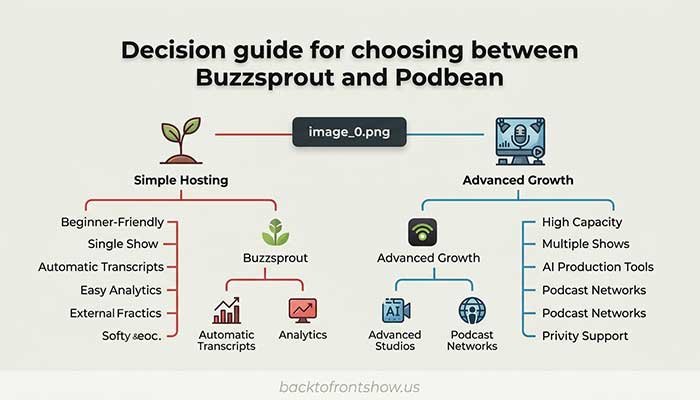
Buzzsprout makes the most sense if:
- You’re starting your first podcast.
- You value simplicity over having every possible setting.
- You publish a normal weekly or biweekly audio show.
- You want understandable analytics.
- You want automatic transcripts.
- You want built-in subscriptions or listener support.
- You want easy dynamic announcements and promotional inserts.
- You’re comfortable paying separately for optional audio mastering or AI tools.
- You run no more than a modest number of podcasts.
For a solo creator publishing one regular show, this is the platform I’d usually start with.
Who Should Choose Podbean?
Podbean is likely the better choice if:
- You publish many hours of audio each month.
- You want more upload capacity for your money.
- You need two or more audio/video shows.
- You’re building a podcast network.
- You want integrated AI production tools.
- Advertising is an important part of your strategy.
- You need business or private-podcast capabilities.
- You want advanced team and network options.
- You need a free plan that can keep a small show online longer term.
For organizations and heavier publishers, Podbean’s broader hosting structure can make more sense.
Buzzsprout vs Podbean: Final Verdict
For most people starting a podcast, Buzzsprout is my overall pick because it’s easier to use and keeps the hosting process simple.
Its straightforward interface, useful analytics, automatic transcripts, podcast website, monetization options, and dynamic content tools cover what most independent podcasters actually need.
Podbean wins when capacity and scalability become more important. Its entry-level annual paid plan is cheaper, its upload limits are substantially more generous, and its Network and Business tiers make it better suited to organizations and larger podcast operations.
So I would choose them this way:
Choose Buzzsprout if:
You want to launch a podcast without unnecessary complexity.
Choose Podbean if:
You need more content capacity, integrated AI tools, multiple shows, or network/business features.
Before paying, estimate how many hours of finished audio or video you’ll publish each month. That single calculation can make the right choice much clearer.