The most common podcast episode length is currently 20 to 40 minutes, based on Buzzsprout’s September 2026 platform data. About 31% of episodes published on the platform fall into that range. However, there isn’t one universal “average podcast episode length” that every creator should aim for.
The right length depends on your format, topic, audience, publishing schedule, and how much useful material you actually have.
A focused 15-minute educational episode can work better than a padded 45-minute one. At the same time, an engaging 90-minute interview may feel too short to its audience.
If you’re starting a podcast, 20 to 40 minutes is a practical benchmark, but it should be a starting point rather than a rule.
What Is the Average Podcast Episode Length?
There isn’t a reliable industry-wide number that represents the exact mathematical average duration of every active podcast.
A more useful way to answer the question is to look at how podcast episodes are distributed by length.
Buzzsprout’s September 2026 statistics show:
| Podcast Episode Duration | Share of Episodes |
|---|---|
| Less than 10 minutes | 20% |
| 10–20 minutes | 16% |
| 20–40 minutes | 31% |
| 40–60 minutes | 20% |
| More than 60 minutes | 13% |
The 20–40 minute category is the largest, accounting for 31% of episodes in Buzzsprout’s data.
That doesn’t mean a 30-minute podcast is automatically better. In fact, the same data shows considerable variation: about one-third of episodes are 40 minutes or longer, while more than one-third are under 20 minutes.
So if someone asks me for a simple starting point, I’d usually suggest thinking in terms of roughly 20–40 minutes, then adjusting according to the show rather than trying to hit an arbitrary industry average.
How Long Should a Podcast Be?
A podcast should be long enough to deliver what the episode promises and no longer than necessary.
That’s the principle I find most useful.
Spotify’s creator guidance also emphasizes that podcast length depends on the show’s format and audience. It gives 30–60 minutes for interview podcasts and 15–30 minutes for solo shows as typical ranges.
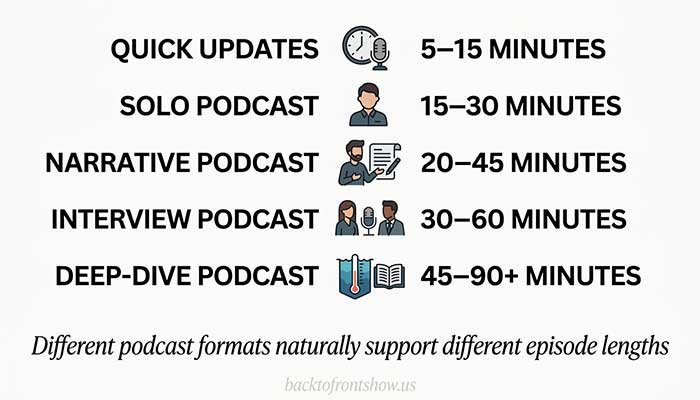
Here’s a practical starting guide:
| Podcast Format | Practical Starting Length |
|---|---|
| Short updates or news briefs | 5–15 minutes |
| Solo educational podcast | 15–30 minutes |
| Storytelling or narrative | 20–45 minutes |
| Co-hosted conversation | 30–60 minutes |
| Interview podcast | 30–60 minutes |
| Deep-dive discussion | 45–90+ minutes |
These aren’t requirements. They’re useful starting ranges.
For example, imagine you’re creating a weekly personal finance podcast where each episode explains one question, such as how a Roth IRA works. You may only need 18 minutes to answer it clearly.
Stretching that episode to 45 minutes because you think “podcasts should be long” would probably make the episode worse, not better.
The Ideal Podcast Length Depends on the Format
Different podcast formats naturally need different amounts of time.
Solo Podcasts: Around 15–30 Minutes
Solo episodes often benefit from being relatively focused.
One host can move through information quickly because there aren’t multiple people responding to each other, telling stories, or asking follow-up questions.
Spotify suggests approximately 15–30 minutes for solo shows.
A shorter solo format can work particularly well for:
- Tutorials
- Business advice
- Educational episodes
- Industry updates
- Commentary
- Frequently asked questions
The challenge with solo episodes isn’t making them long enough. It’s often knowing when you’ve made your point.
I’ve found that creators can improve these episodes simply by removing repeated explanations and getting to the practical takeaway faster.
Interview Podcasts: Around 30–60 Minutes
Interviews usually need more room because you have an introduction, background, questions, follow-ups, stories, and natural conversation.
Spotify identifies 30–60 minutes as a typical range for interviews.
That still doesn’t mean you should end an excellent conversation at minute 60.
If the guest is providing genuinely useful information and the conversation continues to move forward, a longer episode may be completely appropriate.
On the other hand, keeping an average interview running for 90 minutes simply because other popular shows do it isn’t a good reason.
Conversational and Co-Hosted Podcasts: Around 30–60 Minutes
Two or more hosts generally create longer episodes because conversation takes time.
These shows might include:
- News discussion
- Comedy
- Sports commentary
- Pop culture
- Current events
- Casual conversation
Thirty to 60 minutes gives the hosts enough room to develop several topics without automatically turning every episode into a long-form show.
Strong chemistry can support much longer episodes, though.
Narrative and Storytelling Podcasts: Around 20–45 Minutes
Story-driven podcasts should generally be structured around the story rather than a target duration.
A tightly edited 25-minute episode can be far more compelling than the same story stretched to an hour.
Consider:
- How much setup is required?
- How many characters or sources are involved?
- Does the story need multiple acts?
- Are there interviews or archival clips?
- Where does the episode naturally end?
For serialized shows, episode length can also depend on where the strongest narrative break occurs.
News and Update Podcasts: Around 5–20 Minutes
Listeners often choose news briefings because they want information quickly.
A daily market update, industry briefing, or news recap may only need 10 minutes.
In this format, conciseness can actually be part of the value proposition.
Deep-Dive Podcasts: 45–90 Minutes or Longer
Long episodes make sense when the subject genuinely benefits from depth.
Examples include:
- Long-form interviews
- History
- Science
- True crime
- Technical discussions
- Investigative reporting
- Detailed analysis
The question isn’t whether a 90-minute podcast is “too long.”
The question is whether the listener continues receiving enough value to justify the next minute.
Is a 30-Minute Podcast a Good Length?
Yes. Thirty minutes is an excellent starting length for many podcasts.
It sits directly inside Buzzsprout’s largest current duration category of 20–40 minutes.
It also gives you enough time to:
- Introduce a topic
- Explain the main idea
- Provide examples
- Explore a few supporting points
- Give the listener actionable takeaways
- Close without rushing
For a new podcaster who has no listener data yet, I’d consider 20–30 minutes a very manageable place to begin for a focused informational show.
You can change the length as you learn what your audience responds to.
Are Longer Podcasts Better?
Not automatically.
Long episodes can be excellent when the material supports them.
They allow more room for:
- Detailed conversations
- Complex explanations
- Guest stories
- Context
- Multiple perspectives
- Long-form storytelling
But longer episodes also require more from your listener.
And they require more from you.
Longer recordings normally mean more recording time, editing, quality control, show-note preparation, and production work.
Libsyn’s podcast-planning guidance makes a similar point: longer episodes generally take longer to prepare, record, and edit, so creators should consider what they can realistically sustain.
A 75-minute show that becomes impossible to produce consistently isn’t necessarily better than a focused 30-minute show you can sustain.
Are Short Podcasts Better?
Short podcasts have their own advantages.
They can be:
- Easier to produce
- Faster to edit
- Easier for listeners to fit into a busy day
- Well suited to a narrow topic
- Effective for frequent publishing
But “short” doesn’t automatically mean engaging.
If an episode promises a detailed explanation and gives the listener an incomplete eight-minute answer, its short duration isn’t an advantage.
Length needs to match the promise.
Don’t Choose Podcast Length Based Only on Commute Time
You may have heard advice suggesting that a podcast should fit neatly into an average commute.
I wouldn’t build an entire podcast strategy around that assumption.
People listen to podcasts while:
- Driving
- Walking
- Exercising
- Cleaning
- Working
- Cooking
- Traveling
- Relaxing at home
Listeners can also stop an episode and continue later.
The growth of mobile listening makes this especially relevant. In Buzzsprout’s September 2026 platform statistics, 81.3% of listening devices were classified as mobile.
Design the episode for your audience and subject rather than trying to fit every listener’s daily schedule.
Read More: Podcast Industry Statistics 2026: Audience, Growth, Video & Advertising Data
How to Find the Ideal Podcast Length for Your Show
Instead of copying another podcast’s duration, use your own show to find the answer.
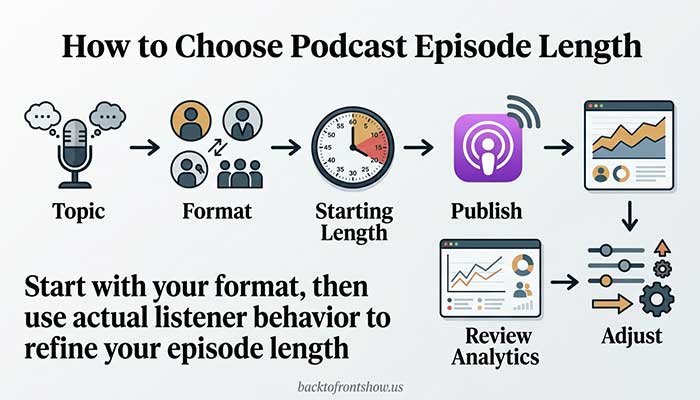
1. Start With the Topic
Ask what the episode actually needs.
If the topic can be fully explained in 18 minutes, don’t manufacture another 20 minutes.
If a useful interview needs 70 minutes, don’t cut valuable discussion just to hit a 30-minute target.
2. Match the Format
Use the format as an initial guide.
A concise solo teaching show will usually have different requirements from a three-person comedy podcast.
Choose a range that naturally fits the structure.
3. Set a Range Instead of an Exact Number
You don’t need every episode to be exactly 30:00.
A range is easier to work with.
For example:
Target: 25–35 minutes
One week’s episode might be 27 minutes and another 33 minutes. The listener still gets a reasonably consistent experience.
4. Check Your Podcast Analytics
Once you’ve published enough episodes, your own listener behavior becomes much more valuable than a general industry benchmark.
Apple Podcasts provides episode-level analytics that creators can use to evaluate performance, including episode duration and listening-performance information.
Compare episodes of different lengths.
Look for patterns such as:
- Where listeners stop
- Whether certain formats hold attention better
- Whether longer episodes consistently underperform
- Whether a shorter format improves completion
- Which topics keep people engaged
Don’t judge length using one episode. Look for patterns across multiple episodes.
5. Ask Your Audience
Analytics show behavior, but listeners can also tell you what they want.
You could ask:
Do you prefer our 20–30 minute episodes or our longer 45–60 minute episodes?
A simple poll can provide useful context alongside your analytics.
6. Consider Your Production Capacity
An ideal format also has to be sustainable.
Imagine you decide every weekly episode should last 90 minutes.
That may mean:
- More preparation
- Longer recording sessions
- More editing
- More audio to review
- More clips and chapters to prepare
- More opportunities for production delays
If a 40-minute format gives listeners the same value and keeps your publishing schedule sustainable, it may be the better choice.
From my experience working with podcasting content, sustainability is an easy factor to underestimate. A format you can maintain consistently is usually more practical than an ambitious format that exhausts your production capacity.
Does Every Podcast Episode Need to Be the Same Length?
No.
Consistency helps set expectations, but consistency doesn’t require identical episode durations.
A show could normally publish 30–40 minute episodes and occasionally release a 60-minute special interview.
That makes sense because the format explains the difference.
What can become confusing is extreme variation without a clear reason—for example:
- Episode 1: 12 minutes
- Episode 2: 95 minutes
- Episode 3: 22 minutes
- Episode 4: 110 minutes
That doesn’t automatically make a podcast bad, but listeners may have difficulty knowing what kind of commitment each episode requires.
A general duration range creates useful predictability.
Should You Split a Long Podcast Into Two Episodes?
Sometimes.
Splitting a long episode can make sense when:
- There is a clear stopping point
- Each part can stand on its own
- The conversation covers two distinct subjects
- The full episode becomes difficult to navigate
- Breaking it up improves the story
Don’t split an episode purely to generate more downloads.
The listener experience should come first.
If a 75-minute conversation flows naturally from beginning to end, publishing it as one episode may be simpler.
Use Chapters to Make Longer Episodes Easier to Navigate
If you publish longer podcasts, chapters can help listeners navigate the episode.
Apple recommends providing chapters for episodes longer than 10 minutes and suggests limiting them to no more than about six chapters per hour. Apple’s current chapter guidelines also recommend making individual chapters at least two minutes long.
Chapters are particularly useful for:
- Interviews covering several topics
- Educational episodes
- Q&A shows
- News roundups
- Long-form discussions
For example, a 60-minute interview might include chapters for:
- Guest introduction
- Starting the business
- Early mistakes
- Growth strategy
- Current challenges
- Advice for beginners
That makes a longer episode easier to understand and revisit.
Common Podcast Length Mistakes
Stretching an Episode to Hit a Target
This is probably the most important mistake to avoid.
If you have 22 minutes of useful material, publish a good 22-minute episode.
Don’t repeat ideas for another eight minutes just to reach 30.
Copying a Famous Podcast
A successful three-hour show doesn’t prove your podcast should be three hours.
Established shows may have:
- Different audiences
- Famous hosts
- Different formats
- Strong guest access
- Large production teams
- Years of audience loyalty
Borrow principles, not arbitrary runtimes.
Cutting Valuable Content Just to Stay Short
The opposite mistake also happens.
If an insightful interview naturally reaches 55 minutes, forcing it down to 30 minutes may remove exactly what makes it useful.
Edit unnecessary material, not useful depth.
Ignoring Analytics
Your initial episode length is an educated guess.
Once you have actual audience data, use it.
If listeners consistently respond better to your concise episodes, that’s worth investigating.
Making Production Unsustainable
Don’t design a show you can’t realistically maintain.
A consistent, focused podcast is usually preferable to a highly ambitious format that repeatedly misses its publishing schedule.
Read More: How Many Americans Listen to Podcasts?
A Simple Podcast Length Decision Guide
If you’re still unsure, use this approach:
Choose 10–20 minutes if:
Your show delivers quick updates, narrowly focused advice, or short solo episodes.
Choose 20–40 minutes if:
You want a flexible starting range for educational content, focused conversations, storytelling, or general informational episodes.
Choose 40–60 minutes if:
Your format involves interviews, co-host discussions, detailed explanations, or subjects that need more development.
Choose 60+ minutes if:
Your audience specifically values long-form conversations, deep dives, detailed storytelling, or extensive analysis.
Then publish several episodes, examine listener behavior, and adjust.
What I Recommend for New Podcasters
For a beginner without existing listener data, I’d normally recommend choosing a target range rather than chasing an industry average.
For many informational shows, 20–40 minutes is a sensible place to start. It’s also the most common duration category in Buzzsprout’s September 2026 data.
But don’t treat 20 minutes as a minimum or 40 minutes as a maximum.
What I’ve learned is that the stronger question isn’t:
“How long should my podcast be?”
It’s:
“How long does this episode need to be to give my listener what they came for?”
Answer that well, stay reasonably consistent, and then use your own analytics to refine the format.
That’s much more useful than trying to hit a universal podcast duration that doesn’t really exist.
Key Takeaways
- There is no single ideal podcast length for every show.
- In Buzzsprout’s September 2026 data, 20–40 minutes is the largest episode-duration category at 31%.
- Spotify gives typical ranges of 15–30 minutes for solo podcasts and 30–60 minutes for interviews.
- Topic, format, audience, and production capacity should determine episode length.
- Don’t add filler simply to reach a target duration.
- Longer episodes aren’t automatically better, and shorter episodes aren’t automatically more engaging.
- Start with a reasonable range and refine it using your own listener analytics.
- For many new informational podcasts, 20–40 minutes is a practical starting point, not a rule.
FAQs:
Sources
- Buzzsprout Podcast Stats — September 2026
Current platform data on podcast episode duration, publishing frequency, downloads, countries, and listening devices. Buzzsprout Podcast Stats - Spotify for Creators — How to Start a Podcast
Spotify’s creator guidance on podcast formats and typical episode-length ranges, including 15–30 minutes for solo shows and 30–60 minutes for interview shows. Spotify for Creators Guide - Apple Podcasts for Creators — Analytics
Official information about episode-level podcast analytics and duration data available to creators. Apple Podcasts Analytics - Apple Podcasts for Creators — Chapters
Official guidance for structuring and providing podcast chapters, including recommendations for longer episodes. Apple Podcasts Chapter Guidelines - Libsyn — Plan Your Podcast
Practical guidance about choosing an episode length based on format, production requirements, goals, experimentation, and analytics. Libsyn Podcast Planning Guide